Window Films Production and Capacity Outlook
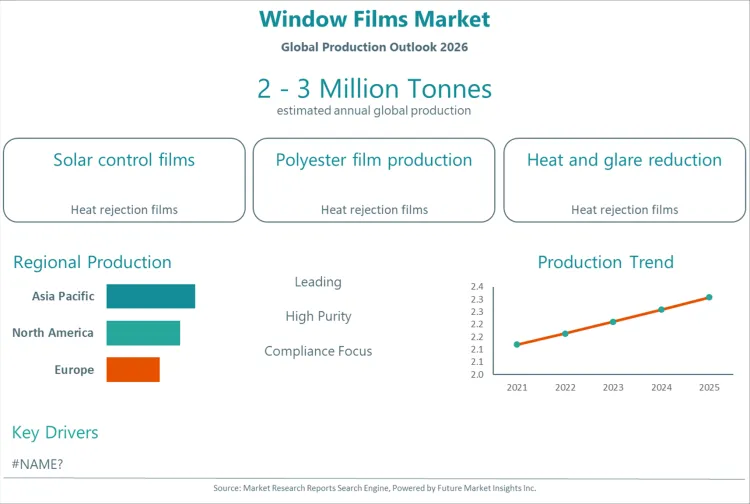
Global window films production capacity in 2026 is estimated at approximately 2 to 3 million tonnes, covering architectural, automotive and specialty functional films. Capacity growth is steady and application driven, supported by demand for solar control, safety enhancement and energy efficiency rather than discretionary aesthetic upgrades alone. Investment activity focuses on coating technology upgrades, optical performance improvement and regional capacity expansion close to end use markets.
Production leadership remains concentrated in regions with advanced polymer film manufacturing, coating capability and access to downstream fabrication industries. Asia Pacific leads global volume production supported by electronics film expertise and cost efficient manufacturing. North America maintains strong capacity in high performance automotive and architectural films. Europe focuses on regulated, sustainability aligned and specialty window film products. Several regions remain import dependent due to limited coating and metallisation capability.
Demand growth is reinforced by building energy regulations, automotive comfort requirements and rising awareness of heat and glare management. Buyers prioritise optical clarity, durability, compliance and installation reliability.
Key Questions Answered
- How closely is window film demand linked to energy efficiency regulation?
- How do automotive standards affect product qualification?
- How resilient is window film demand across construction cycles?
- How do performance requirements influence capacity planning?
Window Film Product Families That Define How Buyers Actually Use Them
Product Classification
- Solar control films
- Heat rejection films
- Infrared reflecting films
- Glare reduction films
- Safety and security films
- Shatter resistant films
- Blast mitigation films
- Anti intrusion films
- Automotive window films
- UV protection films
- Privacy and tint films
- Heat control automotive films
- Decorative and privacy films
- Frosted and patterned films
- Branding and signage films
- Interior design applications
- Specialty functional films
- Low emissivity films
- Anti fog films
- Smart and switchable films
Solar control and automotive films account for the largest volume demand, while safety and specialty films deliver higher value density.
Key Questions Answered
- How do buyers differentiate solar control and safety films?
- How do optical and thermal properties influence selection?
- How do regulations affect tint and reflectivity limits?
- How does application environment affect film choice?
Window Film Manufacturing Routes That Define Cost and Performance
Process Classification
- Base film extrusion
- Polyester film production
- Thickness and clarity control
- Surface uniformity
- Coating and metallisation
- Sputtered metal coatings
- Dyed and nano ceramic coatings
- Performance layer integration
- Adhesive and liner application
- Pressure sensitive adhesives
- Installation durability
- Removal performance
- Slitting and finishing
- Custom width cutting
- Roll finishing
- Quality inspection
Manufacturing complexity increases with higher performance films, particularly those requiring multi layer coatings and precise optical control.
Key Questions Answered
- How sensitive window film cost is to raw material pricing?
- How do coating technologies affect performance consistency?
- How does manufacturing yield influence competitiveness?
- How do quality controls affect installer acceptance?
Window Film End Use Spread Across Key Application Segments
End Use Segmentation
- Residential buildings
- Heat and glare reduction
- UV protection
- Privacy enhancement
- Commercial buildings
- Energy efficiency compliance
- Occupant comfort
- Façade retrofit solutions
- Automotive and transportation
- Passenger vehicles
- Commercial fleets
- Public transport glazing
- Safety and security applications
- Government buildings
- Retail and banks
- Critical infrastructure
- Specialty and design uses
- Interior decoration
- Branding and signage
- Temporary installations
Residential and commercial buildings dominate architectural film demand, while automotive applications provide consistent volume driven by vehicle ownership growth.
Key Questions Answered
- How do building owners evaluate return on window film installation?
- How do automotive OEM and aftermarket requirements differ?
- How does retrofit demand compare with new construction use?
- How do safety requirements affect film thickness selection?
Window Films Regional Production and Consumption Assessment
Asia Pacific
Asia Pacific leads production and consumption driven by urbanisation, vehicle ownership growth and electronics film manufacturing capability.
North America
North America shows strong demand for high performance automotive and architectural films aligned with energy efficiency standards.
Europe
Europe focuses on regulated, sustainability aligned window films for buildings and vehicles.
Middle East
The Middle East demonstrates strong demand for solar control films due to high cooling requirements.
Latin America and Africa
These regions show growing adoption tied to urban development and vehicle aftermarket demand, with import dependence.
Key Questions Answered
- How do climate conditions influence regional demand profiles?
- How do building codes vary by region?
- How does import dependence affect supply reliability?
- How do installation practices differ across markets?
Window Films Supply Chain, Cost Drivers and Trade Patterns
The window film supply chain spans polymer film production, coating, conversion, distribution and installation. Proximity to installers and distributors is critical due to handling sensitivity and service requirements.
Key cost drivers include polyester film pricing, coating materials, energy use and labour costs. Trade flows connect Asian manufacturing hubs with global installation markets, while regional finishing operations support customisation.
Contracts emphasise performance warranties, regulatory compliance and supply continuity.
Key Questions Answered
- How do raw material costs translate into film pricing?
- How do logistics affect delivered film quality?
- How do buyers benchmark performance across suppliers?
- How do warranties influence supplier selection?
Window Films Ecosystem View and Strategic Themes
The ecosystem includes film manufacturers, coating technology providers, distributors, installers, automotive dealers, construction firms and regulators. Demand growth is influenced by energy efficiency goals, climate conditions and aesthetic trends.
Strategic themes include nano ceramic coatings, low emissivity film adoption, smart film development and installer network expansion.
Deeper Questions Decision Makers Should Ask
- How secure is long term access to high quality base films?
- How differentiated are coating technologies?
- How exposed are portfolios to regulatory change?
- How scalable are installer and distribution networks?
- How robust are performance testing and certification systems?
- How aligned are products with building efficiency targets?
- How transparent are warranty and durability claims?
- How quickly can innovation be commercialised?
Bibliography
- ISO. (2024). Automotive glazing and window film performance standards.
- Ullmann’s Encyclopedia of Industrial Chemistry. (2024). Polymer films and surface coatings. Wiley VCH.
- International Energy Agency. (2024). Building energy efficiency and cooling demand.
Frequently Asked Questions
What is the estimated global window films production volume in 2025?
Global window films production in 2025 is estimated at approximately 2 to 3 million tonnes, driven by architectural and automotive demand.
What are the biggest cost drivers shaping window film pricing?
Pricing is driven by polyester film costs, coating technology complexity, energy use and labour.
Why are solar control films gaining importance?
They support energy efficiency, reduce cooling loads and improve occupant comfort.
How do regulations affect window film adoption?
Building codes and automotive glazing rules define allowable reflectivity, tint levels and safety performance.
Which segments drive future window film growth?
Commercial building retrofits, automotive aftermarket and high temperature regions drive growth.