Water and Wastewater Treatment Chemicals Production and Capacity Outlook
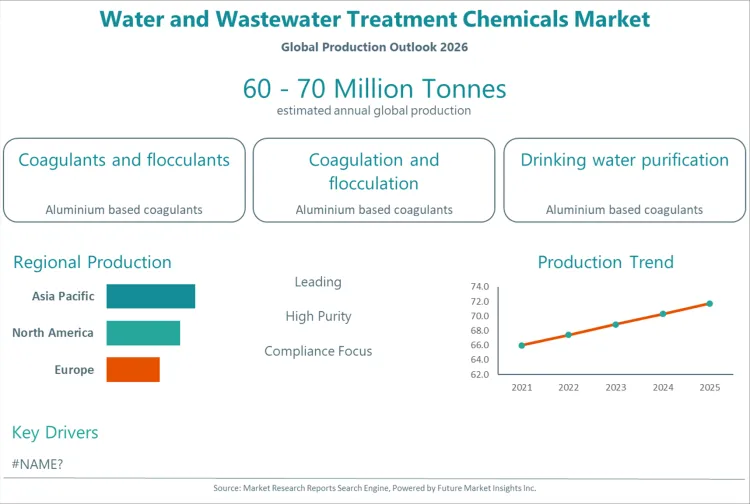
Global water and wastewater treatment chemicals production capacity in 2026 is estimated at approximately 60 to 70 million tonnes per year, covering coagulants, flocculants, disinfectants, corrosion inhibitors and specialty treatment formulations. Capacity growth is steady and infrastructure led, reflecting rising urban populations, tightening discharge regulations and expansion of industrial water reuse rather than cyclical demand.
Production capacity remains closely aligned with regional water infrastructure investment and industrial activity. Asia Pacific leads volume growth driven by urbanisation, industrial expansion and wastewater treatment build out. North America maintains stable capacity supported by ageing infrastructure replacement and industrial water management. Europe focuses on specialty and compliance driven chemicals aligned with stringent environmental regulations. Several developing regions remain import dependent due to limited local production and high logistics sensitivity.
Demand stability is reinforced by non discretionary water treatment requirements. Buyers prioritise supply continuity, regulatory compliance and consistent performance under variable water conditions.
Key Questions Answered
- How closely is chemical demand tied to water infrastructure investment?
- How do tightening discharge standards affect capacity planning?
- How resilient is demand across economic cycles?
- How do supply disruptions impact essential water services?
Water and Wastewater Treatment Chemical Families That Define How Buyers Actually Use Them
Product Classification
- Coagulants and flocculants
- Aluminium based coagulants
- Iron based coagulants
- Polymer flocculants
- Disinfectants and biocides
- Chlorine and hypochlorite
- Chlorine dioxide
- Ozone and alternative oxidants
- pH control and alkalinity agents
- Lime and limestone
- Caustic soda
- Acid dosing systems
- Corrosion and scale inhibitors
- Phosphates and blends
- Film forming inhibitors
- Scale control formulations
- Specialty treatment chemicals
- Nutrient removal agents
- Defoaming agents
- Odour control chemicals
Coagulants, disinfectants and pH control chemicals account for the largest volume demand, while specialty chemicals deliver higher value density and performance differentiation.
Key Questions Answered
- How do buyers select chemicals based on raw water quality?
- How do municipal and industrial requirements differ?
- How does dosage variability affect procurement?
- How do safety considerations influence product choice?
Water and Wastewater Treatment Process Routes That Define Cost and Performance
Process Classification
- Primary treatment chemicals
- Coagulation and flocculation
- Suspended solids removal
- Clarification optimisation
- Secondary and biological treatment chemicals
- Nutrient control
- Process stabilisation
- Sludge conditioning
- Tertiary and advanced treatment chemicals
- Disinfection and polishing
- Micropollutant removal
- Reuse and recycling support
- Sludge and residuals treatment chemicals
- Dewatering polymers
- Odour control agents
- Conditioning chemicals
Chemical selection is closely linked to treatment process design, influent variability and regulatory discharge limits.
Key Questions Answered
- How sensitive treatment cost is to influent variability?
- How do advanced treatment requirements affect chemical demand?
- How do process changes influence dosage efficiency?
- How do buyers balance cost and treatment performance?
Water and Wastewater Treatment Chemical End Use Across Key Sectors
End Use Segmentation
- Municipal water treatment
- Drinking water purification
- Distribution system protection
- Residual disinfection
- Municipal wastewater treatment
- Sewage treatment plants
- Nutrient removal
- Sludge management
- Industrial water treatment
- Cooling and boiler water
- Process water treatment
- Zero liquid discharge systems
- Commercial and institutional facilities
- Hospitals and campuses
- Data centres
- Large buildings
Municipal treatment represents the largest and most stable demand segment, while industrial water treatment drives higher complexity and specialty chemical use.
Key Questions Answered
- How do municipalities prioritise treatment reliability?
- How do industrial users integrate chemicals into process water systems?
- How does water reuse increase chemical intensity?
- How do users manage treatment compliance risk?
Water and Wastewater Treatment Chemicals Regional Production and Consumption Assessment
Asia Pacific
Asia Pacific leads demand growth driven by urbanisation, industrial expansion and wastewater treatment capacity additions.
North America
North America maintains stable demand supported by infrastructure renewal, industrial water management and regulatory enforcement.
Europe
Europe focuses on specialty chemicals aligned with strict environmental and water quality regulations.
Latin America
Latin America shows rising demand tied to water infrastructure expansion with partial import dependence.
Middle East and Africa
These regions show strong long term potential driven by water scarcity, desalination integration and wastewater reuse, though supply chains remain fragmented.
Key Questions Answered
- How do regional regulations influence chemical demand profiles?
- How do import dependent regions manage supply reliability?
- How does water scarcity affect treatment intensity?
- How do infrastructure investment cycles vary by region?
Water and Wastewater Treatment Chemicals Supply Chain, Cost Drivers and Trade Patterns
The supply chain spans basic chemical production, formulation, blending, storage and delivery to treatment facilities. Proximity to end users is critical due to safety, storage and transport constraints.
Key cost drivers include energy pricing, raw material availability, regulatory compliance and logistics. Trade flows are largely regional due to transport costs and hazardous material handling requirements.
Contracts emphasise continuity of supply, performance guarantees and compliance with safety and environmental standards.
Key Questions Answered
- How do raw material costs translate into treatment chemical pricing?
- How do logistics constraints affect delivered cost?
- How do buyers benchmark chemical performance?
- How do supply interruptions affect treatment operations?
Water and Wastewater Treatment Chemicals Ecosystem View and Strategic Themes
The ecosystem includes chemical producers, formulators, distributors, utilities, industrial users, engineering firms and regulators. Water treatment chemicals are mission critical inputs with limited substitution options.
Strategic themes include tightening discharge regulations, growth in water reuse, digital dosing optimisation and sustainability driven reformulation.
Deeper Questions Decision Makers Should Ask
- How secure is long term access to essential treatment chemicals?
- How exposed are utilities to supply concentration risk?
- How scalable are specialty treatment solutions?
- How resilient are supply chains to energy price volatility?
- How robust are safety and compliance systems?
- How aligned are suppliers with water reuse strategies?
- How transparent are sustainability disclosures?
- How quickly can treatment systems adapt to new contaminants?
Bibliography
- World Health Organization. (2024). Guidelines for drinking-water quality: Treatment requirements and chemical control. WHO Press.
- International Water Association. (2024). Global water and wastewater treatment outlook: Infrastructure investment, regulation, and chemical demand. IWA Publishing.
- International Energy Agency. (2024). Water infrastructure, energy use, and chemical inputs in municipal and industrial systems. IEA Publications.
Frequently Asked Questions
What is the estimated global water and wastewater treatment chemicals production volume in 2025?
Global production in 2025 is estimated at approximately 60 to 70 million tonnes, driven by municipal treatment and industrial water management.
What are the biggest cost drivers shaping treatment chemical pricing?
Pricing is driven by energy costs, raw material availability, logistics and regulatory compliance.
Why is demand for water treatment chemicals considered non discretionary?
They are essential for public health, environmental protection and regulatory compliance, regardless of economic conditions.
How does water reuse affect chemical demand?
Water reuse increases treatment complexity, raising demand for specialty and advanced treatment chemicals.
Which segments drive future growth?
Wastewater reuse, industrial water treatment and nutrient removal applications are expected to drive growth.