EPDM Rubber Production and Pricing Environment
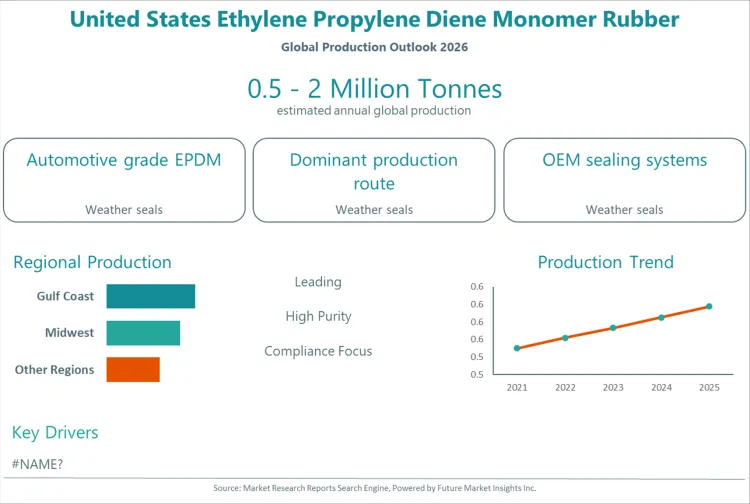
United States EPDM rubber production capacity in 2026 is estimated at approximately 0.5 to 1.5 thousand tonnes, reflecting a mature elastomer segment supported by strong integration with domestic olefin production. Capacity additions have been limited, with investment focused on debottlenecking, grade flexibility, and performance improvements rather than large scale new plants.
Pricing behaviour is driven primarily by ethylene and propylene costs, diene availability, energy pricing, and plant utilisation rates. Because EPDM production is capital intensive and operates on continuous polymerisation systems, supply responsiveness is limited in the short term. Feedstock volatility transmits directly into production economics, particularly during periods of tight olefin balance.
Production capacity is concentrated along the US Gulf Coast and Midwest, where access to competitive shale derived olefins and established synthetic rubber infrastructure supports reliable operation.
Key Questions Answered
- How sensitive is EPDM supply to olefin availability?
- How do diene choices affect cost and performance?
- How concentrated is production capacity within the United States?
- How flexible are operating rates under demand shifts?
EPDM Product Types That Define Actual Use
Product Classification
- Automotive grade EPDM
- Weather seals
- Hoses and tubing
- Under hood components
- Construction and building grade
- Roofing membranes
- Sealing systems
- Waterproofing applications
- Electrical and cable insulation grade
- Medium and high voltage cables
- Wire insulation
- Specialty electrical compounds
- Industrial and specialty EPDM
- Gaskets and profiles
- Mechanical goods
- Custom compounded formulations
Automotive and construction applications represent the largest volume outlets. Electrical and specialty grades require tighter molecular weight control and higher consistency, supporting longer qualification cycles and stable supplier relationships.
Key Questions Answered
- How do buyers differentiate automotive and roofing grades?
- How do compound requirements vary by end use?
- How does diene content affect performance characteristics?
- How do qualification cycles influence supplier selection?
EPDM Production Routes That Shape Cost and Control
Process Classification
- Solution polymerisation
- Dominant production route
- High molecular weight control
- Energy and solvent management requirements
- Ethylene propylene diene selection
- ENB based systems
- DCPD based systems
- Performance and cost tradeoffs
- Integrated olefin to polymer systems
- Feedstock security
- Reduced logistics exposure
- Improved cost stability
- Finishing and bale forming systems
- Polymer recovery
- Residual solvent removal
- Handling efficiency
Integrated producers benefit from stable feedstock access and consistent polymer quality. Diene choice influences cure rate, weather resistance, and application suitability, making formulation flexibility a key competitive factor.
Key Questions Answered
- How sensitive are costs to ethylene and propylene pricing?
- How does diene selection influence polymer properties?
- How efficient are solvent recovery systems?
- How does integration reduce supply risk?
EPDM End Use Distribution Across the United States
End Use Segmentation
- Automotive manufacturing
- OEM sealing systems
- Aftermarket components
- Electric vehicle applications
- Construction and infrastructure
- Commercial roofing
- Residential sealing
- Infrastructure waterproofing
- Electrical and power systems
- Power cables
- Renewable energy infrastructure
- Industrial wiring
- Industrial goods and machinery
- Seals and gaskets
- Vibration control
- Mechanical components
Automotive and construction uses anchor baseline demand. Electrical applications grow steadily, supported by grid upgrades and renewable energy investment.
Key Questions Answered
- How do automotive production cycles affect EPDM demand?
- How stable is roofing related consumption?
- How do electrical standards affect grade requirements?
- How do industrial users manage long term sourcing?
United States Regional Production Assessment
Gulf Coast
The Gulf Coast hosts the largest share of EPDM capacity due to access to ethylene and propylene from steam crackers and refineries.
Midwest
The Midwest supports EPDM production linked to automotive manufacturing and established rubber processing clusters.
Other Regions
Other regions rely on interregional supply or imports for specific EPDM grades and compounds.
Key Questions Answered
- How does olefin integration shape regional supply security?
- How do logistics costs affect delivered pricing?
- How does proximity to automotive hubs influence output?
- How do regional regulations affect operations?
EPDM Supply Chain, Cost Structure, and Trade Flows
The EPDM supply chain begins with ethylene, propylene, and diene sourcing followed by polymerisation, finishing, compounding, and distribution to processors and OEMs. Inventory management is important due to grade diversity and customer specific formulations.
Primary cost drivers include olefin pricing, energy consumption, solvent recovery efficiency, and plant utilisation. Trade flows include exports to Latin America and selective imports for specialty grades not produced domestically.
Key Questions Answered
- How do feedstock costs translate into EPDM pricing?
- How constrained is compounding and finishing capacity?
- How do imports affect grade availability?
- How do buyers benchmark domestic and imported supply?
EPDM Ecosystem View and Strategic Considerations
The United States EPDM ecosystem includes olefin producers, synthetic rubber manufacturers, compounders, automotive suppliers, construction material producers, cable manufacturers, distributors, and regulators. Integration between olefin supply and elastomer production remains a primary source of resilience.
Strategic considerations include securing long term olefin access, expanding high performance and specialty grades, improving energy efficiency, and aligning production with automotive electrification and infrastructure investment trends.
Deeper Questions Decision Makers Should Ask
- How secure is long term ethylene and propylene access?
- How differentiated is the EPDM grade portfolio?
- How resilient are operations during energy cost volatility?
- How defensible are long term OEM qualifications?
- How adaptable are assets to regulatory change?
- How scalable are performance driven product upgrades?
Bibliography
- American Chemical Society. (2024). Solution polymerisation of EPDM elastomers: Structure-property relationships. Industrial & Engineering Chemistry Research, 63(19), 8125-8143.
- Rubber Division, American Chemical Society. (2024). Diene selection in EPDM: ENB versus DCPD performance trade-offs. Rubber Chemistry and Technology, 97(2), 231-248.
- National Institute of Standards and Technology. (2024). Polymer processing and solvent recovery efficiency in elastomer manufacturing. NIST Technical Notes.
Frequently Asked Questions
What is the estimated United States EPDM production capacity in 2026?
United States EPDM production capacity in 2026 is estimated at approximately 0.5 to 2 million tonnes.
What factors most strongly influence EPDM pricing?
Key influences include ethylene and propylene costs, diene availability, energy pricing, and plant utilisation.
Why is EPDM production concentrated in the Gulf Coast and Midwest?
Access to competitive olefin feedstocks and proximity to automotive and industrial customers support capacity concentration.
How do buyers choose between EPDM suppliers?
Buyers evaluate compound performance, consistency, supply reliability, technical support, and long term cost stability.