On this page
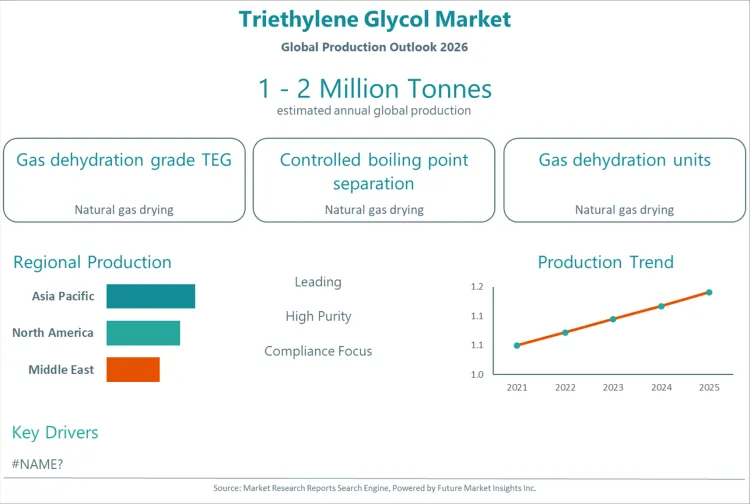
Global triethylene glycol production in 2026 is estimated at approximately 1.0 to 2.0 million tonnes, reflecting its role as a mid volume glycol with specialized industrial importance. Output growth follows steady expansion rather than rapid scaling, supported by natural gas processing activity, industrial fluids demand, and polyester related applications.
Production economics are closely linked to ethylene oxide and ethylene glycol feedstock availability, energy input, and plant integration levels. Pricing behavior differs by purity and end use orientation, particularly for gas dehydration grade material that requires tight water content control. Conditions combine large integrated producers with stable operating assets and limited greenfield capacity additions.
The global supply environment shows moderate year on year growth tied to upstream gas infrastructure investment, industrial maintenance cycles, and steady chemical consumption patterns. Demand visibility remains relatively predictable due to long term usage in dehydration and heat transfer systems.
Production capacity remains concentrated in regions with strong petrochemical integration and access to ethylene oxide. North America supports significant output aligned with natural gas processing demand. Asia Pacific represents the largest production base due to scale of petrochemical complexes and downstream manufacturing. The Middle East contributes export oriented volumes supported by low cost feedstocks. Europe maintains smaller but stable production focused on industrial and specialty uses. Several regions remain import dependent due to lack of ethylene oxide integration.
Gas dehydration, industrial fluids, and chemical intermediate applications anchor baseline demand due to TEG’s hygroscopic properties and thermal stability. Buyers prioritize consistent purity, water absorption performance, and long term supply reliability.
Gas dehydration grade accounts for a large share of consumption due to widespread use in natural gas infrastructure. Industrial and chemical grades support diversified demand across manufacturing and processing sectors. Buyers differentiate grades based on purity, water content tolerance, and contaminant limits.
Ethylene oxide based oligomerization followed by fractionation remains the dominant production route for TEG due to technical maturity and consistent quality outcomes. Buyers benefit from predictable composition, stable physical properties, and long qualification cycles.
Natural gas dehydration represents the most stable demand center due to continuous operation requirements. Industrial and chemical uses provide diversification and resilience across economic cycles. Buyers emphasize fluid stability, low volatility losses, and predictable regeneration behavior.
Asia Pacific leads global TEG production supported by large scale petrochemical integration and broad downstream consumption across industrial and chemical sectors.
North America supports significant capacity aligned with natural gas processing infrastructure and petrochemical feedstock availability.
The Middle East contributes export oriented volumes supported by integrated ethylene oxide assets and low cost feedstocks.
Europe maintains smaller scale production focused on industrial fluids and specialty chemical uses, supplemented by imports.
These regions rely largely on imports, with demand tied to gas infrastructure development and industrial growth.
The triethylene glycol supply chain begins with ethylene oxide production followed by oligomerization, fractionation, storage, and distribution. End users include gas processors, industrial operators, chemical manufacturers, and fluid formulators.
Feedstock pricing, energy input, plant utilization, and purification efficiency dominate cost structure. Logistics costs vary by region due to bulk liquid transport requirements. Trade flows reflect regional production hubs supplying long term customers rather than short term transactional movements.
Pricing formation reflects purity grade, contract duration, and application criticality rather than short term volatility. Buyers favor stable supply agreements to support continuous operations.
The triethylene glycol ecosystem includes petrochemical producers, gas processing operators, industrial fluid formulators, distributors, and regulators. Asia Pacific anchors production scale, while North America and the Middle East support dehydration driven demand.
Equipment providers support fractionation columns, dehydration units, regeneration systems, and fluid handling infrastructure. Producers coordinate feedstock sourcing, quality control, safety management, and long term customer agreements.
Global triethylene glycol production in 2026 is estimated at approximately 1 to 2 million tonnes, supported by gas dehydration and industrial fluid demand.
Pricing is driven by ethylene oxide feedstock costs, energy input for fractionation, plant utilization rates, and purity requirements.
TEG offers strong hygroscopic properties, thermal stability, and regenerability, making it effective for continuous moisture removal in gas systems.
Higher purity is required for dehydration and chemical synthesis, while industrial fluid applications tolerate broader specifications.
Buyers evaluate moisture absorption efficiency, regeneration behavior, thermal stability, safety profile, and long term supply reliability rather than unit price alone.
Explore Hydrocarbons, Petrochemicals, and Organic Chemicals Insights
View Reports
Triethylene Glycol Global Production Capacity and Growth Outlook

Thank you!
You will receive an email from our Business Development Manager. Please be sure to check your SPAM/JUNK folder too.
