Output Volumes, Cost Exposure, and Supply Direction
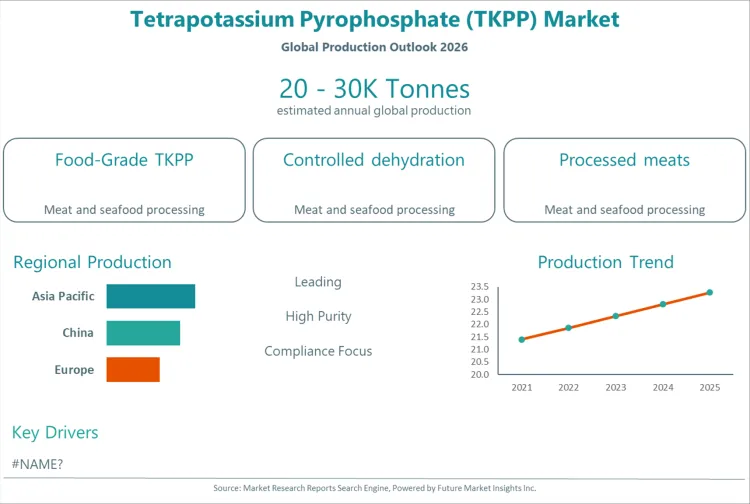
Global TKPP output in 2026 is estimated at approximately 20,000 to 30,000 tonnes, reflecting steady use across food processing, cleaning formulations, and selected industrial applications. Production direction is shaped by availability of phosphoric acid, potassium sources, energy intensity of pyrophosphate formation, and compliance with food and detergent regulations.
Production capacity is concentrated in regions with integrated phosphate processing and strong downstream demand. Asia Pacific accounts for a large share of volume output, supported by detergent manufacturing and food ingredient usage. Europe and North America maintain smaller but higher-purity focused capacity aligned with regulated food and institutional cleaning applications.
Usage patterns remain function-driven rather than volume-driven. Buyers prioritise sequestration efficiency, buffering performance, solubility, and batch consistency over short-term cost optimisation.
Key Questions Answered
- How does phosphoric acid availability affect TKPP output?
- How energyintensive is pyrophosphate production?
- How do purity requirements influence production economics?
- How does regulation affect longterm capacity planning?
Functional Grades and Specifications That Define Use
Product Classification
- FoodGrade TKPP
- Meat and seafood processing
- Moisture retention systems
- Texture and yield control
- DetergentGrade TKPP
- Water softening
- Soil dispersion
- Builder functionality
- IndustrialGrade TKPP
- Metal treatment
- Cleaning formulations
- Process additives
- Custom and LowImpurity TKPP
- Tailored particle size
- Controlled solubility
- Applicationqualified grades
Food-grade material commands the highest quality requirements due to impurity limits and regulatory oversight. Buyers focus on solubility rate, calcium-binding capacity, and reproducibility.
Key Questions Answered
- How do food and detergent grades differ in specification?
- How does particle size affect dissolution behaviour?
- How do impurity limits affect downstream performance?
- How do custom grades reduce formulation variability?
Synthesis and Processing Routes That Shape Quality
Process Classification
- Neutralisation and Condensation
- Reaction of phosphoric acid with potassium hydroxide or carbonate
- Controlled dehydration
- Pyrophosphate formation
- Thermal Treatment and Phase Control
- Temperature management
- Crystallinity control
- Functional performance tuning
- Crystallisation and Drying
- Particle size adjustment
- Flowability improvement
- Moisture control
- PostProcessing and Finishing
- Milling and classification
- Blending
- Packaging under controlled conditions
Process control directly affects sequestration efficiency and solubility. Buyers favour producers with strong thermal management and analytical monitoring.
Key Questions Answered
- How does temperature affect pyrophosphate structure?
- How sensitive is quality to dehydration control?
- How do finishing steps affect handling and storage?
- How do process variations influence performance?
Application Footprint Across Downstream Uses
End Use Segmentation
- Food Processing
- Processed meats
- Seafood and poultry
- Dairy and emulsified products
- Detergents and Cleaning Products
- Laundry formulations
- Institutional cleaners
- Hardsurface cleaning
- Industrial and Technical Uses
- Metal surface treatment
- Cleaninginplace systems
- Water treatment aids
- Specialty and Laboratory Uses
- Analytical reagents
- Controlled chemical systems
- R&D applications
Food processing and detergents account for the largest share of usage, while industrial applications prioritise functional robustness over regulatory stringency.
Key Questions Answered
- How do food processors manage regulatory compliance?
- How do detergents benefit from builder performance?
- How do industrial users tolerate grade variability?
- How do specialty uses justify higherpurity material?
Geographic Distribution and Regional Capabilities
Asia Pacific
Asia Pacific leads TKPP output supported by phosphate availability, detergent production, and food ingredient manufacturing.
China
China accounts for a significant share of global volume, supplying detergent and industrial uses with increasing focus on quality control.
Europe
Europe focuses on food-grade and regulated detergent-grade TKPP, supported by strict compliance and traceability requirements.
North America
North America maintains stable capacity aligned with food processing, institutional cleaning, and industrial applications.
Middle East and Africa
These regions rely largely on imports, with limited local processing and blending activity.
Key Questions Answered
- How does phosphate access affect regional supply stability?
- How do regulations shape grade availability?
- How does proximity to food processors affect responsiveness?
- How do logistics affect delivery consistency?
Value Chain Structure, Cost Drivers, and Trade Movement
The TKPP value chain begins with phosphoric acid and potassium sources, followed by condensation, thermal processing, finishing, and distribution. Major cost drivers include phosphate pricing, energy use, process yields, quality assurance, and compliance overheads.
Trade movement reflects grade requirements. Food-grade TKPP is more likely to move across regions due to limited qualified producers, while detergent-grade material is often produced closer to consumption.
Key Questions Answered
- How do phosphate price movements affect finished costs?
- How does energy intensity influence operating economics?
- How do transport and storage rules affect delivered cost?
- How do buyers compare local and imported supply?
Industry Ecosystem and Strategic Considerations
The TKPP ecosystem includes phosphate producers, potassium suppliers, pyrophosphate manufacturers, food processors, detergent formulators, distributors, and regulators. Reliability depends on feedstock security, process control, regulatory compliance, and application support.
Strategic considerations include substitution pressure from alternative builders and phosphates, regulatory scrutiny of phosphorous discharge, investment in higher-purity capacity, and alignment with food safety standards.
Deeper Questions Decision Makers Should Ask
- How secure is longterm phosphate sourcing?
- How exposed is the business to phosphate restrictions?
- How concentrated is foodgrade TKPP production?
- How adaptable are plants to changing specifications?
- How credible are environmental management practices?
- How strong is customer qualification capability?
- How stable is downstream demand visibility?
- How aligned are suppliers with regulatory evolution?
Bibliography
- Organisation for Economic Co-operation and Development. (2024). Transition away from phosphorus-intensive additives. OECD Sustainability Transitions Report.
- European Commission. (2024). Circular economy implications for phosphorus and detergent formulations. EC Circular Economy Monitoring Framework.
- United Nations Industrial Development Organization. (2024). Cleaner production pathways for phosphate chemicals. UNIDO Industrial Chemicals Report.
- International Association for Soaps, Detergents and Maintenance Products. (2024). Builder systems overview.
Frequently Asked Questions
What is the estimated global TKPP output in 2026?
Global output in 2026 is estimated at approximately 20,000-30,000 tonnes, supported by food processing and detergent applications.
What factors most strongly influence TKPP pricing?
Pricing is influenced by phosphoric acid and potassium costs, energy consumption, purity requirements, and regulatory compliance.
Which applications consume the highest-purity TKPP?
Food processing applications require the highest purity due to safety and regulatory standards.
How does TKPP compare with other phosphate builders?
TKPP offers strong sequestration and buffering performance, while alternatives may provide lower phosphorus content with different performance trade-offs.
How do buyers manage supply and compliance risk?
Buyers rely on supplier qualification, batch testing, regulatory documentation, and long-term supply agreements.