On this page

    THPS Pricing Structure and Production Momentum

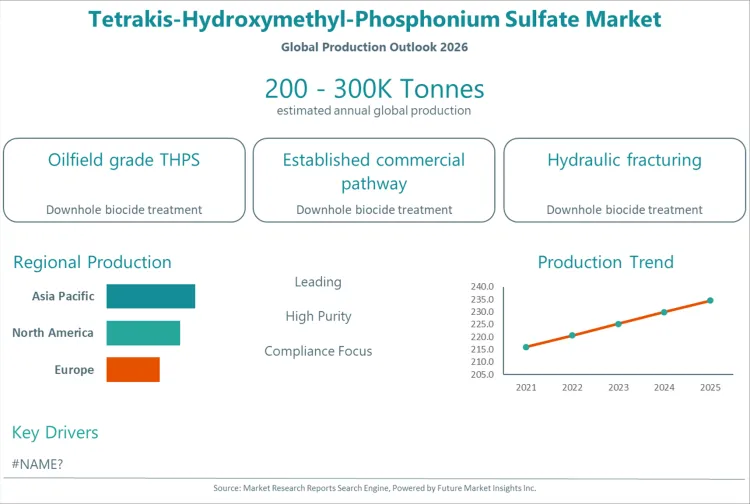
    Global tetrakis-hydroxymethyl-phosphonium sulfate production in 2026 is estimated at approximately 200 to 300 thousand tonnes, reflecting its position as a high-value specialty biocide rather than a bulk chemical. Market growth remains steady, supported by continued demand from oil and gas operations, industrial water treatment, and materials preservation applications.

    Production economics are shaped by upstream phosphine chemistry, formaldehyde sourcing, sulfuric acid availability, and strict process control requirements. Unlike commodity disinfectants, THPS pricing reflects formulation complexity, safety compliance, and customer specific performance guarantees. Market conditions combine established producers supplying long-term contracts with selective capacity expansions aligned to regional oilfield activity.

    Global supply growth shows moderate year-on-year increases tied to drilling activity, enhanced oil recovery programs, and industrial hygiene requirements. Demand visibility fluctuates with energy market cycles, although baseline consumption remains resilient due to maintenance and corrosion control needs.

    Production capacity remains concentrated in regions with strong specialty chemical infrastructure and proximity to oilfield service markets. Asia Pacific represents a significant manufacturing base, supported by chemical integration and export capability. North America sustains demand-driven capacity linked to upstream and midstream oil and gas activity. Europe maintains smaller but stable production volumes aligned with industrial biocide and material preservation uses. Many regions remain import dependent due to the technical and regulatory barriers associated with THPS manufacturing.

    Industrial and energy sector applications continue to anchor demand because THPS delivers broad spectrum biocidal performance with rapid degradation and lower environmental persistence compared to legacy alternatives. Buyers prioritize formulation consistency, documented efficacy, and regulatory acceptance.
    Tetrakis Hydroxymethyl Phosphonium Sulfate Market

    Key Questions Answered

    • How sensitive is THPS demand to oil and gas activity cycles?
    • How do feedstock and formulation costs influence pricing stability?
    • How do environmental regulations shape product positioning?
    • How do logistics and handling constraints affect regional supply?

    THPS Product Forms That Reflect Real World Buyer Usage

    Product Classification

    • Oilfield grade THPS
    • Downhole biocide treatment
    • Hydraulic fracturing fluids
    • Reservoir souring control
    • Industrial water treatment THPS
    • Cooling water systems
    • Process water control
    • Biofouling prevention
    • Material preservation grade THPS
    • Wood preservation
    • Leather and textile treatment
    • Polymer and latex protection
    • Customized and blended formulations
      • Synergistic biocide blends
      • Concentration tailored solutions
      • Application specific stabilisation

    Oilfield grade THPS represents the largest share of global consumption because it addresses microbial corrosion, sulfide generation, and biofouling risks in high value assets. Buyers emphasize rapid kill performance, compatibility with other additives, and predictable breakdown behavior.

    Key Questions Answered

    • How do oilfield buyers evaluate THPS versus alternative biocides?
    • How does formulation concentration affect application efficiency?
    • How do buyers manage safety during transport and handling?
    • How does biodegradability influence procurement decisions?

    THPS Manufacturing Routes That Define Cost Control and Compliance

    Process Classification

    • Phosphine based synthesis routes
      • Established commercial pathway
      • High purity control
      • Stringent safety management
    • Integrated specialty chemical production
      • Onsite feedstock sourcing
      • Reduced contamination risk
      • Improved cost visibility
    • Formulation and dilution operations
      • Application ready products
      • Regional blending facilities
      • Customer specific customization

    Conventional phosphine based synthesis dominates THPS production due to technical maturity and consistent quality outcomes. Buyers benefit from reliable active content, controlled impurity profiles, and compliance with global biocide regulations.

    Key Questions Answered

    • How do production routes affect impurity control?
    • How sensitive is cost to feedstock availability?
    • How does integration improve supply reliability?
    • How do producers manage process safety risk?

    THPS End Use Distribution Across Core Demand Sectors

    End Use Segmentation

    • Oil and gas operations
      • Hydraulic fracturing
      • Produced water treatment
      • Pipeline protection
    • Industrial water systems
      • Cooling towers
      • Process water loops
      • Industrial hygiene
    • Materials preservation
      • Wood treatment
      • Leather processing
      • Polymer stabilization
    • Specialty and niche applications
      • Laboratory use
      • Custom industrial systems
      • Shortterm microbial control

    Oil and gas applications dominate demand due to the high cost of microbial contamination and corrosion. Buyers focus on performance reliability, compatibility with system chemistry, and regulatory acceptance rather than lowest cost positioning.

    Key Questions Answered

    • How do operators integrate THPS into existing treatment programs?
    • How do industrial users optimize dosage and cost?
    • How do preservation applications assess longterm stability?
    • How do niche users justify THPS selection?

    THPS Regional Capacity and Market Positioning

    Asia Pacific

    Asia Pacific serves as a major production and export base supported by specialty chemical manufacturing capability and cost competitive feedstock access.

    North America

    North America represents a demand-driven market tied closely to oilfield services, shale operations, and industrial water treatment programs.

    Europe

    Europe maintains regulated, smaller scale production focused on industrial and material preservation uses, with strong emphasis on compliance.

    Middle East and Latin America

    These regions rely largely on imports to serve oil and gas operations, with demand linked to upstream investment cycles.

    Key Questions Answered

    • How do regional regulations influence THPS availability?
    • How do exporters manage transport and safety compliance?
    • How do import markets secure supply during drilling upswings?
    • How does proximity to oilfields affect competitiveness?

    THPS Supply Chain, Cost Drivers, and Trade Characteristics

    The THPS supply chain begins with specialty chemical synthesis followed by formulation, packaging, and regulated distribution. End users include oilfield service companies, industrial operators, and material processors.

    Feedstock costs, plant utilization, formulation complexity, and compliance requirements dominate cost structure. Transport and storage add additional cost due to handling restrictions and documentation needs. Trade flows favor finished formulations rather than bulk intermediates.

    Pricing mechanisms reflect contract structures, performance guarantees, and regulatory obligations rather than spot market volatility. Buyers often secure framework agreements aligned to operational programs.

    Key Questions Answered

    • How do feedstock contracts affect delivered pricing?
    • How do packaging formats influence logistics cost?
    • How do safety requirements shape trade flows?
    • How do buyers compare regional supply options?

    THPS Ecosystem Overview and Strategic Themes

    The THPS ecosystem includes specialty chemical producers, oilfield service companies, industrial water treatment providers, distributors, regulators, and end users. Asia Pacific supports production, while North America anchors demand.

    Equipment suppliers support synthesis reactors, formulation systems, storage vessels, and dosing equipment. Producers coordinate regulatory approvals, safety systems, and long-term customer supply agreements.

    Deeper Questions Decision Makers Should Ask

    • How resilient is supply to energy sector volatility?
    • How diversified are production assets?
    • How robust are environmental and safety controls?
    • How exposed is pricing to feedstock risk?
    • How flexible are formulations across applications?
    • How defensible are customer relationships?
    • How scalable are blending and distribution assets?
    • How aligned is THPS with evolving biocide regulations?

    Bibliography

    • Zhang, L., Wang, Y., & Liu, Q. (2024). Phosphonium-based biocides in oilfield applications: Performance, degradation, and environmental behavior. Journal of Petroleum Science and Engineering, 234, 112746.
    • Kahrilas, G. A., Blotevogel, J., Stewart, P. S., & Borch, T. (2024). Biocide selection and microbial control strategies in energy and industrial water systems. Water Research, 249, 120965.
    • International Association of Oil & Gas Producers. (2024). Guidance on biocide use in upstream and midstream operations. IOGP.
    • International Water Association. (2024). Industrial water treatment and biofouling control strategies. IWA Publishing.

    Frequently Asked Questions

    What is the estimated global THPS production volume in 2026?

    Global THPS production in 2026 is estimated at approximately 200 to 300 thousand tonnes, with growth linked to oilfield and industrial water treatment demand.

    What are the main cost drivers shaping THPS pricing?

    Pricing is driven by phosphine and formaldehyde feedstock costs, formulation complexity, safety compliance, and plant utilization rates.

    How does oil and gas activity affect THPS demand?

    Drilling and production intensity directly influence demand, although baseline consumption persists due to maintenance and corrosion control needs.

    How do regulations influence THPS market adoption?

    Environmental acceptance and biodegradability support THPS positioning compared to more persistent biocides, particularly in regulated markets.

    How do buyers choose between THPS and alternative biocides?

    Buyers evaluate efficacy, compatibility, degradation profile, safety handling, and total treatment cost rather than unit price alone.

    Key Questions Answered in the Report

    Supply chain and operations

    • How predictable is production output?
    • How is safe storage managed?
    • How consistent is formulation quality?
    • How effective are monitoring systems?
    • How quickly can blending capacity scale?
    • How resilient are logistics routes?
    • How does site location affect compliance?
    • How are operational risks mitigated?

    Procurement and raw materials

    • How are feedstock contracts structured?
    • How do suppliers document regulatory compliance?
    • How stable is active content across batches?
    • What contract terms support reliability?
    • How do buyers manage cost variability?
    • Which suppliers offer regional redundancy?
    • How are audits conducted?
    • How do onboarding requirements differ?

    Technology and innovation

    • Which formulation improvements enhance efficacy?
    • How is automation improving safety?
    • How do blends reduce overall treatment cost?
    • How are producers validating new chemistries?
    • How do plants improve waste handling?
    • How are safety standards evolving?
    • How do materials extend equipment life?
    • How do partnerships accelerate deployment?

    Buyer, channel, and who buys what

    • Which sectors anchor baseline demand?
    • How do oilfield operators assess suppliers?
    • How do industrial users manage risk?
    • What volumes define standard contracts?
    • How do buyers choose import versus domestic supply?
    • How do distributors influence delivered cost?
    • How do buyers verify performance claims?
    • How do users ensure continuity?

    Pricing, contract, and commercial model

    • What benchmarks guide THPS pricing?
    • How often are contracts reviewed?
    • How do pricing models support visibility?
    • How do buyers compare alternatives?
    • What contract duration supports stability?
    • How are disputes resolved?
    • What incentives support adoption?
    • How do contracts vary by application?

    Plant assessment and footprint

    • Which regions support compliant production?
    • What investment defines commercial scale?
    • How do permitting requirements affect siting?
    • How suitable are industrial zones?
    • How consistent are utilities?
    • How do plants manage inspections?
    • How does workforce training affect safety?
    • How suitable are transport corridors for distribution?

    Explore Textiles, Fabrics, Yarn & Fibres Insights

    View Reports

    Trusted By
    Market Research Reports Search Engine

    Tetrakis-Hydroxymethyl-Phosphonium Sulfate Global Production Capacity and Growth Outlook