On this page

    South America Biodiesel Production and Capacity Outlook

    South America biodiesel production capacity in 2026 is estimated at approximately 12 to 15 million tonnes per year, positioning the region as one of the largest biodiesel producers globally. Capacity growth is driven primarily by domestic blending mandates, energy security objectives and agricultural value chain integration rather than discretionary fuel demand. Expansion trends favour incremental capacity additions, plant debottlenecking and feedstock flexibility upgrades over large scale greenfield investments.

    Production leadership is concentrated in countries with strong oilseed output, established biodiesel policies and integrated agribusiness infrastructure. Brazil dominates regional capacity supported by soybean oil availability and consistent blending requirements. Argentina remains a major producer with a strong export orientation, while Colombia and Paraguay expand capacity to support domestic mandates. Several smaller economies rely on imports due to limited feedstock processing capability.

    Demand stability is reinforced by mandated blending programs and domestic diesel consumption. Buyers prioritise regulatory compliance, feedstock traceability and cost predictability.
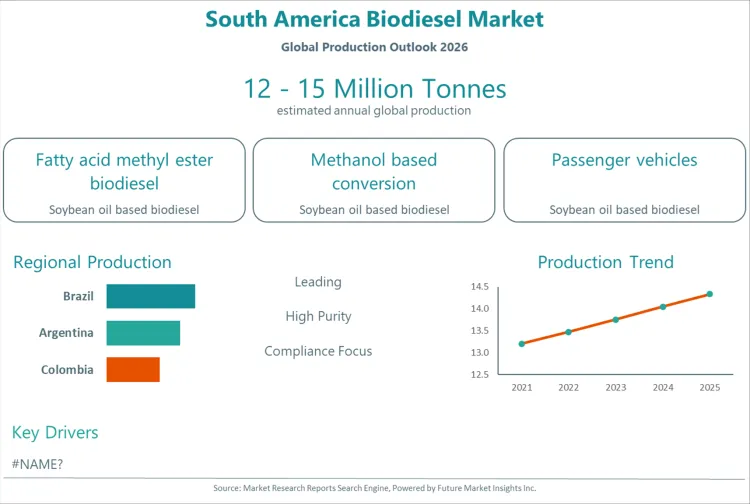
    South America Biodiesel Market

    Key Questions Answered

    • How sustainable is biodiesel capacity growth under current blending mandates?
    • How does agricultural output variability affect production stability?
    • How do export policies influence regional supply balance?
    • How resilient is biodiesel demand to fuel consumption cycles?

    Biodiesel Product Types That Define How Buyers Actually Use It

    Product Classification

    • Fatty acid methyl ester biodiesel
    • Soybean oil based biodiesel
    • Palm oil based biodiesel
    • Sunflower and rapeseed oil biodiesel
    • Multi feedstock biodiesel
    • Blended vegetable oil inputs
    • Waste oil integration
    • Feedstock flexibility systems
    • Export grade biodiesel
    • Specification compliant fuels
    • Cold flow adjusted grades
    • Traceability certified volumes
    • Domestic mandate grade biodiesel
      • National blending compliance
      • Tax incentive linked supply
      • Regulated distribution channels

    Soybean oil based biodiesel dominates regional output due to feedstock availability. Export grades require tighter quality control and certification compared with domestic mandate supply.

    Key Questions Answered

    • How do buyers distinguish export grade and domestic biodiesel?
    • How does feedstock choice affect fuel properties?
    • How do cold flow requirements vary by destination?
    • How does traceability influence procurement decisions?

    South America Biodiesel Process Routes That Define Cost and Feedstock Flexibility

    Process Classification

    • Conventional transesterification
      • Methanol based conversion
      • Alkali catalysed systems
      • Mature and widely deployed
    • Feedstock pretreatment systems
      • Degumming and neutralisation
      • Free fatty acid management
      • Yield optimisation
    • Flexible feedstock processing
      • Multi oil input handling
      • Waste oil co processing
      • Cost optimisation focus
    • Glycerine recovery and purification
      • Co product monetisation
      • Pharmaceutical and industrial grades
      • Margin support mechanism

    Process economics are highly sensitive to feedstock pricing and conversion efficiency. Plants with flexible feedstock capability demonstrate stronger resilience during agricultural price volatility.

    Key Questions Answered

    • How sensitive biodiesel cost is to soybean oil pricing?
    • How does feedstock flexibility affect plant utilisation?
    • How do co product values influence margins?
    • How does process efficiency affect competitiveness?

    Biodiesel End Use Spread Across South American Fuel Markets

    End Use Segmentation

    • Road transport diesel blending
      • Passenger vehicles
      • Freight transport
      • Public transport fleets
    • Agricultural and off road use
      • Farm equipment
      • Mining and construction
      • Rural logistics
    • Export fuel supply
      • European biodiesel blending
      • Regional trade
      • Contract based shipments
    • Power generation and backup use
      • Remote generation
      • Distributed energy
      • Emergency supply

    Domestic road transport blending accounts for the majority of consumption due to mandated usage. Export demand introduces volatility tied to international policy and trade conditions.

    Key Questions Answered

    • How do national blending mandates shape demand stability?
    • How do export flows respond to international policy changes?
    • How do fuel quality requirements vary by end use?
    • How do buyers manage seasonal demand swings?

    South America Biodiesel Regional Production and Policy Assessment

    Brazil

    Brazil leads regional biodiesel production supported by soybean supply, national blending mandates and integrated agribusiness networks.

    Argentina

    Argentina maintains strong capacity with a significant export focus, though policy variability influences utilisation rates.

    Colombia

    Colombia expands biodiesel output aligned with palm oil availability and domestic blending programs.

    Paraguay and Uruguay

    These countries show moderate growth driven by domestic fuel needs and agricultural output.

    Other South American Countries

    Several nations rely on imports or limited domestic production due to feedstock constraints.

    Key Questions Answered

    • How do national policies affect capacity utilisation?
    • How does feedstock availability differ by country?
    • How do export restrictions influence producer strategy?
    • How does policy stability affect investment confidence?

    South America Biodiesel Supply Chain, Cost Drivers and Trade Patterns

    The biodiesel supply chain integrates agricultural production, oilseed crushing, biodiesel conversion, storage and regulated fuel distribution. Feedstock logistics and storage play a critical role due to seasonal harvest cycles.

    Key cost drivers include vegetable oil pricing, methanol costs, energy use and compliance expenses. Trade flows connect Argentina and Brazil with export destinations, while intra regional trade supports supply balancing.

    Contracts are typically structured around mandate compliance, indexed feedstock pricing and quality specifications.

    Key Questions Answered

    • How do agricultural cycles affect biodiesel availability?
    • How do feedstock prices translate into fuel cost?
    • How do logistics and storage affect delivered pricing?
    • How do buyers benchmark domestic versus export supply?

    South America Biodiesel Ecosystem View and Strategic Themes

    The ecosystem includes farmers, oilseed processors, biodiesel producers, fuel distributors, regulators and export traders. Biodiesel acts as a policy driven bridge between agriculture and energy sectors.

    Strategic themes include feedstock diversification, policy stability, carbon intensity tracking and integration with renewable diesel pathways.

    Deeper Questions Decision Makers Should Ask

    • How secure is long term feedstock access?
    • How exposed are producers to policy changes?
    • How scalable are flexible feedstock assets?
    • How resilient are export oriented strategies?
    • How robust are sustainability and traceability systems?
    • How aligned are stakeholders across agriculture and energy?
    • How transparent are carbon accounting frameworks?
    • How quickly can producers adapt to mandate shifts?

    Bibliography

    • FAO. (2024). Bioenergy and agricultural integration in South America.
    • International Energy Agency. (2024). Biofuels supply and policy outlook.
    • USA Department of Agriculture. (2024). Oilseeds and biofuels market analysis.

    Frequently Asked Questions

    What is the estimated South America biodiesel production volume in 2025?

    South America biodiesel production in 2025 is estimated at approximately 12 to 14 million tonnes, driven by domestic blending mandates and export activity.

    What are the biggest cost drivers shaping biodiesel pricing in the region?

    Pricing is driven by soybean oil costs, methanol pricing, energy inputs and regulatory compliance expenses.

    How do blending mandates affect biodiesel demand stability?

    Mandates create baseline demand but expose producers to political and regulatory risk.

    Why is soybean oil the dominant feedstock?

    Soybean oil dominates due to regional agricultural scale, established crushing infrastructure and cost efficiency.

    Which countries are most influential in regional biodiesel trade?

    Brazil and Argentina are the most influential due to production scale and export capability.

    Key Questions Answered in the Report

    Supply chain and operations

    • How predictable is feedstock availability?
    • How stable is plant utilisation across seasons?
    • How effective are quality control systems?
    • How resilient are storage and logistics networks?
    • How quickly can plants switch feedstocks?
    • How are co products managed?
    • How robust are traceability systems?
    • How are operational disruptions handled?

    Procurement and raw material

    • How are vegetable oils indexed in contracts?
    • How do suppliers manage price volatility?
    • How is feedstock diversification achieved?
    • What contract duration supports stability?
    • How are alternative feedstocks qualified?
    • How do buyers manage supply disruption risk?
    • How are audits conducted?
    • How do onboarding requirements vary by country?

    Technology and innovation

    • How do process upgrades improve feedstock flexibility?
    • How is glycerine purification optimised?
    • How are emissions reduced at plant level?
    • How does digital monitoring improve yields?
    • How do producers manage scale up risk?
    • How are waste streams minimised?
    • How do partnerships support innovation?
    • How does innovation support carbon reduction goals?

    Buyer, channel and who buys what

    • Which sectors consume the largest biodiesel volumes?
    • How do distributors manage mandate compliance?
    • What volumes define standard supply agreements?
    • How do buyers compare domestic and export supply?
    • How do channels influence delivered cost?
    • How do buyers verify sustainability claims?
    • How do users manage operational risk?
    • How do specifications vary by destination?

    Pricing, contract and commercial model

    • What reference points guide biodiesel pricing?
    • How frequently are pricing reviews conducted?
    • How do contracts reflect feedstock volatility?
    • How do buyers compare biodiesel with fossil diesel?
    • What duration supports investment recovery?
    • How are disputes resolved?
    • How do policy incentives affect pricing terms?
    • How do contracts vary by mandate structure?

    Plant assessment and footprint

    • Which regions offer reliable feedstock supply?
    • What investment defines competitive scale?
    • How do permitting timelines affect capacity?
    • How suitable are agro industrial clusters?
    • How consistent are policy frameworks?
    • How are safety and environmental audits managed?
    • How does workforce availability affect operations?
    • How do logistics links support domestic and export flows?

    Explore Energy and Environmental Chemicals Insights

    View Reports

    Trusted By
    Market Research Reports Search Engine

    South America Biodiesel Global Production Capacity and Growth Outlook