On this page
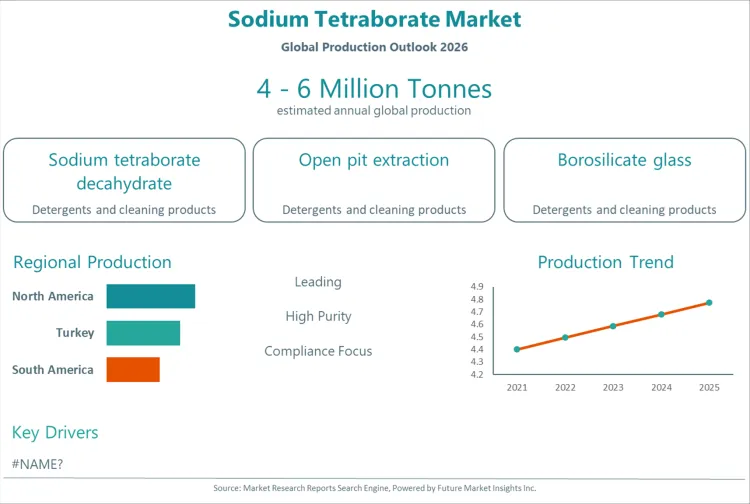
Global sodium tetraborate production in 2026 is estimated at approximately 4 to 6 million tonnes, reflecting its role as a foundational boron compound used across glass, ceramics, detergents, and agriculture. Output growth follows steady industrial expansion rather than rapid acceleration, supported by construction activity, durable goods manufacturing, and long standing agricultural use.
Production economics are closely linked to borate ore availability, mining costs, energy input for refining, and logistics from geographically concentrated reserves. Pricing behavior varies by hydration level and purity, particularly between technical, refined, and specialty grades. Conditions combine a small number of vertically integrated producers with long operating histories and limited new capacity development.
The global supply environment shows gradual year on year volume growth shaped by infrastructure investment, stable household consumption of cleaning products, and continued use in glass fiber and insulation materials. Demand visibility remains relatively predictable due to sodium tetraborate’s established role in mature industrial value chains.
Production capacity is highly concentrated in regions with commercially viable borate reserves. North America represents a major production base supported by large scale mining and refining operations. Turkey contributes significant global volumes due to extensive natural borate resources. South America supports regional supply through established mining assets. Asia Pacific and Europe rely more heavily on imports for refined material due to limited domestic ore availability.
Glass manufacturing, detergents, agriculture, and ceramics anchor baseline demand due to sodium tetraborate’s buffering, fluxing, and micronutrient properties. Buyers prioritize consistent chemical composition, secure long term supply, and regulatory compliance.
Decahydrate grades account for the largest share of consumption due to widespread use in detergents and agriculture. Pentahydrate and anhydrous forms support higher temperature and performance sensitive applications. Buyers differentiate grades based on water content, solubility behavior, and purity.
Natural ore mining followed by refining and controlled crystallization dominates global sodium tetraborate production due to resource availability and technical maturity. Buyers benefit from predictable product chemistry and long production histories, although supply concentration introduces strategic risk.
Glass and detergent applications represent the largest volume uses due to consistent consumption patterns. Agricultural demand varies with planting cycles and regional soil conditions. Buyers emphasize reliability, regulatory compliance, and predictable performance.
North America supports significant production through large scale borate mining and refining operations, supplying domestic and export demand.
Turkey represents a critical global supply base due to extensive borate reserves and state supported mining infrastructure.
South America contributes regional supply through established mining assets serving agriculture and industrial uses.
These regions rely largely on imports for refined sodium tetraborate, with demand tied to glass manufacturing, detergents, and agriculture.
The sodium tetraborate supply chain begins with borate ore extraction followed by refining, crystallization, drying, packaging, and distribution. End users include glass manufacturers, detergent producers, agricultural input suppliers, and industrial processors.
Mining costs, energy consumption, refining yield, and transport distance dominate cost structure. Bulk handling and long distance shipping add complexity due to volume and weight. Trade flows reflect limited production locations supplying diversified downstream regions.
Pricing formation reflects ore quality, refining complexity, contract duration, and logistics considerations rather than short term fluctuations. Buyers often secure multi year supply agreements to reduce exposure to concentration risk.
The sodium tetraborate ecosystem includes mining companies, refiners, distributors, industrial manufacturers, agricultural suppliers, and regulators. Production remains highly concentrated, while demand is geographically diversified.
Equipment providers support mining systems, crystallizers, dryers, packaging lines, and bulk handling infrastructure. Producers coordinate reserve management, refining operations, environmental compliance, and long term customer contracts.
Global sodium tetraborate production in 2026 is estimated at approximately 4 to 6 million tonnes, supported by glass, detergent, and agricultural demand.
Pricing is driven by mining and refining costs, energy input, ore quality, and logistics distance from production sites.
Commercially viable borate reserves are limited to a small number of regions, which concentrates mining and refining capacity.
Hydration level affects solubility, handling, and suitability for different applications such as detergents, glass, or high temperature processes.
Buyers use long term contracts, inventory buffers, and diversified sourcing where possible to ensure continuity.
Explore Inorganic Chemicals Insights
View Reports
Sodium Tetraborate Global Production Capacity and Growth Outlook

Thank you!
You will receive an email from our Business Development Manager. Please be sure to check your SPAM/JUNK folder too.
