On this page
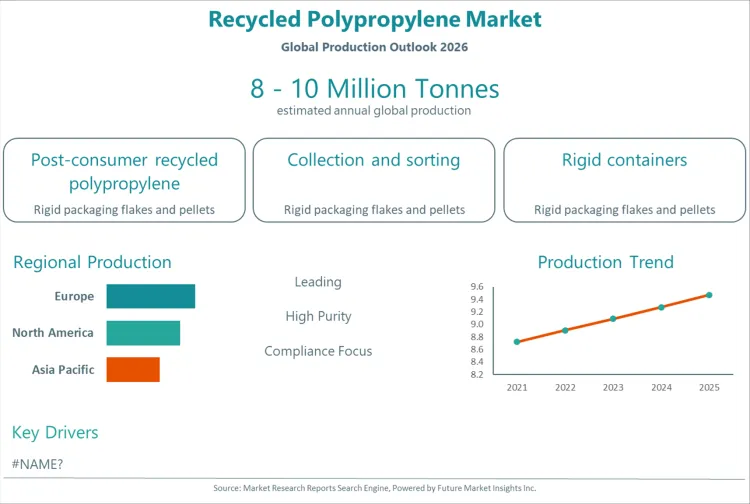
Global recycled polypropylene production in 2026 is estimated at approximately 8.0 to 10 million tonnes, positioning rPP as one of the fastest growing recycled polyolefin streams. Growth reflects accelerating regulatory pressure, brand sustainability commitments, and rising demand for circular materials across packaging, automotive, and consumer goods.
Industry economics remain highly sensitive to feedstock availability, sorting efficiency, and quality loss during reprocessing. Unlike virgin polypropylene, rPP pricing does not follow a single global benchmark. Prices vary widely based on color, melt flow, contamination levels, and certification status. Industry conditions combine high demand for food contact capable and near virgin grades with persistent shortages of clean post-consumer feedstock.
The global supply picture shows uneven year on year capacity growth. Investment is strongest in regions with extended producer responsibility schemes, deposit return systems, and advanced sorting infrastructure. Supply expansion often lags demand growth, creating structural tightness for high specification grades.
Production leadership remains concentrated in Europe due to early regulation and collection systems. Asia Pacific contributes large volumes tied to manufacturing scale, although quality varies by market. North America expands capacity through packaging commitments and retailer driven demand. Many regions remain constrained by collection gaps and inconsistent waste streams.
Packaging, automotive, and household goods applications anchor demand growth as buyers seek to reduce virgin polymer exposure and meet recycled content targets. Buyers prioritize consistent melt flow, odor control, color stability, and traceability.
Post industrial rPP offers the most consistent quality and remains preferred for performance sensitive applications. Post consumer rPP dominates volume growth but faces variability challenges. Food contact capable rPP remains supply constrained and commands premium pricing.
Mechanical recycling dominates near term supply due to lower cost and established infrastructure. Advanced recycling routes aim to improve purity and enable higher value applications but face scale, energy, and cost hurdles. Buyers assess routes based on regulatory acceptance and performance outcomes rather than technology claims alone.
Packaging leads demand growth due to regulatory pressure and brand commitments. Automotive adoption increases where performance specifications can be met consistently. Buyers focus on supply security, quality repeatability, and long term pricing visibility.
Europe leads rPP capacity supported by extended producer responsibility schemes, recycled content mandates, and advanced sorting infrastructure. Demand often exceeds supply for high quality grades.
North America expands capacity through retailer commitments and packaging targets. Collection gaps and inconsistent feedstock streams remain constraints.
Asia Pacific supplies significant rPP volumes driven by manufacturing scale. Quality differentiation is wide across markets due to variable collection systems.
These regions show emerging potential but remain early stage due to limited collection infrastructure and investment.
The rPP supply chain begins with waste collection followed by sorting, washing, reprocessing, compounding, and distribution. End users include packaging converters, automotive suppliers, consumer goods manufacturers, and industrial processors.
Feedstock cost and yield loss dominate economics. Sorting efficiency, contamination removal, energy use, and logistics further shape delivered cost. Trade flows are regional rather than global due to transport cost and regulatory controls on waste movement.
Pricing formation reflects quality specifications, certification requirements, and contract length rather than spot polymer indices. Buyers increasingly favor multi year agreements to secure volume and quality.
The rPP ecosystem includes waste collectors, sorting operators, recyclers, compounders, brand owners, converters, and regulators. Europe leads policy driven demand, while North America and Asia Pacific expand processing capacity.
Technology providers support sorting, washing, extrusion, odor reduction, and quality control systems. Recyclers coordinate feedstock contracts, certification audits, and long term offtake agreements.
Global recycled polypropylene production in 2026 is estimated at approximately 8 to 10 million tonnes, with strong growth driven by packaging and consumer goods demand.
Pricing is driven by feedstock availability, sorting and washing efficiency, yield loss, energy use, and certification costs.
Food contact applications require advanced decontamination, closed loop systems, and regulatory approvals, which restrict available supply.
Mandates and brand commitments create structural demand growth, particularly for packaging, often outpacing supply expansion.
Buyers evaluate total cost, performance consistency, regulatory compliance, sustainability targets, and long term supply security rather than price alone.
Explore Polymers & Plastics Insights
View Reports
Recycled Polypropylene Global Production Capacity and Growth Outlook

Thank you!
You will receive an email from our Business Development Manager. Please be sure to check your SPAM/JUNK folder too.
