On this page
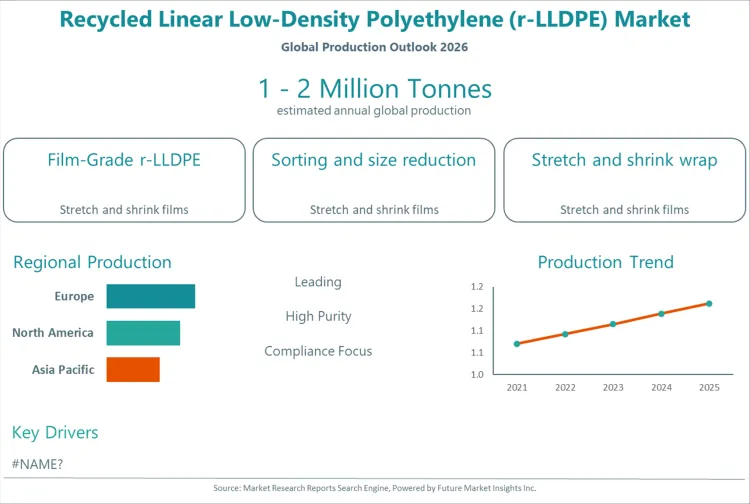
Global r-LLDPE output in 2026 is estimated at approximately 1 to 2 million tonnes, reflecting continued expansion supported by recycled-content obligations, substitution away from virgin polymers, and increased use in flexible film applications. Output growth is shaped by the efficiency of film collection programs, advances in washing and separation systems, and investment in compounding and stabilisation capabilities.
Production remains uneven due to fragmented film waste streams, multilayer contamination, and inconsistent polymer composition. Europe and parts of North America lead higher-quality output supported by organised recovery schemes and advanced upgrading capacity. Asia Pacific contributes large volumes, though specification consistency varies. Several regions remain dependent on imported recycled material to meet functional requirements.
Usage is concentrated in applications prioritising toughness, flexibility, and downgauging potential. Buyers focus on melt flow consistency, contamination thresholds, mechanical strength, and supply dependability rather than short-term cost advantages.
Higher-grade material commands premiums due to limited availability and stricter performance expectations. Buyers prioritise elongation, puncture resistance, and processing consistency.
Mechanical recycling dominates due to cost efficiency, while output quality remains closely tied to feedstock cleanliness. Buyers favour suppliers with strong control over sourcing and processing.
Flexible packaging accounts for the largest share of value usage, while agricultural and industrial segments absorb significant volumes where appearance standards are lower.
Europe leads higher-quality r-LLDPE output due to structured film collection programs, recycled-content obligations, and advanced upgrading capacity.
North America continues to add capacity through film recycling investments, though post-consumer film recovery remains inconsistent.
Asia Pacific supplies large volumes of recycled polyethylene, but grade consistency varies due to mixed waste inputs.
Latin America shows improving collection activity but remains limited by upgrading and compounding capacity.
These regions remain at early stages with limited organised film recovery and reliance on imports for consistent grades.
The r-LLDPE supply chain begins with post-consumer and post-industrial film collection, followed by sorting, washing, recycling, compounding, and distribution. Feedstock acquisition, washing intensity, yield losses, energy use, and logistics dominate cost formation.
Trade flows reflect quality requirements, with higher-grade material moving toward regions with strict recycled-content rules. Long-term supply arrangements are increasingly used to manage variability and ensure continuity.
The r-LLDPE ecosystem includes collectors, sorting operators, recyclers, compounders, converters, brand owners, and regulators. Progress depends on alignment across recovery quality, processing capability, and downstream acceptance.
Strategic themes include improving film collection rates, investing in upgrading technologies, tailoring compounds to specific applications, and securing long-term offtake alignment.
Global output in 2026 is estimated at approximately 1 to 2 million tonnes, constrained mainly by clean film availability.
Key influences include feedstock costs, contamination rates, washing intensity, yield losses, energy use, and logistics.
Flexible packaging, agricultural films, and industrial liners account for the majority of usage.
r-LLDPE provides better toughness and puncture resistance than LDPE, while HDPE offers higher stiffness but less flexibility.
Buyers rely on blending strategies, additive systems, long-term contracts, and incoming material testing.
Explore Polymers & Plastics Insights
View Reports
Recycled Linear Low-Density Polyethylene (r-LLDPE) Global Production Capacity and Growth Outlook

Thank you!
You will receive an email from our Business Development Manager. Please be sure to check your SPAM/JUNK folder too.
