Reactive Diluents Production and Capacity Outlook
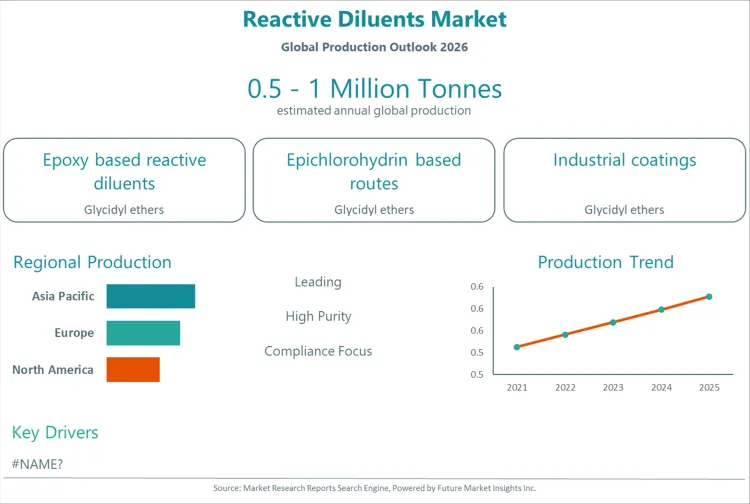
Global reactive diluent production capacity in 2026 is estimated at approximately 0.5 to 1 million tonnes, reflecting steady growth aligned with expansion in thermoset resins, composites and coatings rather than standalone volume driven investment. Capacity additions are primarily incremental, focused on integration with epoxy and unsaturated resin manufacturing rather than greenfield facilities.
Production remains concentrated in regions with established epoxy resin, acrylic monomer and specialty chemical infrastructure. Asia Pacific leads capacity growth due to expanding composites, coatings and wind energy demand. Europe maintains a strong position in specialty and low volatility reactive diluents driven by regulatory compliance requirements. North America supports stable output tied to construction, infrastructure and industrial coatings demand. Several emerging regions remain import dependent due to limited specialty chemical manufacturing depth.
Demand growth is supported by viscosity reduction needs, formulation flexibility and performance optimisation across resin systems. Buyers prioritise reactivity control, compatibility with base resins and regulatory compliance.
Key Questions Answered
- How closely is reactive diluent supply linked to epoxy and resin production?
- How do formulation trends influence capacity utilisation?
- How do regulatory requirements affect product portfolios?
- How resilient is demand across construction and industrial cycles?
Reactive Diluents Product Families That Define How Buyers Actually Use Them
Product Classification
- Epoxy based reactive diluents
- Glycidyl ethers
- Aliphatic and aromatic structures
- Low viscosity epoxy formulations
- Acrylic and methacrylate reactive diluents
- Radiation curable systems
- UV and electron beam coatings
- Fast curing applications
- Vinyl ester and unsaturated polyester diluents
- Styrene replacement systems
- Low emission resin formulations
- Composite processing aids
- Specialty and bio based reactive diluents
- Low volatility formulations
- Renewable feedstock derivatives
- Regulatory compliant alternatives
Epoxy reactive diluents dominate consumption due to widespread epoxy resin use. Acrylic reactive diluents grow steadily driven by radiation curable coatings and electronics applications.
Key Questions Answered
- How do formulators select reactive diluent chemistry?
- How does functionality influence curing behaviour?
- How do low volatility products affect processing?
- How does regulatory compliance shape grade selection?
Reactive Diluents Process Routes That Define Cost, Performance and Scale
Process Classification
- Glycidyl ether synthesis
- Epichlorohydrin based routes
- Alcohol and phenol feedstocks
- Functionality control
- Acrylation and methacrylation
- Esterification reactions
- Controlled molecular weight design
- Polymerisation inhibitor management
- Integrated specialty chemical production
- Feedstock security
- Cost optimisation
- Quality consistency
- Finishing and purification
- Distillation and stabilisation
- Colour and impurity control
- Specification tightening
Production routes focus on precise control of functionality and purity due to the strong influence of reactive diluents on final resin performance.
Key Questions Answered
- How sensitive are reactive diluent costs to epichlorohydrin pricing?
- How does purity affect resin performance and shelf life?
- How do process choices influence environmental footprint?
- How does integration improve supply reliability?
Reactive Diluents End Use Spread Across Key Sectors
End Use Segmentation
- Coatings and paints
- Industrial coatings
- Protective and marine coatings
- Powder and liquid systems
- Composites and laminates
- Wind energy blades
- Automotive composites
- Construction panels
- Adhesives and sealants
- Structural adhesives
- Flooring and construction systems
- Electronic encapsulation
- Electronics and specialty applications
- Printed circuit boards
- Potting and encapsulation
- High performance coatings
Coatings and composites represent the largest consumption segments. Wind energy and infrastructure projects drive higher demand for low emission and high performance reactive diluents.
Key Questions Answered
- How do coatings producers balance viscosity and performance?
- How do composite manufacturers manage curing profiles?
- How do electronics users manage thermal stability?
- How do end users evaluate substitution options?
Reactive Diluents Regional Production Potential Assessment
Asia Pacific
Asia Pacific leads global production and consumption supported by epoxy resin capacity, composite manufacturing and infrastructure growth.
Europe
Europe focuses on specialty, low emission and regulatory compliant reactive diluents rather than volume expansion.
North America
North America maintains stable production tied to construction, coatings and industrial adhesives demand.
Middle East
The Middle East shows emerging potential through petrochemical integration but remains limited in specialty grades.
Latin America and Africa
These regions remain largely import dependent due to limited specialty chemical manufacturing capability.
Key Questions Answered
- How do regional regulations influence product mix?
- How do import dependent regions manage supply risk?
- How does proximity to resin producers affect competitiveness?
- How do logistics costs affect delivered pricing?
Reactive Diluents Supply Chain, Cost Drivers and Trade Patterns
The reactive diluent supply chain begins with petrochemical feedstocks such as epichlorohydrin, acrylic acid derivatives and specialty alcohols, followed by synthesis, purification and distribution to resin formulators.
Feedstock pricing, plant utilisation and energy inputs dominate cost structure. Regulatory compliance, particularly related to volatile organic compounds and toxicological classification, adds complexity. Trade flows connect specialty chemical hubs with resin production centres.
Buyers structure contracts around formulation compatibility, specification consistency and long term availability.
Key Questions Answered
- How do feedstock costs translate into reactive diluent pricing?
- How do regulatory requirements affect supply availability?
- How do buyers benchmark alternative chemistries?
- How do logistics influence supply chain resilience?
Reactive Diluents Ecosystem View and Strategic Themes
The ecosystem includes specialty chemical producers, epoxy and resin manufacturers, coatings formulators, composite fabricators and regulators. Asia Pacific anchors volume growth, while Europe drives regulatory and formulation innovation.
Strategic themes include low volatility development, styrene replacement, bio based alternatives and alignment with emissions standards.
Deeper Questions Decision Makers Should Ask
- How resilient is demand to regulatory tightening?
- How diversified are reactive diluent portfolios?
- How exposed are assets to feedstock volatility?
- How scalable are bio based alternatives?
- How quickly can formulations adapt to new rules?
- How robust are quality and compliance systems?
- How aligned are suppliers and formulators?
- How sustainable are current chemistries long term?
Bibliography
- CoatingsTech. (2024). Advances in low emission resin formulation.
- Ullmann’s Encyclopedia of Industrial Chemistry. (2024). Reactive diluents and resin modification. Wiley VCH.
- European Chemicals Agency. (2024). Epoxy and acrylate substance regulatory overview.
Frequently Asked Questions
What is the estimated global reactive diluents production volume in 2025?
Global reactive diluents production in 2025 is estimated at approximately 0.5 to 1 million tonnes, aligned with epoxy resin and coatings demand.
What are the biggest cost drivers shaping reactive diluents pricing?
Pricing is driven by epichlorohydrin and acrylic feedstock costs, energy inputs, regulatory compliance and formulation complexity.
How do regulations affect reactive diluent usage?
Regulations targeting volatile organic compounds and hazardous substances encourage adoption of low volatility and alternative chemistries.
Why are reactive diluents preferred over inert solvents?
Reactive diluents participate in curing reactions, improving performance while reducing emissions and solvent loss.
Which sectors drive reactive diluents demand growth?
Coatings, composites, wind energy and electronics are the primary demand drivers.