On this page
Global potassium carbonate production in 2026 is estimated at approximately 1 to 2 million tonnes, reflecting steady capacity growth anchored in established industrial demand rather than rapid expansion cycles. Potassium carbonate is a mature inorganic chemical with broad application across glass, fertilizers, soaps, detergents, specialty chemicals, and emerging energy related uses.
Supply growth is driven by gradual expansion in glass manufacturing, specialty fertilizer demand, and increased use in chemical synthesis and buffering applications. Production economics balance relatively stable downstream demand against exposure to potash availability, energy costs, and regional environmental compliance requirements. Capacity additions are typically incremental, focused on debottlenecking or integration with upstream potash processing rather than greenfield megaprojects.
Production leadership remains concentrated in regions with strong potash resources, established chemical infrastructure, and access to industrial consumers. Asia Pacific leads global output supported by fertilizer and glass industries. Europe maintains stable capacity focused on specialty and high purity grades. North America supports integrated production aligned with agricultural and industrial demand. Other regions remain partially import dependent due to limited potash processing capability.
Industrial and agricultural applications continue to support baseline demand growth due to potassium carbonate’s role in nutrient supply, alkalinity control, and process efficiency. Buyers value consistent purity, predictable solubility, and reliable long term supply.
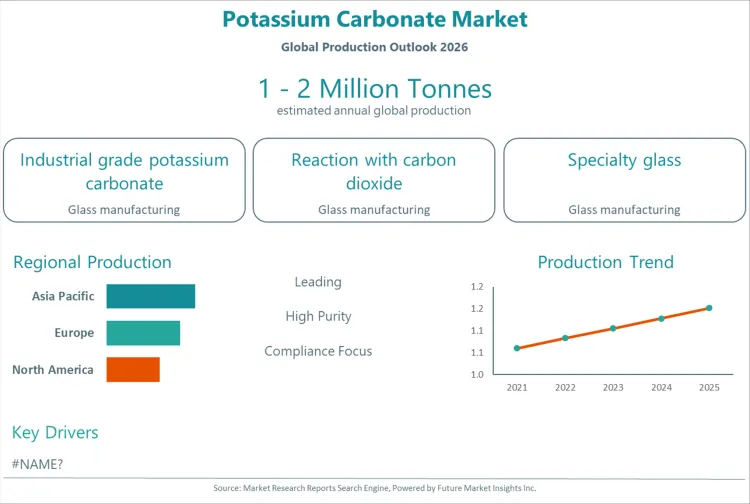
Industrial grade potassium carbonate represents the largest share of global consumption due to its extensive use in glass and chemical manufacturing. Agricultural grade material serves niche fertilizer markets where chloride free potassium sources are required. High purity grades address applications where tight impurity control is essential.
Potash based routes dominate global production due to feedstock availability and cost efficiency. Conversion from potassium hydroxide supports higher purity grades but carries higher energy intensity. Technology selection affects yield efficiency, energy use, and product quality consistency.
Buyers benefit from predictable performance, consistent particle characteristics, and stable supply rather than rapid production flexibility.
Glass and chemical applications dominate consumption due to continuous production requirements. Agricultural uses provide stable seasonal demand, while food and pharmaceutical applications require smaller volumes with higher quality standards.
Asia Pacific leads global production supported by fertilizer demand, glass manufacturing, and integrated potash processing.
Europe maintains established capacity focused on specialty, food, and pharmaceutical grades under strict regulatory oversight.
North America supports integrated production aligned with agricultural and industrial consumption.
The Middle East shows emerging potential tied to fertilizer production and chemical diversification strategies.
These regions remain partially import dependent with growing agricultural demand but limited local processing capacity.
Potassium carbonate supply begins with potash extraction, followed by chemical conversion, purification, drying, and distribution. Products are transported in bulk bags, drums, or bulk shipments depending on grade and application. Downstream buyers include glass manufacturers, fertilizer blenders, chemical processors, and food ingredient suppliers.
Potash pricing, energy consumption, plant utilisation, and logistics reliability dominate cost structure. Trade flows serve regions without local potash processing, with higher purity grades more frequently traded due to concentrated production.
The potassium carbonate ecosystem includes potash miners, chemical processors, fertilizer producers, glass manufacturers, detergent formulators, food processors, distributors, and regulators. Asia Pacific drives volume demand, while Europe shapes quality and compliance standards.
Equipment providers support reactors, crystallisers, dryers, and safety systems. Producers coordinate feedstock sourcing, quality assurance, and long term supply agreements.
Global potassium carbonate production in 2025 is estimated at approximately 1 to 2 million tonnes, reflecting steady growth aligned with industrial and agricultural demand.
Pricing is primarily shaped by potash feedstock costs, energy consumption, plant utilisation, and logistics expenses.
Regions without potash processing capacity rely on imports and face higher exposure to logistics costs and supply disruptions.
Food, pharmaceutical, and environmental regulations drive demand for high purity grades and influence production location decisions.
Buyers select grades based on purity requirements, regulatory compliance, and application sensitivity rather than price alone.
Explore Inorganic Chemicals Insights
View Reports
Potassium Carbonate Global Production Capacity and Growth Outlook

Thank you!
You will receive an email from our Business Development Manager. Please be sure to check your SPAM/JUNK folder too.
