On this page

    Polyurethane Sealants Price and Production Outlook

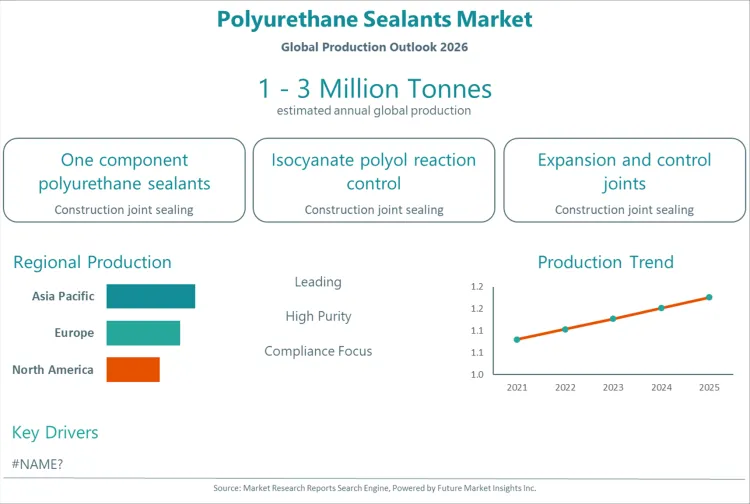
    Global polyurethane sealant production in 2026 is estimated at approximately 1.9 to 2.3 million tonnes, reflecting steady growth supported by construction activity, infrastructure development, and demand for durable elastic sealing solutions. Production trends closely follow building cycles, automotive manufacturing volumes, and industrial assembly requirements.

    Production economics are shaped by isocyanate pricing, polyol availability, additive and filler costs, and energy use in prepolymer synthesis and compounding. One component moisture curing systems dominate volume due to ease of application, while two component systems support higher performance and faster cure requirements. Capacity expansion is typically incremental, focused on formulation line expansion, blending optimisation, and packaging upgrades rather than new isocyanate synthesis.

    Production capability is concentrated in regions with established polyurethane chemical infrastructure and strong downstream construction and manufacturing bases. Asia Pacific anchors a significant share of capacity supported by infrastructure growth and industrialisation. Europe maintains a strong position in high performance and regulated formulations. North America supports steady output aligned with construction, automotive, and industrial maintenance demand. Other regions rely on imports or regional blending facilities.

    Demand growth is supported by commercial and residential construction, transportation assembly, and industrial equipment manufacturing. Buyers prioritise adhesion performance, elasticity, weather resistance, and long term durability.
    Polyurethane Sealants Market

    Key Questions Answered

    • How do isocyanate and polyol price trends influence polyurethane sealant economics?
    • How concentrated is global polyurethane sealant production capacity?
    • How do formulation choices affect performance and cost?
    • How does construction and industrial activity influence utilisation rates?

    Polyurethane Sealant Product Families That Define How Buyers Actually Use It

    Product Classification

    • One component polyurethane sealants
    • Construction joint sealing
    • Window and façade applications
    • General purpose industrial sealing
    • Two component polyurethane sealants
      • Structural glazing
      • Flooring and expansion joints
      • High load industrial applications
    • Low modulus and high elasticity sealants
      • Movement joints
      • Façade and cladding systems
      • Weather sealing
    • Specialty polyurethane sealants
      • Chemical resistant formulations
      • High temperature resistant systems
      • Fast curing industrial grades

    One component systems dominate volume due to simplicity and wide application range. Two component systems are preferred where controlled cure speed and higher mechanical performance are required.

    Key Questions Answered

    • How do buyers choose between one and two component sealants?
    • How does modulus affect joint performance?
    • How do additives influence weather and UV resistance?
    • How do buyers qualify sealants for structural use?

    Polyurethane Sealant Process Routes That Define Cost, Speed and Customer Focus

    Process Classification

    • Prepolymer synthesis
      • Isocyanate polyol reaction control
      • Free isocyanate content management
      • Molecular weight tuning
    • Compounding and formulation
      • Filler and plasticiser incorporation
      • Rheology control
      • Performance optimisation
    • Packaging and moisture protection
      • Cartridge and sausage packaging
      • Shelf life preservation
      • Handling safety
    • Quality testing and batch control
      • Adhesion and elongation testing
      • Cure profile validation
      • Storage stability assessment

    Prepolymer formulation and moisture control define sealant quality. Producers focus on consistency, ease of application, and long shelf life to meet contractor requirements.

    Key Questions Answered

    • How does prepolymer design influence cure speed and elasticity?
    • How do fillers affect cost and performance balance?
    • How do producers ensure shelf stability?
    • How does packaging influence product reliability?

    Polyurethane Sealant End Use Spread Across Key Sectors

    End Use Segmentation

    • Construction and infrastructure
      • Expansion and control joints
      • Façade and glazing systems
      • Flooring and roofing
    • Automotive and transportation
      • Body sealing
      • Interior and exterior joints
      • Vibration and noise control
    • Industrial manufacturing
      • Equipment assembly
      • Machinery sealing
      • Process plant maintenance
    • Marine and specialty applications
      • Deck sealing
      • Structural bonding
      • Water exposure environments

    Construction applications account for the largest share of volume due to widespread use in building joints. Automotive and industrial uses support specification driven demand.

    Key Questions Answered

    • How do building standards influence sealant selection?
    • How do automotive users evaluate vibration resistance?
    • How do industrial users manage chemical exposure?
    • How do buyers assess lifecycle performance?

    Polyurethane Sealant Regional Potential Assessment

    Asia Pacific

    Asia Pacific leads production supported by infrastructure development, urbanisation, and manufacturing growth.

    Europe

    Europe focuses on high performance, low emission, and regulated polyurethane sealant systems.

    North America

    North America maintains steady demand driven by construction renovation, industrial maintenance, and transportation manufacturing.

    Middle East and Other Regions

    These regions show selective growth tied to infrastructure projects and industrial expansion.

    Key Questions Answered

    • How do regional building cycles influence demand?
    • How do regulations affect formulation strategies?
    • How does logistics shape regional supply?
    • How do buyers manage regional sourcing?

    Polyurethane Sealant Supply Chain, Cost Drivers and Trade Patterns

    The supply chain begins with isocyanate and polyol sourcing followed by prepolymer synthesis, compounding, packaging, and distribution to contractors, distributors, and OEMs. End users include construction firms, automotive assemblers, and industrial maintenance providers.

    Key cost drivers include isocyanate pricing, polyol costs, fillers, energy use, packaging, and logistics. Trade flows remain active due to uneven production distribution and project based demand. Long term supplier relationships and qualification driven sourcing dominate procurement.

    Key Questions Answered

    • How do raw material prices affect delivered sealant cost?
    • How does scale influence producer competitiveness?
    • How do logistics affect shelf life and availability?
    • How do buyers benchmark qualified suppliers?

    Polyurethane Sealant Ecosystem View and Strategic Themes

    The ecosystem includes isocyanate and polyol producers, sealant manufacturers, additive suppliers, construction companies, automotive OEMs, distributors, and regulators. Asia Pacific anchors volume demand, while Europe and North America lead in formulation innovation and regulation compliance.

    Strategic themes include low emission formulations, improved weather resistance, faster cure systems, and alignment with sustainability and occupational safety requirements. Supply reliability and performance consistency remain executive priorities.

    Deeper Questions Decision Makers Should Ask

    • How secure is long term access to isocyanates and polyols?
    • How scalable are existing formulation assets?
    • How resilient are operations to regulatory tightening?
    • How differentiated are sealant portfolios by application?
    • How robust are quality and testing systems?
    • How competitive are regional cost structures?
    • How quickly can formulations adapt to new standards?
    • How aligned are suppliers with contractor needs?

    Bibliography

    • PlasticsEurope. (2024). Polyurethane materials: Production structure and regional capacity. PlasticsEurope.
    • Asia Petrochemical Industry Conference. (2024). Polyurethane downstream markets in Asia Pacific. APIC.
    • Confederation of European Construction Industries. (2023). Sealants and adhesives demand in regulated markets. FIEC.

    Frequently Asked Questions

    What is the estimated global polyurethane sealant production volume in 2026?

    Global polyurethane sealant production in 2026 is estimated at approximately 1.9 to 2.3 million tonnes.

    Why are polyurethane sealants widely used in construction?

    They offer strong adhesion, high elasticity, durability, and resistance to weather and movement.

    What are the main cost drivers for polyurethane sealants?

    Key drivers include isocyanate and polyol pricing, fillers, additives, packaging, and energy use.

    How do one component and two component sealants differ?

    One component sealants cure with moisture and are easy to apply, while two component systems offer faster and more controlled curing.

    How do buyers manage supply and performance risk?

    Buyers rely on qualified suppliers, compliance testing, and long term sourcing relationships.

    Key Questions Answered in the Report

    Supply chain and operations

    • How predictable is sealant output given raw material variability?
    • How stable are prepolymer and compounding operations?
    • How consistent are cure and adhesion properties?
    • How resilient are packaging and storage systems?
    • How quickly can capacity be expanded?
    • How are quality deviations managed?
    • How does site location affect distribution efficiency?
    • How scalable are existing assets?

    Procurement and raw material

    • How are isocyanate and polyol contracts structured?
    • How do suppliers manage price volatility?
    • How transparent are cost adjustment mechanisms?
    • What contract duration supports supply continuity?
    • Which suppliers offer regional diversification?
    • How are safety and compliance requirements handled?
    • How do qualification timelines affect sourcing flexibility?
    • How do buyers mitigate supplier concentration risk?

    Technology and innovation

    • Which formulations reduce emissions and odor?
    • How are fast curing systems improving productivity?
    • How do additives improve weather resistance?
    • How are low modulus systems evolving?
    • How do innovations extend service life?
    • How are testing protocols improving reliability?
    • How are partnerships accelerating development?
    • How does digital monitoring improve batch consistency?

    Buyer and application focus

    • Which applications drive polyurethane sealant demand growth?
    • How do contractors qualify sealants for projects?
    • What volumes define standard supply agreements?
    • How do buyers compare polyurethane with alternative sealants?
    • How do channel structures influence delivered cost?
    • How do buyers verify performance claims?
    • How do users manage installation risk?
    • How do application requirements evolve over time?

    Explore Coatings, Inks, Adhesives & Sealants Insights

    View Reports

    Trusted By
    Market Research Reports Search Engine

    Polyurethane Sealants Global Production Capacity and Growth Outlook