Oxygen Concentrator Production and Capacity Outlook
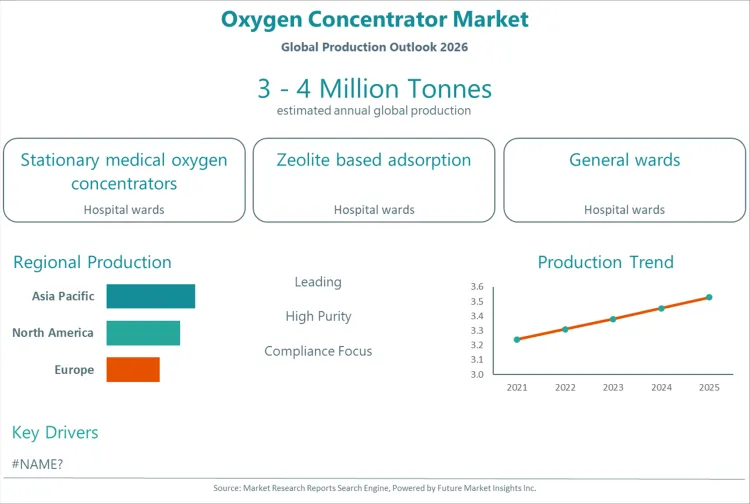
Global oxygen concentrator production capacity in 2026 is estimated at approximately 3 to 4 million units annually, reflecting sustained expansion following structural increases in medical oxygen demand. Capacity growth is driven by hospital infrastructure upgrades, expansion of homecare oxygen therapy and preparedness planning for respiratory health emergencies. Investment focuses on modular assembly lines, compressor reliability improvement and supply chain localisation rather than purely volume driven expansion.
Production leadership remains concentrated in regions with established medical device manufacturing ecosystems, electronics integration capability and regulatory certification infrastructure. Asia Pacific leads global unit production supported by scale manufacturing and cost efficiency. North America maintains strong capacity for high specification hospital and homecare devices. Europe focuses on compliance driven production aligned with stringent medical device regulations. Several regions remain import dependent due to certification barriers and limited component supply depth.
Demand stability is reinforced by ageing populations, chronic respiratory disease prevalence and decentralisation of care into home settings. Buyers prioritise reliability, uptime, serviceability and regulatory compliance.
Key Questions Answered
- How sustainable is post pandemic oxygen concentrator demand growth?
- How do component supply constraints affect production scalability?
- How do regulatory requirements influence manufacturing timelines?
- How resilient is demand across healthcare budget cycles?
Oxygen Concentrator Product Families That Define How Buyers Actually Use Them
Product Classification
- Stationary medical oxygen concentrators
- Hospital wards
- Clinics and long term care facilities
- Continuous oxygen therapy
- Portable oxygen concentrators
- Homecare and ambulatory use
- Travel and mobility support
- Battery operated systems
- High flow oxygen concentrators
- Critical care support
- Emergency preparedness
- Oxygen therapy escalation
- Industrial and non medical concentrators
- Laboratory applications
- Welding and cutting support
- Small scale industrial oxygen needs
Stationary and portable medical concentrators dominate global demand, with portable units showing faster growth due to homecare adoption and patient mobility needs.
Key Questions Answered
- How do buyers choose between stationary and portable systems?
- How do flow rate and purity requirements vary by care setting?
- How does portability affect device performance trade offs?
- How do certification requirements differ by application?
Oxygen Concentrator Technology Routes That Define Cost, Performance and Reliability
Technology Classification
- Pressure swing adsorption systems
- Zeolite based adsorption
- Mature and widely deployed
- Cost efficient operation
- Vacuum swing adsorption systems
- Improved efficiency
- Lower energy consumption
- Higher system complexity
- Advanced molecular sieve materials
- Improved oxygen purity
- Extended service life
- Higher material cost
- Integrated digital control systems
- Flow and purity monitoring
- Predictive maintenance
- Remote diagnostics
Pressure swing adsorption remains the dominant technology due to reliability and cost balance, while incremental improvements focus on efficiency and durability.
Key Questions Answered
- How sensitive device cost is to zeolite material pricing?
- How do compressor reliability and duty cycles affect lifespan?
- How do energy efficiency improvements influence operating cost?
- How do digital systems improve uptime and serviceability?
Oxygen Concentrator End Use Spread Across Healthcare and Industrial Segments
End Use Segmentation
- Hospitals and healthcare facilities
- General wards
- Intensive care units
- Emergency response
- Homecare and long term therapy
- Chronic respiratory disease management
- Elderly care
- Post acute recovery
- Emergency and disaster preparedness
- Mobile healthcare units
- Field hospitals
- Government stockpiles
- Industrial and laboratory use
- Research facilities
- Small scale manufacturing
- Educational institutions
Healthcare applications dominate demand, with homecare and emergency preparedness driving diversification beyond traditional hospital procurement.
Key Questions Answered
- How do healthcare providers evaluate total cost of ownership?
- How does decentralised care influence device demand?
- How do emergency stockpiling strategies affect purchasing cycles?
- How do industrial uses differ in specification requirements?
Oxygen Concentrator Regional Production and Adoption Potential
Asia Pacific
Asia Pacific leads unit production supported by electronics manufacturing scale and growing healthcare access.
North America
North America drives high specification demand tied to homecare, insurance coverage and regulatory standards.
Europe
Europe focuses on compliance driven manufacturing and hospital grade device deployment.
Latin America
Latin America shows rising demand linked to healthcare infrastructure expansion but remains import dependent.
Middle East and Africa
These regions show growing adoption driven by hospital investment and emergency preparedness, with limited local production.
Key Questions Answered
- How do healthcare funding models influence regional demand?
- How do import dependent regions manage supply continuity?
- How do regulatory approval timelines differ by region?
- How does service infrastructure affect adoption?
Oxygen Concentrator Supply Chain, Cost Drivers and Trade Patterns
The oxygen concentrator supply chain spans compressors, molecular sieves, electronics, enclosures and final assembly. Component reliability and certification compliance are critical due to medical device classification.
Key cost drivers include compressor sourcing, sieve material pricing, electronics integration and regulatory compliance expenses. Trade flows connect component manufacturing hubs with final assembly and healthcare markets.
Buyers prioritise service availability, spare parts access and long term supplier reliability.
Key Questions Answered
- How do component shortages affect delivery timelines?
- How do certification requirements shape supplier qualification?
- How do buyers benchmark quality and reliability?
- How do logistics and after sales service influence selection?
Oxygen Concentrator Ecosystem View and Strategic Themes
The ecosystem includes medical device manufacturers, component suppliers, healthcare providers, distributors, service companies and regulators. Demand stability depends on healthcare policy, reimbursement structures and demographic trends.
Strategic themes include localisation of manufacturing, service network expansion, digital monitoring integration and emergency readiness planning.
Deeper Questions Decision Makers Should Ask
- How secure is long term component sourcing?
- How resilient are production lines to demand spikes?
- How scalable are service and maintenance networks?
- How exposed are portfolios to regulatory change?
- How robust are quality management systems?
- How aligned are devices with homecare trends?
- How transparent are safety and performance metrics?
- How quickly can production respond to emergencies?
Bibliography
- World Health Organization. (2024). Oxygen therapy and medical device guidance.
- USA Food and Drug Administration. (2024). Medical oxygen and concentrator regulatory framework.
- International Organization for Standardization. (2024). Medical electrical equipment standards.
Frequently Asked Questions
What is the estimated global oxygen concentrator production volume in 2025?
Global oxygen concentrator production in 2025 is estimated at approximately 3.0 to 4.0 million units, driven by medical and homecare demand.
What are the biggest cost drivers shaping oxygen concentrator pricing?
Pricing is driven by compressor costs, molecular sieve materials, electronics components and regulatory compliance.
How do oxygen concentrators compare with cylinder based oxygen supply?
Oxygen concentrators reduce dependency on cylinder logistics, offering continuous supply with lower long term operating cost.
How do regulations affect oxygen concentrator availability?
Medical device regulations govern certification, quality systems and post market surveillance, influencing time to market.
Which segments drive future oxygen concentrator demand?
Homecare oxygen therapy, ageing populations and emergency preparedness programs are expected to drive growth.