On this page

    Ortho Xylene Pricing Signals and Production Direction

    Global ortho xylene production in 2026 is estimated at approximately 3 to 4 million tonnes, reflecting its role as a key aromatic intermediate primarily consumed in phthalic anhydride production. Output trends closely follow operating rates in aromatics complexes and downstream demand from plasticisers, resins and unsaturated polyester applications.

    Production economics are driven by reformate availability, mixed xylene pool composition, separation efficiency and energy intensity of fractionation. Cost behaviour is strongly influenced by the relative balance among ortho, meta and para xylene streams, since separation decisions affect overall aromatics optimisation rather than ortho xylene alone.

    The global supply environment shows disciplined capacity management rather than rapid expansion. Incremental improvements focus on recovery efficiency, debottlenecking of fractionation units and integration with downstream phthalic anhydride assets. Large scale standalone capacity additions remain limited due to high capital intensity and feedstock integration requirements.

    Production capacity is concentrated in regions with large scale refining and petrochemical infrastructure. Asia Pacific leads global output supported by integrated aromatics complexes and downstream chemical consumption. Europe maintains stable capacity aligned with plasticiser and resin demand. North America supports meaningful production integrated with refinery reformers and chemical manufacturing. Several regions rely on imports due to limited aromatics separation capability.

    Phthalic anhydride production continues to anchor baseline demand, with additional consumption in coatings resins, plasticisers and specialty intermediates. Buyers value consistent purity, predictable supply and alignment with downstream operating schedules.
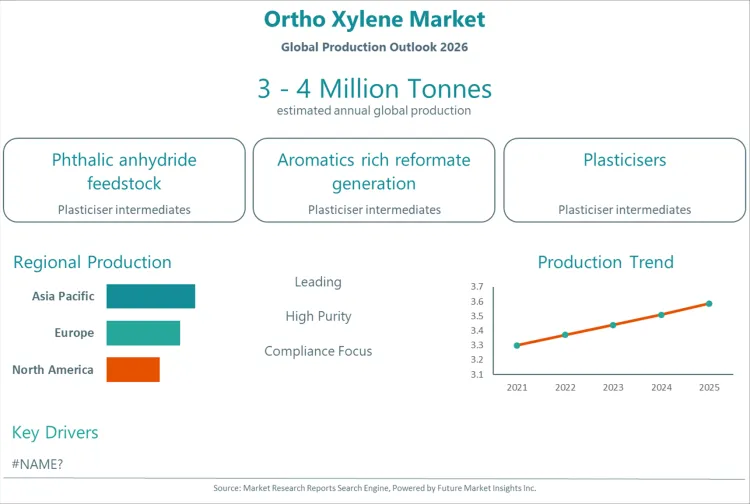
    Ortho Xylene Market

    Key Questions Answered

    • How sensitive is ortho xylene availability to reformer severity and aromatics pool composition?
    • Which cost components dominate during periods of high energy intensity?
    • How do separation tradeoffs between xylene isomers affect effective output?
    • Where do operational constraints limit incremental recovery gains?

    Ortho Xylene Product Role in Downstream Chemical Systems

    Functional Classification

    • Phthalic anhydride feedstock
      • Plasticiser intermediates
      • Unsaturated polyester resins
      • Alkyd resins
    • Specialty chemical intermediates
      • Dyes and pigments
      • Agrochemical synthesis
      • Pharmaceutical intermediates
    • Solvent and formulation uses
      • Limited direct solvent applications
      • Process aids
      • Specialty blends

    The majority of ortho xylene is consumed captively or under contract by phthalic anhydride producers. Direct use as a solvent is limited and highly application specific. Buyers differentiate supply based on isomer purity, sulfur content and trace impurity control.

    Key Questions Answered

    • How tight are impurity tolerances for phthalic anhydride production?
    • When do buyers accept mixed xylene streams instead of purified ortho xylene?
    • Which downstream processes are most sensitive to sulfur and nitrogen traces?

    Ortho Xylene Production Routes That Define Cost and Control

    Process Classification

    • Catalytic reforming
      • Aromatics rich reformate generation
      • Severity driven composition shifts
      • Hydrogen co production
    • Xylene separation and fractionation
      • Distillation based separation
      • Energy intensive operations
      • Yield optimisation tradeoffs
    • Integrated aromatics management
      • Balancing para, meta and ortho streams
      • Downstream unit coordination
      • Inventory management

    Ortho xylene is recovered from mixed xylene streams rather than produced independently. Separation efficiency and energy management are central operational challenges. Integration with downstream consumption improves overall system economics and reduces logistics exposure.

    Key Questions Answered

    • Where do separation losses most commonly occur?
    • How does energy pricing affect fractionation operating decisions?
    • At what point does recovery optimisation conflict with downstream flexibility?

    Ortho Xylene End Use Spread Across Key Sectors

    End Use Segmentation

    • Phthalic anhydride production
      • Plasticisers
      • Unsaturated polyester resins
      • Alkyd coatings
    • Resins and coatings
      • Industrial coatings
      • Construction materials
      • Marine applications
    • Specialty chemicals
      • Dyes and pigments
      • Agrochemical intermediates
      • Fine chemical synthesis

    Phthalic anhydride production dominates volume consumption due to continuous operating requirements. Resin and specialty chemical uses contribute smaller volumes but introduce additional purity and scheduling constraints. Buyers focus on steady supply, predictable composition and long term availability.

    Ortho Xylene Regional Production and Supply Assessment

    Asia Pacific

    Asia Pacific leads global ortho xylene production supported by large scale refining capacity and downstream phthalic anhydride integration.

    Europe

    Europe maintains stable production aligned with plasticiser and resin manufacturing, with limited scope for capacity expansion.

    North America

    North America supports integrated production tied to refinery reformers and chemical complexes.

    Other Regions

    Other regions depend on imports due to limited aromatics separation infrastructure and smaller refining footprints.

    Key Questions Answered

    • How does regional refining capacity shape ortho xylene availability?
    • Which regions face the highest dependency on imports?
    • How do environmental regulations influence aromatics operations?

    Ortho Xylene Supply Chain, Cost Drivers and Trade Flows

    The supply chain begins with crude oil processing followed by catalytic reforming, aromatics extraction, xylene separation, storage and distribution. Downstream buyers include phthalic anhydride producers, resin manufacturers and specialty chemical producers.

    Key cost drivers include crude feedstock quality, reformer operating severity, energy use in fractionation and logistics. Storage and transport costs are moderate but influenced by flammability classification and handling requirements. Trade flows reflect concentration of production in refining hubs supplying downstream chemical regions.

    Pricing formation reflects feedstock economics, energy intensity and contract structure rather than short term volatility.

    Key Questions Answered

    • How do crude slate changes affect mixed xylene composition?
    • How does energy availability influence separation run rates?
    • How do buyers benchmark integrated versus merchant supply?
    • Where does inventory buffering reduce risk versus increase carrying cost?

    Ortho Xylene Ecosystem View and Strategic Themes

    The ecosystem includes refiners, aromatics producers, fractionation operators, phthalic anhydride manufacturers, resin producers and regulators. Production decisions are often optimised at the aromatics pool level rather than for ortho xylene alone.

    Equipment suppliers support reformers, extractive distillation units, fractionation columns and storage systems. Producers coordinate crude selection, operating severity, downstream integration and long term supply arrangements.

    Bibliography

    • European Chemicals Agency. (2024). Xylene regulatory and safety overview.
    • Li, Z., Wang, Y., & Chen, Q. (2024). Energy optimization and yield trade-offs in mixed xylene separation systems. Industrial & Engineering Chemistry Research, 63(18), 7564-7578.
    • Meyer, T., & Hoffmann, J. (2024). Aromatics pool optimization under variable reformer severity conditions. Energy & Fuels, 38(6), 5121-5134.

    Frequently Asked Questions

    What is the estimated global ortho xylene production volume in 2026?

    Global production in 2026 is estimated at approximately 3 to 4 million tonnes, largely driven by phthalic anhydride demand.

    What are the main cost drivers for ortho xylene?

    Costs are driven by crude feedstock quality, reformer operation, energy use in separation and logistics.

    Why is ortho xylene rarely produced independently?

    It is recovered from mixed xylene streams, and production decisions are governed by overall aromatics optimisation.

    How do buyers manage supply continuity risk?

    Buyers rely on integrated supply, inventory buffers and long term agreements aligned with downstream unit operation.

    Key Questions Answered in the Report

    Supply Chain and Operations

    • How predictable is ortho xylene recovery under different reformer severities?
    • Where do fractionation bottlenecks most often limit throughput?
    • How sensitive is output to energy supply disruptions?
    • How frequently do maintenance outages reduce effective recovery rates?
    • How does aromatics pool optimisation affect ortho xylene availability?
    • How much buffer inventory is realistic given storage constraints?
    • How quickly can separation units adjust to downstream demand changes?
    • How dependent is recovery stability on operator experience?
    • Which operational risks increase as fractionation assets age?

    Procurement and Raw Materials

    • How diversified are crude and reformate sourcing strategies?
    • How exposed are operations to changes in crude quality?
    • How flexible are supply contracts during refinery outages?
    • Which impurities most strongly affect downstream chemical units?
    • How do buyers validate upstream operating discipline?
    • Which inputs represent the highest long term sourcing risk?

    Technology and Process Innovation

    • Which separation technologies improve energy efficiency?
    • How does advanced control improve isomer recovery stability?
    • Where can heat integration reduce operating intensity?
    • How effective are digital tools at predicting off spec streams?
    • Which upgrades most meaningfully extend fractionation asset life?
    • How quickly can process changes be validated without disrupting supply?

    Buyer, Channel and Who Buys What

    • Which downstream units require uninterrupted ortho xylene supply?
    • How long does requalification take if purity specifications change?
    • Which users are most exposed to short term supply interruption?
    • Where does substitution with alternative feedstocks remain feasible?
    • How much inventory do downstream users typically hold?
    • Which applications are actively evaluating alternative intermediates?

    Pricing, Contract and Commercial Model

    • How are purity premiums structured across applications?
    • How do contracts address energy driven cost variability?
    • What mechanisms support recovery of efficiency upgrade investment?
    • How do buyers and suppliers share outage related risk?
    • Which contract lengths best support continuous operation?
    • How do agreements differ between captive and merchant supply?

    Plant Assessment and Footprint

    • Which regions remain viable for aromatics expansion over the long term?
    • How do permitting timelines affect future separation capacity?
    • How does site integration influence operational resilience?
    • Which investments most effectively reduce long term energy exposure?
    • How suitable are existing assets for incremental recovery improvement?
    • Where does consolidation improve reliability versus reduce redundancy?

    Explore Hydrocarbons, Petrochemicals, and Organic Chemicals Insights

    View Reports

    Trusted By
    Market Research Reports Search Engine

    Ortho Xylene Global Production Capacity and Growth Outlook