On this page
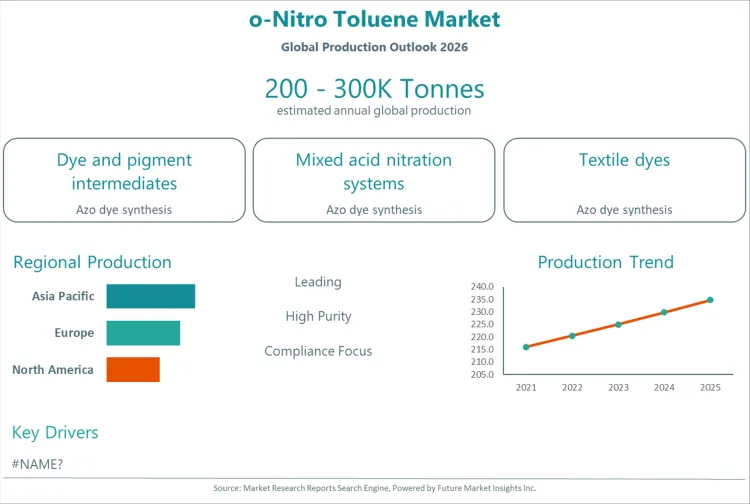
Global o-nitro toluene production in 2026 is estimated at approximately 200 to 300 thousand tonnes, reflecting its role as a positional nitroaromatic intermediate rather than a broadly interchangeable chemical. Output trends are closely tied to demand from dyes, pigments, agrochemical actives and pharmaceutical intermediates that specifically require the ortho isomer.
Production economics are driven by toluene availability, nitric acid input costs, nitration selectivity, heat management and downstream isomer separation efficiency. Cost behavior differs materially across ortho, meta and para nitrotoluene isomers, with o-nitro toluene often carrying higher effective production cost due to selectivity limitations and purification requirements.
The global supply environment shows stable but constrained growth. Capacity expansion is limited by environmental compliance requirements, waste acid handling capacity and safety considerations inherent to nitration chemistry. Incremental improvements tend to focus on yield optimisation, better isomer control and acid recovery rather than new large scale assets.
Production capacity is concentrated in regions with established aromatic nitration infrastructure. Asia Pacific leads global output supported by integrated aromatic chemical complexes and strong downstream consumption. Europe maintains smaller, regulated capacity focused on specialty and pharmaceutical intermediates. North America supports limited production aligned with fine chemicals and agrochemical synthesis. Several regions rely on imports due to restricted nitration capacity and regulatory hurdles.
Dyes, pigments, agrochemical intermediates and pharmaceutical synthesis anchor baseline demand. Buyers prioritise isomer purity, batch consistency and reliable delivery aligned with downstream synthesis schedules.
o-Nitro toluene is primarily valued for its positional specificity. Substitution with meta or para isomers is rarely feasible without redesigning downstream synthesis. Buyers differentiate supply based on ortho content, impurity profile and reproducibility across batches.
Nitration of toluene remains the dominant production route, inherently producing a mixture of isomers. Managing heat release, suppressing dinitration and optimising ortho yield are central operational challenges. Separation efficiency plays a critical role in final product economics.
Dyes and agrochemical intermediates account for the largest volume share due to continuous production requirements. Pharmaceutical uses impose stricter quality, documentation and traceability requirements. Buyers focus on continuity of supply, purity control and regulatory alignment.
Asia Pacific leads global production supported by integrated nitration capacity and strong downstream consumption.
Europe maintains regulated capacity focused on pharmaceutical and specialty chemical intermediates.
North America supports smaller scale production aligned with fine chemical and agrochemical supply chains.
Other regions depend largely on imports due to limited nitration infrastructure and environmental constraints.
The supply chain begins with toluene sourcing followed by nitration, isomer separation, purification, storage and distribution. Downstream buyers include dye manufacturers, agrochemical producers, pharmaceutical companies and specialty chemical formulators.
Key cost drivers include toluene pricing, nitric acid availability, energy use, separation efficiency and waste acid handling. Logistics costs are moderate but influenced by hazardous material classification and permitting requirements. Trade flows reflect concentration of production in Asia Pacific supplying global downstream users.
Pricing formation reflects isomer specificity, purity requirements and contract duration rather than short term volatility.
The ecosystem includes aromatic feedstock suppliers, nitration operators, separation specialists, downstream chemical manufacturers and regulators. Production is concentrated among operators with strong safety management and environmental compliance capability.
Equipment suppliers support nitration reactors, heat exchange systems, acid recovery units and separation columns. Producers coordinate feedstock sourcing, process control, compliance and long term supply relationships.
Global production in 2026 is estimated at approximately 200 to 300 thousand tonnes, driven by dyes, agrochemicals and specialty synthesis.
Costs are driven by toluene availability, nitric acid input, energy use, isomer separation intensity and waste handling requirements.
Many downstream reactions require the ortho position specifically, making substitution with other isomers technically impractical.
Buyers rely on qualified suppliers, inventory buffers and longer term agreements aligned with downstream synthesis cycles.
Explore Hydrocarbons, Petrochemicals, and Organic Chemicals Insights
View Reports
o-Nitro Toluene Global Production Capacity and Growth Outlook

Thank you!
You will receive an email from our Business Development Manager. Please be sure to check your SPAM/JUNK folder too.
