Output Levels, Cost Exposure, and Directional Change
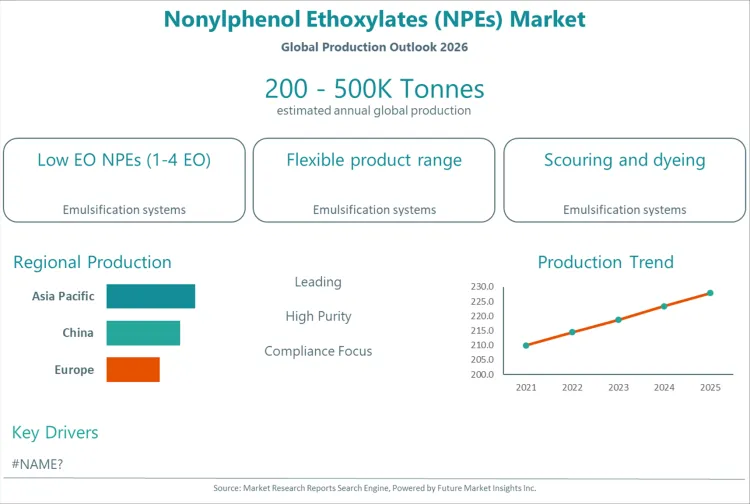
Global NPE output in 2026 is estimated at approximately 200,000 to 500,000 tonnes, reflecting declining use in regulated regions and continued reliance in specific industrial and process-critical applications elsewhere. Production direction is shaped by availability of nonylphenol intermediates, ethylene oxide supply, plant safety constraints, and the pace of regulatory-driven reformulation.
Production capacity remains concentrated among producers with integrated alkylphenol and ethoxylation assets. Asia Pacific accounts for the largest share of remaining output, supported by textile processing, industrial cleaning, and polymer emulsion applications. Europe and parts of North America maintain sharply reduced capacity, largely serving legacy, exempted, or export-oriented uses.
Consumption patterns are increasingly polarised. Buyers prioritise performance reliability, emulsification strength, and compatibility with existing systems, while managing regulatory exposure and long-term substitution planning.
Key Questions Answered
- How quickly is NPE output contracting in regulated regions?
- How does nonylphenol availability affect supply continuity?
- How do compliance costs influence production economics?
- How do substitution timelines affect procurement decisions?
Product Variants and Ethoxylation Profiles That Matter
Product Classification
- Low EO NPEs (14 EO)
- Emulsification systems
- Polymer processing
- Industrial detergency
- Medium EO NPEs (59 EO)
- Textile processing
- Hardsurface cleaning
- Dispersant applications
- High EO NPEs (1015 EO)
- Wetting agents
- Solubilisation systems
- Specialty formulations
- ApplicationSpecific and Custom EO Grades
- Tailored cloud point
- Controlled hydrophiliclipophilic balance
- Processqualified products
Medium EO grades account for the largest share of usage due to balanced performance. Buyers focus on EO distribution consistency, cloud point control, and batch reproducibility.
Key Questions Answered
- How does EO chain length influence detergency and wetting?
- How do users select EO ranges by application?
- How does EO distribution affect formulation stability?
- How do custom grades reduce process disruption?
Reaction Pathways and Control Methods That Shape Quality
Process Classification
- Batch Ethoxylation
- Flexible product range
- Variable EO distribution
- Lower capital intensity
- Continuous Ethoxylation
- Improved consistency
- Higher throughput
- Reduced batch variability
- Catalyst and Reaction Control Systems
- Narrower EO distribution
- Reduced byproducts
- Enhanced reproducibility
- PostReaction Finishing and Purification
- Neutralisation
- Stripping and filtration
- Stability enhancement
Process control plays a critical role in limiting free nonylphenol content and ensuring repeatable performance. Buyers favour producers with strong analytical monitoring and safety systems.
Key Questions Answered
- How do catalysts influence EO distribution?
- How is free nonylphenol minimised?
- How do process routes affect batch variability?
- How does finishing influence storage stability?
Application Footprint Across Downstream Uses
End Use Segmentation
- Textile Processing
- Scouring and dyeing
- Wetting and detergency
- Emulsification of finishes
- Industrial and Institutional Cleaning
- Heavyduty cleaners
- Degreasers
- Surface preparation
- Polymer and Resin Processing
- Emulsion polymerisation
- Latex stabilisation
- Additive dispersion
- Agrochemical and Specialised Uses
- Emulsifiable concentrates
- Formulation aids
- Process surfactants
Textiles and polymer processing remain the most resistant to substitution due to performance sensitivity, while cleaning applications show higher replacement rates.
Key Questions Answered
- Which applications face the highest substitution pressure?
- How do users manage reformulation risk?
- How do performance gaps affect replacement surfactants?
- How do legacy systems delay transition?
Regional Exposure and Regulatory Contrast
Asia Pacific
Asia Pacific maintains the largest share of NPE usage due to ongoing textile, polymer, and industrial activity, though regulatory oversight is increasing.
China
China remains a major producer and user, with growing emphasis on controlled use and gradual substitution in selected applications.
Europe
Europe has largely phased out NPEs except for restricted, exempted, or export-related uses under strict regulatory frameworks.
North America
North America supports limited NPE production, primarily for industrial, polymer, and export-oriented applications.
Latin America, Middle East, and Africa
These regions continue to use NPEs in industrial and textile processing, with regulatory structures evolving at different speeds.
Key Questions Answered
- How do regional regulations affect continued use?
- How does export demand influence production location?
- How do compliance timelines differ by region?
- How does enforcement consistency affect supply planning?
Value Chain Structure, Cost Levers, and Movement of Supply
The NPE value chain begins with nonylphenol production, followed by ethoxylation, finishing, packaging, and distribution to industrial users. Key cost levers include nonylphenol pricing, ethylene oxide availability, safety compliance, and waste management requirements.
Movement of supply is increasingly regionalised due to regulatory constraints, with cross-border shipments focused on regions with permitted or transitional uses.
Key Questions Answered
- How do nonylphenol price movements affect finished costs?
- How does regulatory compliance influence logistics?
- How do buyers evaluate permitted versus restricted supply?
- How do disposal and waste rules affect operating costs?
Ecosystem Dynamics and Strategic Considerations
The NPE ecosystem includes alkylphenol producers, ethoxylation operators, formulators, industrial users, distributors, and regulators. Long-term reliability depends on regulatory awareness, substitution readiness, and controlled use management.
Strategic considerations include phased exit planning, development of alternative surfactant systems, investment in compliance monitoring, and alignment with customer transition timelines.
Deeper Questions Decision Makers Should Ask
- How exposed is the business to regulatory phaseouts?
- How concentrated is remaining NPE supply?
- How resilient are operations to sudden compliance changes?
- How prepared are customers for substitution?
- How defensible are current applications?
- How credible are stewardship and control programs?
- How stable is short to mediumterm demand visibility?
- How aligned are suppliers and users on transition planning?
Bibliography
- World Health Organization. (2024). Nonylphenol and nonylphenol ethoxylates: health and environmental risk evaluation. WHO Environmental Health Criteria Update.
- European Environment Agency. (2024). Aquatic toxicity and persistence of alkylphenol surfactants. EEA Industrial Chemicals Assessment.
- USA National Toxicology Program. (2024). Endocrine activity and chronic exposure assessment of nonylphenol compounds. NTP Toxicological Review.
- CESIO. (2024). Surfactant stewardship and substitution guidance.
Frequently Asked Questions
What is the estimated global NPE output in 2026?
Global output in 2026 is estimated at approximately 200,000-500,000 tonnes, with usage increasingly concentrated in industrial and regulated-exempt applications.
Why are NPEs under regulatory pressure?
NPEs degrade into nonylphenol, which is persistent and toxic to aquatic life, leading to restrictions in many regions.
Which applications still rely heavily on NPEs?
Textile processing, polymer emulsions, and certain industrial cleaning applications remain highly dependent due to performance characteristics.
How do alternatives compare with NPEs?
Alcohol ethoxylates and other non-phenolic surfactants offer better environmental profiles but may require reformulation and higher dosages.
How do buyers manage transition risk?
Buyers use phased substitution, dual qualification, controlled-use strategies, and close collaboration with suppliers.