On this page

    Nitro Chloro Benzene Pricing Signals and Production Direction

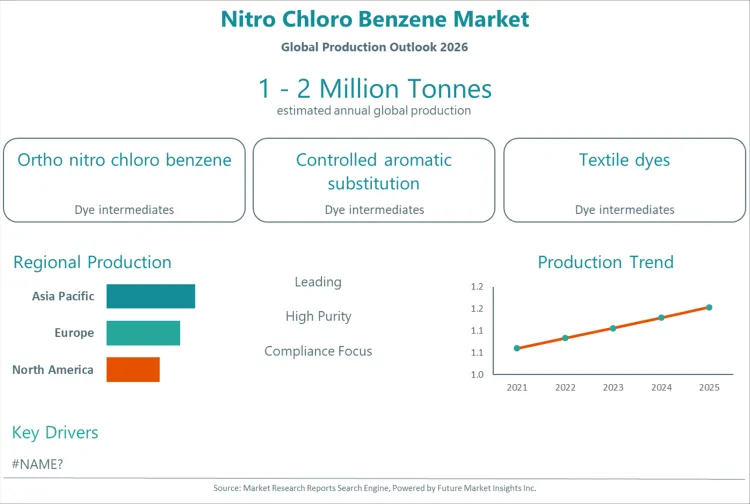
    Global nitro chloro benzene production in 2026 is estimated at approximately 1.5 to 2 Million tonnes, reflecting its position as a critical aromatic intermediate rather than a finished chemical. Output trends closely follow downstream synthesis activity in dyes, pigments, crop protection actives and pharmaceutical intermediates.

    Production economics are driven by benzene availability, chlorine and nitric acid input costs, reaction selectivity, heat management and isomer separation intensity. Cost behavior varies significantly across ortho, meta and para isomers due to different downstream demand profiles and purification requirements. Capacity expansion remains incremental, with producers prioritising yield optimisation, safety upgrades and waste acid recovery improvements over large scale greenfield investment.

    The global supply environment shows steady but uneven expansion. Effective output is often constrained by environmental compliance requirements, waste handling capacity and maintenance cycles in nitration units. Demand visibility remains relatively stable because nitro chloro benzene is embedded in multi step synthesis routes where substitution is complex and rarely immediate.

    Production capacity is concentrated in regions with established aromatic chemistry and nitration infrastructure. Asia Pacific leads global output supported by integrated chemical complexes and proximity to downstream consumers. Europe maintains smaller but regulated capacity focused on specialty and pharmaceutical intermediates. North America supports limited production aligned with fine chemicals and regulated applications. Several regions rely on imports due to strict environmental constraints and limited nitration capability.

    Dyes, pigments, agrochemical intermediates, rubber chemicals and pharmaceutical synthesis continue to anchor baseline demand. Buyers prioritise isomer consistency, impurity control and delivery reliability over short term cost advantages.
    Nitro Chloro Benzene Market

    Key Questions Answered

    • How sensitive is nitro chloro benzene output to benzene, chlorine and nitric acid availability?
    • At what operating rates do heat management and selectivity constraints emerge?
    • How much cost variability is driven by environmental compliance rather than feedstocks?
    • How do maintenance cycles affect effective annual output versus nameplate capacity?

    Nitro Chloro Benzene: Isomer Families That Define How Buyers Actually Use It

    Product Classification

    • Ortho nitro chloro benzene
    • Dye intermediates
    • Rubber chemical synthesis
    • Specialty aromatic derivatives
    • Meta nitro chloro benzene
    • Pharmaceutical intermediates
    • Fine chemical synthesis
    • Controlled reaction pathways
    • Para nitro chloro benzene
    • Pigment intermediates
    • Agrochemical synthesis
    • Polymer additive precursors
    • Technical and mixed isomer grades
    • Cost sensitive applications
    • Further downstream separation
    • Non critical purity uses

    Para and ortho isomers represent the largest share of global consumption due to broader downstream use. Meta isomer volumes are smaller but require higher purity and tighter documentation. Buyers differentiate products based on isomer ratio stability, trace impurity profiles and batch to batch reproducibility.

    Key Questions Answered

    • How tightly must isomer ratios be controlled to avoid downstream inefficiencies?
    • When do buyers accept technical grade material instead of separated isomers?
    • Which applications are most sensitive to trace impurity carryover?
    • How often are isomer specifications requalified by downstream users?

    Nitro Chloro Benzene: Process Routes That Define Cost, Selectivity and Risk

    Process Classification

    • Benzene chlorination
    • Controlled aromatic substitution
    • Catalyst and temperature sensitive reactions
    • Benefits from upstream integration
    • Nitration processes
    • Mixed acid nitration systems
    • High heat release reactions
    • Selectivity driven operation
    • Isomer separation and purification
    • Fractional distillation
    • Crystallisation and filtration
    • Energy intensive operations

    Nitration of chlorinated benzene remains the dominant production route. Process safety, heat removal and acid recovery are central operational challenges. Older assets face increasing pressure to upgrade control systems and waste handling infrastructure to maintain compliance.

    Key Questions Answered

    • Where do yield losses and by product formation concentrate?
    • How does heat management affect selectivity and uptime?
    • How efficient are acid recovery systems at scale?
    • At what point does separation energy demand outweigh synthesis efficiency gains?

    Nitro Chloro Benzene: End Use Spread Across Key Sectors

    End Use Segmentation

    • Dyes and pigments
    • Textile dyes
    • Organic pigments
    • Printing and coatings colorants
    • Agrochemical intermediates
    • Herbicide synthesis
    • Fungicide intermediates
    • Crop protection chemistry
    • Pharmaceuticals and fine chemicals
    • Active ingredient synthesis
    • Controlled intermediates
    • Regulated production chains
    • Rubber and specialty chemicals
      • Antioxidants
      • Accelerators
      • Polymer modification

    Dyes and agrochemical intermediates account for the largest volume share due to continuous synthesis requirements. Pharmaceutical applications impose stricter purity, traceability and documentation standards. Buyers focus on supply continuity, regulatory alignment and long term reliability.

    Nitro Chloro Benzene: Regional Production and Supply Assessment

    Asia Pacific

    Asia Pacific leads global production supported by integrated aromatic chemical infrastructure and strong downstream demand.

    Europe

    Europe maintains regulated capacity focused on specialty and pharmaceutical intermediates, with limited scope for expansion.

    North America

    North America supports smaller scale production aligned with fine chemicals and pharmaceutical synthesis.

    Other Regions

    Other regions rely largely on imports due to environmental restrictions and lack of nitration infrastructure.

    Key Questions Answered

    • How do environmental regulations shape regional production concentration?
    • Which regions face the highest dependency on imports?
    • How resilient are import dependent regions to logistics disruption?

    Nitro Chloro Benzene Supply Chain, Cost Drivers and Trade Flows

    The nitro chloro benzene supply chain begins with benzene sourcing followed by chlorination, nitration, isomer separation, storage and distribution. Downstream buyers include dye manufacturers, agrochemical producers, pharmaceutical companies and specialty chemical formulators.

    Key cost drivers include benzene pricing, chlorine and nitric acid costs, energy use, waste acid recovery efficiency and regulatory compliance expenses. Logistics costs are moderate but influenced by hazardous material handling and permitting requirements. Trade flows reflect production concentration in Asia Pacific supplying global downstream users.

    Pricing formation reflects isomer specificity, purity requirements and contract duration rather than short term volatility. Buyers often favour longer term agreements to protect synthesis continuity.

    Key Questions Answered

    • How do feedstock price shifts translate into delivered cost?
    • How does waste acid handling capacity constrain throughput?
    • How do buyers benchmark domestic versus imported isomer grades?
    • Where does inventory buffering reduce risk versus create exposure?

    Nitro Chloro Benzene: Ecosystem View and Strategic Themes

    The nitro chloro benzene ecosystem includes aromatic feedstock suppliers, chlorination and nitration operators, separation specialists, downstream chemical manufacturers and regulators. Production remains concentrated among operators with strong process safety and environmental management capability.

    Equipment providers support nitration reactors, heat exchange systems, acid recovery units and separation columns. Producers coordinate feedstock sourcing, process control, regulatory compliance and long term customer relationships.

    Bibliography

    • Li, X., Zhang, Y., & Chen, L. (2024). Isomer distribution control and separation strategies for nitrochlorobenzenes. Separation and Purification Technology, 336, 123448.
    • International Labour Organization. (2024). Occupational safety in high-hazard chemical reaction systems. ILO.
    • Nowak, P., & Klein, T. (2024). Environmental constraints and operating reliability in legacy nitration units. Journal of Loss Prevention in the Process Industries, 89, 104312.
    • American Chemistry Council. (2024). Responsible handling of nitration and chlorination intermediates. ACC.

    Frequently Asked Questions

    What is the estimated global nitro chloro benzene production volume in 2026?

    Global nitro chloro benzene production in 2026 is estimated at approximately 1.5 to 2 million tonnes, supported by dyes, agrochemicals and specialty synthesis.

    What are the main cost drivers for nitro chloro benzene production?

    Costs are driven by benzene availability, chlorine and nitric acid inputs, energy use, isomer separation intensity and environmental compliance.

    Why is isomer control critical for nitro chloro benzene?

    Different isomers are required for specific downstream reactions, and deviations can disrupt yields and product quality.

    How do regulations affect production location?

    Strict controls on nitration chemistry, waste acid handling and emissions limit capacity expansion in many regions.

    How do buyers manage supply continuity risk?

    Buyers rely on qualified suppliers, inventory buffers and longer term agreements aligned with downstream synthesis cycles.

    Key Questions Answered in the Report

    Supply chain and operations

    • How predictable is isomer yield under variable operating conditions?
    • How robust are heat removal and emergency control systems?
    • How often are waste handling systems capacity constrained?
    • How quickly can production restart after an unplanned shutdown?

    Procurement and raw materials

    • How diversified are benzene, chlorine and nitric acid sourcing contracts?
    • How do suppliers document long term isomer consistency?

    Technology and innovation

    • Which reactor designs improve selectivity and safety?
    • How does heat integration reduce energy intensity without increasing risk?

    Buyer, channel and who buys what

    • Which applications require single isomer sourcing?
    • Where does mixed isomer use remain acceptable?

    Pricing, contract and commercial model

    • How are isomer premiums justified during feedstock disruption?
    • How do contracts address regulatory driven cost escalation?

    Plant assessment and footprint

    • Which sites support compliant nitration at scale?
    • How does workforce experience influence safety and reliability outcomes?

    Explore Hydrocarbons, Petrochemicals, and Organic Chemicals Insights

    View Reports

    Trusted By
    Market Research Reports Search Engine

    Nitro Chloro Benzene Global Production Capacity and Growth Outlook