On this page
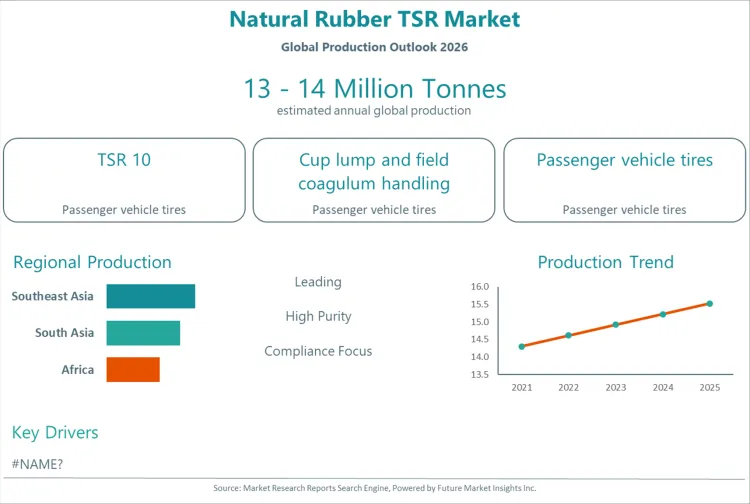
Global technically specified rubber production in 2026 is estimated at approximately 13 to 14 million tonnes, representing the dominant share of total natural rubber output. TSR has become the preferred form of natural rubber for industrial users due to its consistency, traceability, and suitability for automated tire and rubber goods manufacturing.
Production growth follows long term expansion in global vehicle fleets, replacement tire demand, and industrial rubber consumption rather than short term swings. Unlike sheet rubber, TSR production is highly dependent on centralised processing facilities that aggregate field coagulum, cup lump, and latex from multiple plantations. Price behaviour reflects plantation output, weather patterns, inventory levels, and tire manufacturing demand.
Production leadership remains concentrated in Southeast Asia, where integrated plantation networks and processing infrastructure support large scale TSR output. Thailand, Indonesia, Vietnam, Malaysia, and India account for the majority of global capacity. Africa and Latin America are expanding TSR production but remain secondary suppliers. Most consuming regions remain structurally import dependent.
Tire manufacturers anchor baseline demand and prioritise predictable physical properties, contamination control, and long term supply reliability.
TSR 10 and TSR 20 represent the majority of global volume due to broad acceptance in tire manufacturing. Low dirt and specialty grades serve applications requiring tighter cleanliness and performance control. Blended grades allow processors to deliver consistent properties across variable plantation inputs.
Centralised crumb rubber processing is the defining feature of TSR production. Processing efficiency and quality discipline directly affect yield, operating cost, and buyer acceptance. Automation and laboratory control improve consistency but increase capital intensity.
Buyers value specification stability, traceability, and predictable processing behaviour over rapid volume expansion.
Tire manufacturing dominates TSR consumption due to automation requirements and performance consistency. Industrial and engineered rubber applications provide diversification and steady demand tied to infrastructure and manufacturing activity.
Southeast Asia dominates TSR production supported by dense plantation networks and large scale crumb rubber facilities.
South Asia maintains significant TSR capacity focused on domestic tire consumption and selective exports.
Africa shows increasing TSR investment driven by plantation expansion and processing upgrades.
Latin America contributes smaller but growing volumes supported by modern processing facilities.
Europe, North America, and East Asia remain structurally import dependent.
TSR supply begins with plantation collection, followed by centralised processing, grading, baling, and export logistics. Products are shipped in standardised bales to tire manufacturers and industrial processors. Trade flows are global, with Southeast Asia supplying all major consuming regions.
Labor availability, plantation productivity, processing yield, energy use, quality control costs, and logistics dominate cost structure. Inventory management plays a critical role due to agricultural seasonality and shipping lead times.
The TSR ecosystem includes smallholder farmers, plantation operators, processing companies, traders, tire manufacturers, industrial users, logistics providers, and regulators. Southeast Asia anchors supply, while global tire producers shape quality and sustainability requirements.
Traceability, deforestation controls, and social compliance are increasingly central to TSR sourcing. Long term supply agreements and productivity improvement programs aim to stabilise output and improve plantation economics.
Global TSR production in 2025 is estimated at approximately 13 to 14 million tonnes, representing the majority of natural rubber output.
Pricing is driven by plantation yield, labor availability, processing efficiency, quality control costs, logistics, and tire demand.
TSR offers better consistency, automation compatibility, and traceability for modern manufacturing.
Deforestation rules, labor standards, and traceability requirements increasingly influence supplier selection.
Buyers rely on diversified sourcing, long term contracts, inventory buffers, and sustainability aligned partnerships.
Explore Polymers & Plastics Insights
View Reports
Natural Rubber TSR Global Production Capacity and Growth Outlook

Thank you!
You will receive an email from our Business Development Manager. Please be sure to check your SPAM/JUNK folder too.
