On this page
Global natural rubber production in 2026 is estimated at approximately 15 to 17 million tonnes, reflecting structurally steady growth aligned with tire manufacturing, automotive output, and replacement demand rather than short term cyclical expansion. Natural rubber remains a strategically important agricultural raw material with limited synthetic substitution in performance critical applications, particularly in tires and heavy duty rubber goods.
Supply growth is driven by long term vehicle parc expansion, infrastructure development, and industrial rubber consumption. At the same time, production is constrained by biological growth cycles, climate exposure, land availability, and labor intensity. Price formation reflects a balance between plantation output, weather patterns, disease risk, inventory levels, and downstream tire demand.
Production leadership remains highly concentrated in Southeast Asia, where climatic conditions and established plantation infrastructure support large scale output. Thailand, Indonesia, Vietnam, Malaysia, and India dominate global supply. Africa and Latin America contribute smaller but growing volumes. Most consuming regions remain import dependent due to climatic limitations.
Tire manufacturing continues to anchor baseline demand. Buyers value consistent quality, predictable physical properties, and long term supply reliability.
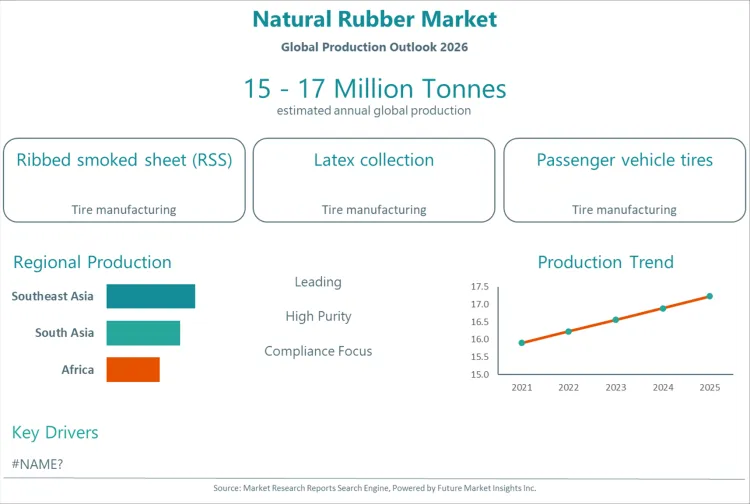
Technically specified rubber represents the largest share of global consumption due to consistency requirements in tire manufacturing. RSS grades continue to serve regional and specialty demand. Latex concentrate supports medical, hygiene, and adhesive applications where elasticity and purity are critical.
Production technology is relatively mature, but operational efficiency varies widely based on plantation practices, processing discipline, and quality control. Centralised processing and blending improve consistency for industrial buyers but increase logistics complexity.
Buyers prioritise consistency, traceability, and contamination control over speed of output expansion.
Tires dominate natural rubber consumption due to performance requirements that synthetic alternatives cannot fully replicate. Industrial and medical uses provide diversification, while consumer goods demand follows income and population growth trends.
Southeast Asia dominates global production supported by climate suitability, established plantations, and processing infrastructure.
South Asia maintains significant production, particularly in India, focused on domestic consumption and specialty grades.
Africa shows long term growth potential supported by land availability and investment in plantation development.
Latin America contributes smaller volumes with potential expansion tied to sustainable agriculture initiatives.
Europe, North America, and East Asia remain structurally import dependent.
Natural rubber supply begins with plantation harvesting, followed by primary processing, grading, baling, and export logistics. Products are shipped in bales or blocks to tire manufacturers and industrial processors. Downstream buyers include tire producers, rubber goods manufacturers, and medical product companies.
Labor availability, plantation productivity, processing yield, logistics costs, and inventory management dominate cost structure. Trade flows are global, with Southeast Asia exporting to all major consuming regions.
The natural rubber ecosystem includes smallholder farmers, plantation owners, processors, traders, tire manufacturers, industrial users, logistics providers, and regulators. Southeast Asia anchors supply, while global tire producers shape demand patterns.
Sustainability certification, traceability, and deforestation controls are becoming increasingly important. Producers and buyers are aligning on long term sourcing agreements to stabilise supply and improve plantation productivity.
Global natural rubber production in 2025 is estimated at approximately 15 to 17 million tonnes, dominated by Southeast Asian supply.
Pricing is shaped by labor costs, plantation yield, weather conditions, disease risk, logistics, and tire demand.
Rubber trees require specific climatic conditions that limit viable cultivation regions.
Deforestation rules, traceability requirements, and labor standards increasingly influence buyer sourcing decisions.
Buyers use diversified sourcing, long term contracts, inventory buffers, and sustainability aligned partnerships.
Explore Polymers & Plastics Insights
View Reports
Natural Rubber Global Production Capacity and Growth Outlook

Thank you!
You will receive an email from our Business Development Manager. Please be sure to check your SPAM/JUNK folder too.
