On this page

    n-Propanol Price and Production Outlook

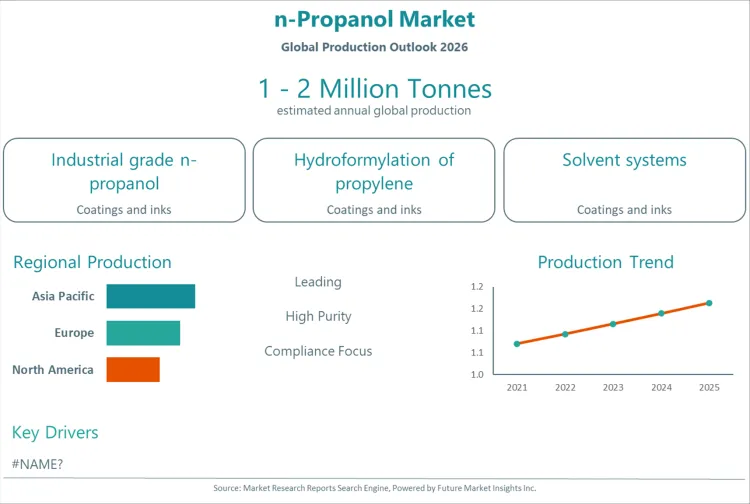
    Global n-propanol production in 2026 is estimated at approximately 1 to 2 million tonnes, reflecting stable growth aligned with solvent demand, chemical synthesis requirements, and specialty application expansion. n-Propanol is a mature oxo alcohol with established end uses, and capacity development tends to follow downstream consumption rather than speculative investment cycles.

    Supply growth is driven by steady demand from coatings, inks, pharmaceuticals, agrochemicals, and intermediate synthesis. Production economics balance relatively predictable demand against exposure to propylene availability, synthesis gas pricing, and energy costs. Capacity additions are typically incremental, focused on debottlenecking existing oxo alcohol units or integrating with broader alcohol portfolios.

    Production leadership remains concentrated in regions with integrated petrochemical infrastructure and access to propylene feedstock. Asia Pacific leads output supported by chemical manufacturing scale. Europe maintains capacity oriented toward high purity and regulated uses. North America supports balanced production tied to industrial and pharmaceutical demand. Other regions remain import dependent due to limited oxo capacity.

    Industrial and specialty solvent applications continue to support baseline demand growth. Buyers value consistent purity, stable solvency performance, and reliable long term supply.
    N Propanol Market

    Key Questions Answered

    • How scalable is propylene supply for npropanol production?
    • How do oxo process economics influence output planning?
    • How do energy costs affect production viability?
    • How do logistics constraints affect regional availability?

    n-Propanol: Product Families that Define How Buyers Actually Use It

    Product Classification

    • Industrial grade npropanol
    • Coatings and inks
    • Chemical synthesis
    • Cleaning formulations
    • Pharmaceutical and cosmetic grade npropanol
    • Drug formulation solvents
    • Personal care processing
    • Laboratory and specialty grade npropanol
    • Analytical applications
    • High purity processing

    Industrial grade n-propanol represents the largest share of consumption due to its role as a versatile solvent and intermediate. Pharmaceutical and cosmetic grades require tighter impurity control, traceability, and regulatory compliance, which limits supplier interchangeability.

    Specialty grades serve lower volume applications where purity and consistency are critical to performance.

    Key Questions Answered

    • How do buyers distinguish industrial and pharmaceutical grades?
    • How do purity specifications vary by end use?
    • How does water content affect solvency performance?
    • How do specialty grades influence sourcing strategies?

    n-Propanol: Process Routes That Define Cost, Speed and Customer Focus

    Process Classification

    • Oxo synthesis routes
    • Hydroformylation of propylene
    • Aldehyde hydrogenation
    • Hydrogenation integration systems
    • Alcohol separation
    • Product purification
    • Byproduct recovery and refining
    • Isomer separation
    • Solvent recycling
    • Integrated oxo alcohol complexes
      • Shared utilities
      • Feedstock optimisation

    Oxo synthesis remains the dominant production route due to scalability and integration with propylene value chains. Process efficiency, catalyst performance, and hydrogen availability influence yield stability and operating cost.

    Technology selection affects energy intensity, byproduct handling, and achievable purity levels. Buyers benefit from predictable performance and supply consistency rather than rapid output flexibility.

    Key Questions Answered

    • How sensitive is npropanol cost to propylene pricing?
    • How do catalyst systems affect yield and selectivity?
    • How does purification impact pharmaceutical grade supply?
    • How does integration reduce total system cost?

    n-Propanol: End Use Spread Across Key Sectors

    End Use Segmentation

    • Coatings, inks, and adhesives
      • Solvent systems
      • Formulation stability
    • Pharmaceuticals and healthcare
      • Drug manufacturing
      • Disinfection applications
    • Chemical intermediates
      • Ester synthesis
      • Specialty chemical production
    • Cosmetics and personal care
      • Processing solvent
      • Formulation aid
    • Laboratory and analytical uses
      • Testing and research

    Coatings and chemical synthesis dominate consumption due to continuous industrial demand. Pharmaceutical and personal care uses account for smaller volumes but higher value due to purity and compliance requirements.

    Key Questions Answered

    • How do formulators select npropanol versus alternatives?
    • How do pharmaceutical users ensure compliance?
    • How do chemical producers manage solvent recovery?
    • How do specialty applications affect qualification timelines?

    n-Propanol: Regional Potential Assessment

    Asia Pacific

    Asia Pacific leads global production supported by integrated oxo alcohol capacity and expanding chemical manufacturing.

    Europe

    Europe maintains established capacity focused on high purity, pharmaceutical, and regulated applications.

    North America

    North America supports balanced production aligned with coatings, healthcare, and industrial demand.

    Middle East

    The Middle East shows limited production with some integration potential linked to propylene availability.

    Latin America and Africa

    These regions remain largely import dependent due to limited oxo alcohol infrastructure.

    Key Questions Answered

    • How does regional propylene availability shape competitiveness?
    • How do regulations influence production location decisions?
    • How do import dependent regions manage supply continuity?
    • How does logistics access affect delivered cost?

    n-Propanol Supply Chain, Cost Drivers and Trade Patterns

    n-Propanol supply begins with propylene sourcing, followed by oxo synthesis, hydrogenation, purification, storage, and distribution. Products are transported in bulk tanks, drums, or ISO containers depending on grade and end use.

    Propylene pricing, energy consumption, catalyst replacement, plant utilisation, and logistics reliability dominate cost structure. Trade flows support regions without local oxo capacity, particularly for pharmaceutical and specialty grades.

    Key Questions Answered

    • How does propylene pricing influence npropanol competitiveness?
    • How do utilisation rates affect unit economics?
    • How do packaging and transport choices shape delivered cost?
    • How do buyers benchmark domestic versus imported supply?

    n-Propanol: Ecosystem View and Strategic Themes

    The n-propanol ecosystem includes propylene suppliers, oxo alcohol producers, solvent formulators, pharmaceutical manufacturers, chemical processors, distributors, and regulators. Asia Pacific drives volume growth, while Europe sets quality and compliance standards.

    Equipment providers support reactors, distillation columns, hydrogen systems, and safety infrastructure. Producers coordinate feedstock sourcing, quality assurance, and long term offtake agreements.

    Deeper Questions Decision Makers Should Ask

    • How secure is long term propylene access?
    • How diversified are oxo production assets?
    • How bankable are long term supply contracts?
    • How resilient are operations to energy price changes?
    • How scalable are existing facilities?
    • How quickly are efficiency gains being realised?
    • How robust are quality and audit systems?
    • How aligned are producers with downstream demand trends?

    Bibliography

    • United States Energy Information Administration. (2024). Propylene supply, steam cracking, and petrochemical feedstocks. USA Department of Energy.
    • International Energy Agency. (2024). Energy intensity and cost drivers in petrochemical and oxo alcohol production. IEA Industrial Energy Analysis.
    • Organisation for Economic Co-operation and Development. (2023). Petrochemical value chains, feedstock exposure, and cost structures. OECD Environment, Health and Safety Publications.
    • World Health Organization. (2022). Concise international chemical assessment document: Propanols. WHO Chemical Safety Series.

    Frequently Asked Questions

    What is the estimated global n-propanol production volume in 2025?

    Global n-propanol production in 2025 is estimated at approximately 1 to 2 million tonnes, reflecting steady growth aligned with solvent and pharmaceutical demand.

    What are the biggest cost drivers that shape n-propanol pricing?

    Pricing is primarily shaped by propylene feedstock costs, energy consumption, catalyst systems, plant utilisation, and logistics expenses.

    How do capacity constraints affect n-propanol availability across regions?

    Regions without integrated oxo alcohol capacity rely on imports and face higher exposure to logistics costs and supply disruptions.

    How do regulations influence n-propanol demand?

    Pharmaceutical, cosmetic, and safety regulations increase demand for high purity grades and influence supplier qualification processes.

    How do buyers choose between n-propanol and alternative solvents?

    Buyers evaluate solvency performance, evaporation rate, compatibility, regulatory acceptance, and supply reliability rather than price alone.

    Key Questions Answered in the Report

    Supply chain and operations

    • How predictable is output given propylene variability?
    • How much buffer inventory supports continuity?
    • How stable is plant uptime?
    • How effective are safety and monitoring systems?
    • How quickly can capacity be adjusted?
    • How dependable are logistics routes?
    • How does site location affect feedstock access?
    • How are contingency risks managed?

    Procurement and raw material

    • How is propylene pricing structured contractually?
    • How do suppliers ensure consistent purity?
    • How does grade specification vary by application?
    • What contract duration supports asset planning?
    • How do buyers mitigate feedstock volatility?
    • Which suppliers offer multi region sourcing?
    • How are compliance requirements handled?
    • How do onboarding processes differ by region?

    Technology and innovation

    • Which catalyst improvements reduce energy use?
    • How effective are digital systems in optimising output?
    • How does purification improve product consistency?
    • How are producers validating new grades?
    • How do plants improve waste handling?
    • How are safety systems evolving?
    • How do materials extend equipment life?
    • How are partnerships accelerating deployment?

    Buyer, channel and who buys what

    • Which sectors adopt npropanol first?
    • How do formulators integrate it into products?
    • How do pharmaceutical users assess supply reliability?
    • What volumes define standard offtake agreements?
    • How do buyers choose between domestic and imported supply?
    • How do channel structures influence delivered cost?
    • How do buyers verify quality claims?
    • How do users manage operational risk?

    Pricing, contract and commercial model

    • What reference points guide npropanol pricing?
    • How frequent are feedstock linked adjustments?
    • How do pricing reviews support long term visibility?
    • How do buyers compare npropanol versus alternatives?
    • What contract duration ensures project viability?
    • How are disputes managed across jurisdictions?
    • What incentives support capacity upgrades?
    • How do contracts differ by application?

    Plant assessment and footprint

    • Which regions maintain reliable propylene availability?
    • What investment levels define commercial scale projects?
    • How do permitting and environmental rules shape site selection?
    • How suitable are industrial hubs for npropanol integration?
    • How consistent are utility conditions?
    • How do plants manage safety and regulatory audits?
    • How do skills and workforce readiness affect operations?
    • How suitable are logistics links for solvent distribution?

    Explore Hydrocarbons, Petrochemicals, and Organic Chemicals Insights

    View Reports

    Trusted By
    Market Research Reports Search Engine

    n-Propanol Global Production Capacity and Growth Outlook