On this page

    n-Nonylphenol Production and Capacity Outlook

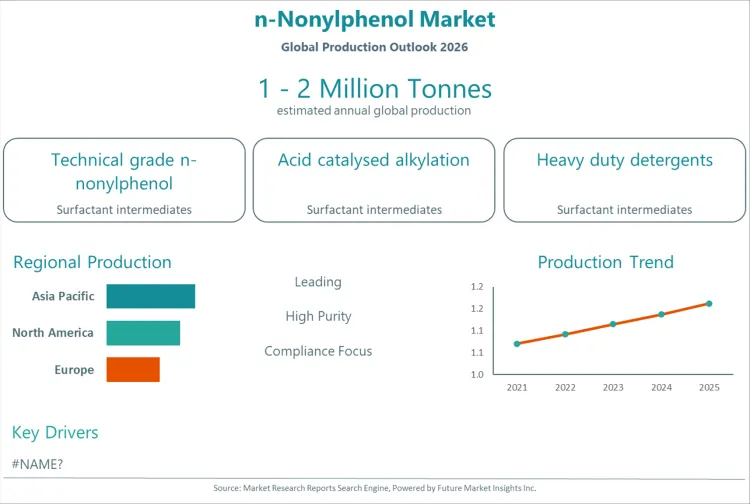
    Global n-nonylphenol production capacity in 2026 is estimated at approximately 1.2 to 1.6 million tonnes, reflecting a mature but structurally constrained chemical segment. Capacity trends are shaped by regulatory pressure, substitution dynamics and regional demand divergence rather than aggressive volume expansion. Production growth remains limited, with most capacity additions focused on debottlenecking and process optimisation rather than greenfield investments.

    Supply is concentrated in regions with established phenol production, alkylbenzene infrastructure and legacy downstream demand. Asia Pacific represents the largest production base due to integrated phenol and surfactant value chains. North America maintains stable output supported by industrial and specialty chemical demand. Europe continues to see capacity rationalisation driven by environmental regulation and end use restrictions. Several regions rely on imports due to limited domestic alkylation capability.

    Demand is increasingly bifurcated between industrial applications that retain functional dependence on n-nonylphenol and sectors transitioning toward regulated alternatives. Buyers prioritise supply continuity, specification compliance and long term regulatory clarity.
    N Nonylphenol Market

    Key Questions Answered

    • How stable is global phenol availability for nnonylphenol production?
    • How do regulatory constraints limit capacity expansion?
    • How is demand evolving across restricted and permitted applications?
    • How do producers manage long term asset viability?

    n-Nonylphenol Product Families That Define How Buyers Actually Use It

    Product Classification

    • Technical grade nnonylphenol
    • Surfactant intermediates
    • Industrial cleaners
    • Emulsifier formulations
    • High purity nnonylphenol
      • Specialty resin systems
      • Industrial lubricants
      • Polymer stabiliser formulations
    • Downstream ethoxylate intermediates
      • Nonylphenol ethoxylates for controlled industrial use
      • Emulsion polymerisation aids
      • Textile and leather processing chemicals

    Technical grade material dominates volume consumption due to its use as an intermediate rather than a final consumer product. Buyers focus on isomer distribution, colour, water content and compliance with restricted use guidelines.

    Key Questions Answered

    • How do buyers differentiate technical and high purity grades?
    • How do impurity profiles affect downstream formulations?
    • How do regulatory classifications influence grade selection?
    • How does traceability affect procurement decisions?

    n-Nonylphenol Process Routes That Define Cost, Control and Compliance

    Process Classification

    • Phenol alkylation with propylene oligomers
      • Acid catalysed alkylation
      • Established industrial route
      • High selectivity control requirements
    • Linear versus branched nonyl chain control
      • Isomer distribution management
      • Functional performance impact
      • Regulatory relevance
    • Integrated phenol based production
      • Feedstock security
      • Cost stability
      • Reduced logistics exposure
    • Post reaction purification and finishing
      • Distillation and neutralisation
      • Colour and odour control
      • Specification tightening

    Acid catalysed alkylation remains the dominant production route. Process control focuses on limiting unwanted isomers and byproducts to meet downstream performance and regulatory specifications.

    Key Questions Answered

    • How sensitive is production cost to phenol pricing?
    • How does isomer distribution affect end use performance?
    • How do producers manage waste and byproduct streams?
    • How do compliance requirements shape process design?

    n-Nonylphenol End Use Spread Across Key Sectors

    End Use Segmentation

    • Industrial and institutional cleaning
      • Heavy duty detergents
      • Surface treatment formulations
      • Equipment cleaning systems
    • Polymer and resin manufacturing
      • Phenolic resins
      • Epoxy systems
      • Rubber processing aids
    • Textile and leather processing
      • Wetting agents
      • Scouring formulations
      • Dyeing auxiliaries
    • Lubricants and additives
      • Industrial lubricants
      • Metalworking fluids
      • Antioxidant systems

    Industrial applications dominate consumption due to functional performance requirements that are not easily substituted. Consumer facing applications continue to decline due to regulatory restrictions.

    Key Questions Answered

    • How do industrial users manage substitution risk?
    • How do resin producers balance performance and compliance?
    • How does regulation affect textile sector usage?
    • How do buyers ensure safe handling and disposal?

    n-Nonylphenol Regional Production Potential Assessment

    Asia Pacific

    Asia Pacific leads production and consumption supported by integrated phenol assets and ongoing industrial demand. Regulatory enforcement varies by country, shaping uneven demand patterns.

    North America

    North America maintains stable output for industrial and specialty uses with controlled downstream applications.

    Europe

    Europe continues to reduce production and consumption due to strict environmental regulation and substitution mandates.

    Latin America

    Latin America shows selective demand in industrial cleaning and polymer applications, often supplied through imports.

    Middle East and Africa

    Limited production exists, with most supply imported for niche industrial uses.

    Key Questions Answered

    • How do regional regulations affect supply continuity?
    • How do import dependent regions manage availability risk?
    • How do enforcement differences shape trade flows?
    • How do producers allocate capacity across regions?

    n-Nonylphenol Supply Chain, Cost Drivers and Trade Patterns

    The n-nonylphenol supply chain begins with phenol production followed by alkylation, purification and distribution to formulators and industrial users. Downstream conversion often occurs within the same industrial clusters to minimise logistics complexity.

    Phenol pricing, catalyst efficiency and waste treatment costs dominate production economics. Regulatory compliance, storage requirements and hazardous material handling add cost layers. Trade flows increasingly concentrate toward regions with permitted industrial use.

    Buyers structure contracts around specification compliance, regulatory assurances and long term availability rather than volume flexibility.

    Key Questions Answered

    • How does phenol pricing influence delivered cost?
    • How do compliance costs affect competitiveness?
    • How do logistics and handling requirements shape trade?
    • How do buyers assess supplier risk exposure?

    n-Nonylphenol Ecosystem View and Strategic Themes

    The n-nonylphenol ecosystem includes phenol producers, alkylation operators, specialty chemical formulators, industrial end users and regulatory bodies. Asia Pacific anchors volume production, while Europe shapes regulatory direction.

    Strategic themes focus on asset rationalisation, substitution readiness and regulatory risk management rather than capacity expansion.

    Deeper Questions Decision Makers Should Ask

    • How resilient is demand to further regulatory tightening?
    • How diversified are downstream application portfolios?
    • How exposed are assets to environmental classification changes?
    • How robust are waste management systems?
    • How secure is phenol feedstock sourcing?
    • How flexible are plants to product transitions?
    • How transparent are compliance and reporting systems?
    • How aligned are suppliers and customers on risk management?

    Bibliography

    • European Chemicals Agency. (2023). Assessment of endocrine-disrupting properties under REACH: Alkylphenols. ECHA Scientific Reports.
    • United Nations Environment Programme. (2023). Global chemicals outlook II: Sustainability transitions in industrial chemicals. UNEP.
    • United Nations Environment Programme. (2024). Chemicals and waste governance: Managing high-concern industrial substances. UNEP.
    • USA Environmental Protection Agency. (2024). Updated TSCA risk management actions for nonylphenol and nonylphenol ethoxylates. Office of Chemical Safety and Pollution Prevention.

    Frequently Asked Questions

    What is the estimated global n-nonylphenol production volume in 2025?

    Global n-nonylphenol production in 2025 is estimated at approximately 1.2 to 1.6 million tonnes, reflecting stable industrial demand and declining consumer applications.

    What are the biggest cost drivers shaping n-nonylphenol pricing?

    Pricing is primarily influenced by phenol feedstock costs, process efficiency, regulatory compliance expenses and waste treatment requirements.

    How do regulations affect n-nonylphenol availability?

    Regulations restrict consumer and environmental discharge uses, concentrating demand in controlled industrial applications and limiting new capacity development.

    How do buyers manage substitution risk?

    Buyers evaluate alternative surfactants, reformulate products and maintain dual sourcing strategies while managing performance trade offs.

    Which sectors continue to use n-nonylphenol?

    Industrial cleaning, resin manufacturing, lubricants and certain textile processing applications remain active users under regulated conditions.

    Key Questions Answered in the Report

    Supply chain and operations

    • How predictable is phenol feedstock availability?
    • How stable is plant utilisation under regulatory pressure?
    • How effective are waste and effluent controls?
    • How resilient are logistics and storage systems?
    • How quickly can production be adjusted?
    • How are hazardous material risks managed?
    • How robust are monitoring and reporting systems?
    • How are contingency disruptions handled?

    Procurement and raw material

    • How is phenol indexed in supply contracts?
    • How do suppliers ensure regulatory compliance?
    • How is price volatility managed?
    • What contract terms support continuity?
    • How are alternative suppliers qualified?
    • How do buyers assess long term availability?
    • How are audits conducted?
    • How do onboarding requirements vary by region?

    Technology and innovation

    • How can alkylation selectivity be improved?
    • How do purification upgrades improve compliance?
    • How are emissions reduced at plant level?
    • How do waste treatment systems evolve?
    • How do producers prepare for substitution trends?
    • How does digital monitoring support compliance?
    • How are safety systems strengthened?
    • How do partnerships support transition planning?

    Buyer, channel and who buys what

    • Which industrial sectors sustain demand?
    • How do buyers qualify compliant supply?
    • What volumes define standard agreements?
    • How do users manage regulatory exposure?
    • How do channels influence delivered cost?
    • How do buyers verify product traceability?
    • How do users manage liability risk?
    • How do specifications differ by application?

    Pricing, contract and commercial model

    • What reference points guide pricing?
    • How are compliance costs reflected in contracts?
    • How do pricing reviews ensure continuity?
    • How do buyers compare compliant suppliers?
    • What contract duration supports asset stability?
    • How are disputes handled?
    • How do force majeure clauses apply?
    • How do terms vary by end use?

    Plant assessment and footprint

    • Which regions support compliant operations?
    • What scale defines economic viability?
    • How do permitting requirements affect operations?
    • How suitable are industrial zones?
    • How consistent is regulatory enforcement?
    • How are safety inspections managed?
    • How does workforce training affect compliance?
    • How do ports and transport links support trade?

    Explore Hydrocarbons, Petrochemicals, and Organic Chemicals Insights

    View Reports

    Trusted By
    Market Research Reports Search Engine

    n-Nonylphenol Global Production Capacity and Growth Outlook