Output Levels, Feedstock Linkage, and Capacity Direction
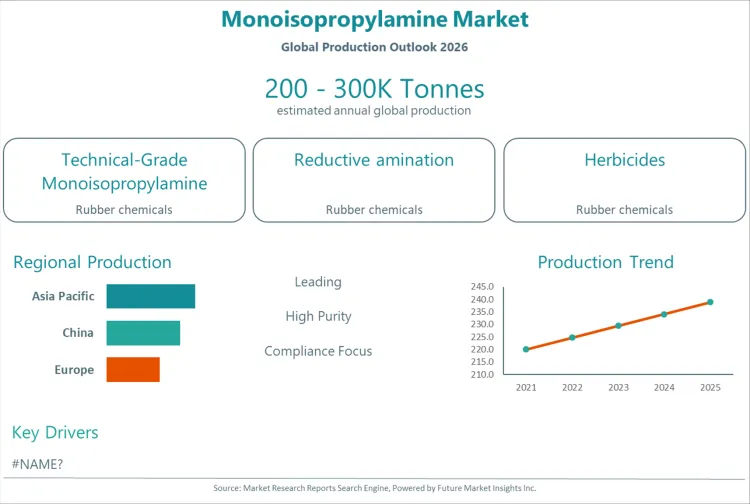
Global monoisopropylamine output in 2026 is estimated at approximately 200,000 to 300,000 tonnes, reflecting its role as a specialty aliphatic amine rather than a high-volume commodity. Output direction is shaped by propylene availability, ammonia supply, process yields, and demand from agrochemical and pharmaceutical intermediates.
Production capacity is moderately concentrated among producers with integrated petrochemical and amine-processing capability. Asia Pacific accounts for the largest share of volume output due to agrochemical manufacturing and chemical intermediate production. Europe and North America maintain stable capacity focused on higher-purity and regulated applications. Capacity expansion is selective, driven mainly by downstream synthesis requirements rather than standalone volume growth.
Usage remains synthesis-driven. Buyers prioritise purity, consistent reactivity, and secure delivery over spot availability.
Key Questions Answered
- How does propylene availability affect monoisopropylamine output?
- How concentrated is global production capacity?
- How do safety and handling requirements influence utilisation?
- How closely is demand tied to agrochemical cycles?
Purity Grades and Functional Variants That Matter
Product Classification
- TechnicalGrade Monoisopropylamine
- Rubber chemicals
- Corrosion inhibitors
- Industrial intermediates
- HighPurity Monoisopropylamine
- Pharmaceutical intermediates
- Fine chemical synthesis
- Controlled reaction systems
- LowWater and LowImpurity Grades
- Moisturesensitive reactions
- Specialty synthesis routes
- Regulated downstream use
- CustomerSpecified Grades
- Tight impurity limits
- Applicationqualified material
- Longterm supply agreements
Technical-grade material accounts for the majority of volume, while high-purity grades command premiums due to additional distillation and analytical control.
Key Questions Answered
- How do impurity levels affect downstream reactions?
- How critical is water content control?
- How do buyers qualify material by application?
- How do custom specifications reduce processing risk?
Synthesis Routes and Process Controls
Process Classification
- Propylene OxideBased Routes
- Reductive amination
- Controlled hydrogenation
- Selectivity management
- Direct Amination of Alcohols
- Catalytic amination
- Ammonia integration
- Byproduct minimisation
- Distillation and Purification
- Separation from di and triamines
- Moisture reduction
- Colour and odour control
- Storage and Handling Systems
- Pressurised or controlled tanks
- Vapour management
- Safety compliance
Process choice affects selectivity, yield, and purity. Buyers favour producers with robust separation capability and consistent batch quality.
Key Questions Answered
- How does route selection affect monoamine yield?
- How are secondary and tertiary amines controlled?
- How does distillation affect cost and purity?
- How are safety risks managed during handling?
Application Footprint Across Downstream Uses
End Use Segmentation
- Agrochemical Intermediates
- Herbicides
- Fungicides
- Insecticide synthesis
- Pharmaceutical and Fine Chemicals
- API intermediates
- Specialty synthesis
- Process reagents
- Rubber and Polymer Chemicals
- Accelerators
- Processing aids
- Stabiliser components
- Industrial and Specialty Uses
- Corrosion inhibitors
- Neutralising agents
- Chemical synthesis aids
Agrochemical and pharmaceutical intermediates account for the largest share of value usage, while rubber and industrial applications absorb steady volumes.
Key Questions Answered
- How do agrochemical users manage seasonal demand?
- How do pharmaceutical users manage purity risk?
- How do rubber processors tolerate specification variation?
- How do industrial users justify continued use?
Regional Production Footprint and Regulatory Contrast
Asia Pacific
Asia Pacific leads global output supported by integrated petrochemical supply and agrochemical manufacturing.
China
China accounts for a significant share of volume, supplying domestic and export-oriented chemical intermediates.
Europe
Europe maintains limited but high-compliance capacity focused on pharmaceutical and specialty uses.
North America
North America supports stable production aligned with regulated chemical synthesis and industrial demand.
Other Regions
Other regions rely largely on imports due to limited amine production infrastructure.
Key Questions Answered
- How do regional regulations affect production economics?
- How does integration with propylene supply affect competitiveness?
- How do exporters manage regulatory divergence?
- How do importers manage hazardous material logistics?
Value Chain Structure, Cost Drivers, and Supply Movement
The monoisopropylamine value chain begins with propylene and ammonia supply, followed by amination, purification, packaging, and controlled distribution. Major cost drivers include feedstock pricing, hydrogen and energy use, separation efficiency, compliance costs, and logistics.
Supply movement reflects qualification requirements. High-purity grades typically move under long-term agreements, while technical grades support regional industrial consumption.
Key Questions Answered
- How do feedstock price shifts affect delivered costs?
- How does distillation intensity influence unit economics?
- How do transport rules affect supply flexibility?
- How do buyers secure continuity of supply?
Industry Ecosystem and Strategic Considerations
The monoisopropylamine ecosystem includes petrochemical producers, amine manufacturers, agrochemical companies, pharmaceutical firms, rubber chemical producers, distributors, and regulators. Long-term positioning depends on feedstock security, process efficiency, and alignment with downstream synthesis pipelines.
Strategic considerations include investment in higher-selectivity processes, expansion of high-purity capacity, diversification across end uses, and preparation for evolving chemical safety standards.
Deeper Questions Decision Makers Should Ask
- How resilient is supply to propylene price volatility?
- How concentrated is compliant production capacity?
- How adaptable are processes to tighter specifications?
- How credible are safety and environmental systems?
- How exposed is demand to agrochemical cycles?
- How strong is technical service capability?
- How stable is downstream demand visibility?
- How aligned are suppliers with customer synthesis needs?
Bibliography
- Ullmann’s Encyclopedia of Industrial Chemistry. (2024). Aliphatic amines and synthesis routes.
- OECD. (2024). Industrial amine safety and handling guidance.
- European Chemicals Agency. (2024). Amine regulatory and safety frameworks.
Frequently Asked Questions
What is the estimated global monoisopropylamine output in 2026?
Global output in 2026 is estimated at approximately 200,000-300,000 tonnes.
Why is monoisopropylamine considered a specialty amine?
It serves as a selective intermediate in synthesis routes and requires controlled production to limit secondary amines.
Which applications require the highest purity grades?
Pharmaceutical intermediates and fine chemical synthesis require the highest purity and lowest moisture content.
How does monoisopropylamine compare with diisopropylamine?
Monoisopropylamine offers higher reactivity and selectivity, while diisopropylamine is bulkier and used differently in synthesis.
How do buyers manage supply and safety risk?
Buyers rely on approved suppliers, controlled storage, long-term agreements, and regulatory documentation.