On this page
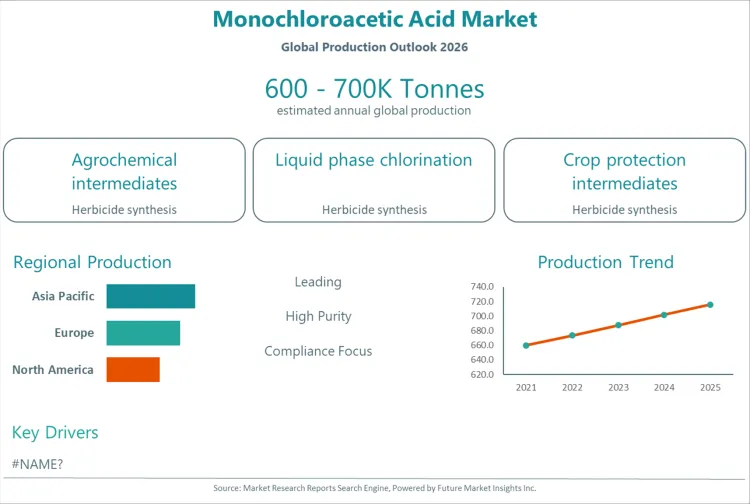
Global monochloroacetic acid production in 2026 is estimated at approximately 600 to 700 thousand tonnes, reflecting its role as a versatile halogenated intermediate rather than a finished consumer chemical. Output trends are closely linked to demand from agrochemical actives, carboxymethyl cellulose, surfactants and pharmaceutical intermediates.
Production economics are shaped by acetic acid availability, chlorine input, reaction selectivity and downstream purification intensity. Cost behavior differs meaningfully between technical grade material and higher purity pharmaceutical and specialty grades. Capacity development focuses primarily on incremental debottlenecking, yield improvement and grade upgrading rather than large greenfield projects.
The global supply environment shows steady growth with periodic tightening linked to chlorine availability and environmental compliance constraints. Demand visibility remains relatively stable due to monochloroacetic acid’s embedded role in multi step synthesis routes where substitution is limited.
Production capacity is concentrated in regions with established chlorination infrastructure and access to competitive acetic acid supply. Asia Pacific leads global output supported by integrated chemical complexes and strong downstream consumption. Europe maintains regulated capacity focused on higher purity and specialty applications. North America supports moderate production aligned with agrochemical and pharmaceutical demand. Several regions rely on imports due to limited chlorination capability.
Agrochemicals, cellulose derivatives, surfactants and pharmaceuticals continue to anchor baseline demand. Buyers prioritise purity consistency, reliable delivery and compliance with safety and environmental standards.
Agrochemical and cellulose derivative applications account for the largest share of global consumption. Pharmaceutical and personal care uses require significantly higher purity and tighter impurity control. Buyers differentiate supply based on purity, moisture content and batch to batch reproducibility.
Direct chlorination of acetic acid remains the dominant production route. Managing reaction heat, suppressing over chlorination and controlling by product formation are central operational challenges. Purification efficiency significantly affects final product economics and grade flexibility.
Agrochemical uses dominate volume consumption due to continuous synthesis requirements. Cellulose derivatives provide stable demand tied to food, pharmaceutical and industrial applications. Buyers focus on continuity of supply, impurity control and regulatory compliance.
Asia Pacific leads global production supported by integrated chlorination capacity and strong downstream consumption.
Europe maintains regulated capacity focused on higher purity, pharmaceutical and specialty grades.
North America supports moderate production aligned with agrochemical and pharmaceutical manufacturing.
Other regions depend largely on imports due to limited chlorination infrastructure and environmental constraints.
The supply chain begins with acetic acid and chlorine sourcing followed by chlorination, purification, packaging and distribution. Downstream buyers include agrochemical producers, cellulose derivative manufacturers, personal care formulators and pharmaceutical companies.
Key cost drivers include acetic acid pricing, chlorine availability, energy use, purification intensity and waste handling. Logistics costs vary by grade and packaging format. Trade flows reflect production concentration in Asia Pacific supplying global downstream users.
Pricing formation reflects purity level, regulatory compliance burden and contract duration rather than short term volatility.
The ecosystem includes acetic acid suppliers, chlorination operators, separation specialists, downstream chemical manufacturers and regulators. Production is concentrated among operators with strong safety management and environmental compliance capability.
Equipment suppliers support chlorination reactors, heat exchange systems, purification columns and waste treatment units. Producers coordinate feedstock sourcing, process control, regulatory compliance and long term customer relationships.
Global production in 2026 is estimated at approximately 600 to 700 thousand tonnes, driven by agrochemical, cellulose and specialty chemical demand.
Costs are driven by acetic acid availability, chlorine supply, energy use, purification intensity and waste handling requirements.
Residual di and trichloroacetic acids can interfere with downstream reactions and affect regulatory compliance.
Buyers rely on qualified suppliers, inventory buffers and longer term agreements aligned with downstream synthesis cycles.
Explore Hydrocarbons, Petrochemicals, and Organic Chemicals Insights
View Reports
Monochloroacetic Acid Global Production Capacity and Growth Outlook

Thank you!
You will receive an email from our Business Development Manager. Please be sure to check your SPAM/JUNK folder too.
