Mining Chemicals Production and Capacity Outlook
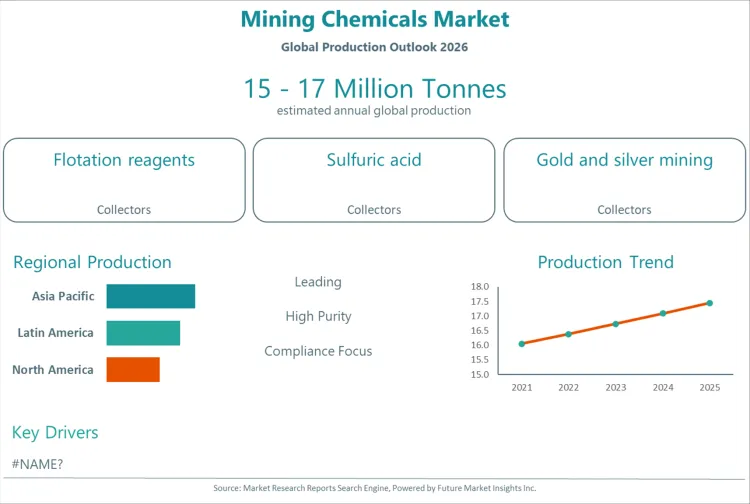
Global mining chemicals production capacity in 2026 is estimated at approximately 15 to 17 million tonnes on an active ingredient basis, reflecting steady growth driven by rising demand for metals, minerals and battery raw materials. Capacity expansion is closely linked to mining activity levels rather than independent chemical investment cycles, with most additions tied to incremental demand from flotation, leaching and ore processing operations.
Production leadership remains concentrated in regions with large scale mining activity, established chemical manufacturing infrastructure and access to bulk logistics. Asia Pacific leads consumption growth driven by coal, base metals and battery mineral extraction. Latin America remains a major demand centre for copper and lithium related chemicals. North America supports stable demand linked to gold, copper and industrial minerals. Africa shows increasing consumption tied to new mining projects, while Europe maintains limited production focused on specialty and high compliance formulations.
Demand growth is supported by declining ore grades, increased processing intensity and expansion of critical mineral extraction. Buyers prioritise performance consistency, secure supply and technical support at mine sites.
Key Questions Answered
- How closely is mining chemicals demand linked to ore grades and recovery rates?
- How do mining investment cycles influence chemical consumption?
- How do logistics constraints affect supply reliability?
- How do environmental regulations shape product portfolios?
Mining Chemicals Product Families That Define How Buyers Actually Use Them
Product Classification
- Flotation reagents
- Collectors
- Frothers
- Depressants and modifiers
- Leaching and extraction chemicals
- Cyanide and alternatives
- Acids and alkalis
- Solvent extraction reagents
- Grinding and processing aids
- Grinding aids
- Dispersants
- Scale inhibitors
- Water treatment and tailings management chemicals
- Flocculants and coagulants
- Tailings dewatering agents
- Dust suppression chemicals
- Explosives and blasting auxiliaries
- Emulsion sensitising agents
- Nitrates and additives
- Initiation support chemicals
Flotation and leaching reagents account for the largest share of chemical consumption due to their direct impact on metal recovery and throughput. Water management chemicals grow in importance as regulatory scrutiny increases.
Key Questions Answered
- How do operators select collectors and frothers for specific ores?
- How do leaching chemistries affect recovery efficiency?
- How does water chemistry influence reagent performance?
- How do safety and handling requirements affect procurement?
Mining Chemicals Process Routes That Define Cost, Performance and Reliability
Process Classification
- Bulk chemical manufacturing
- Sulfuric acid
- Caustic soda
- Ammonium nitrate and nitrates
- Specialty reagent synthesis
- Organic collectors and frothers
- Polymer based flocculants
- Tailored extraction agents
- Blending and formulation
- Site specific reagent optimisation
- Performance tuning
- Transport stability control
- On site and near mine production
- Acid plants
- Emulsion explosives
- Reduced logistics exposure
Bulk chemicals dominate volume, while specialty reagents drive value through performance differentiation. Proximity to mine sites improves reliability and reduces transport risk.
Key Questions Answered
- How sensitive mining chemical costs are to energy pricing?
- How does formulation tailoring improve ore recovery?
- How do producers ensure consistency across batches?
- How does on site production reduce operational risk?
Mining Chemicals End Use Spread Across Key Mining Segments
End Use Segmentation
- Precious metals
- Gold and silver mining
- Heap leaching and milling
- Recovery optimisation
- Base metals
- Copper, zinc and nickel
- Flotation and solvent extraction
- Concentrate upgrading
- Battery and critical minerals
- Lithium and graphite
- Rare earth elements
- Processing intensity increase
- Coal and industrial minerals
- Coal washing
- Phosphate and potash
- Limestone and aggregates
Base and precious metals dominate chemical consumption, while battery minerals drive higher reagent intensity and specialty chemical demand.
Key Questions Answered
- How do declining ore grades affect reagent consumption?
- How do battery minerals change chemical intensity?
- How do operators balance recovery and cost?
- How do safety and environmental standards vary by segment?
Mining Chemicals Regional Production and Consumption Potential
Asia Pacific
Asia Pacific leads consumption driven by coal, iron ore and battery mineral extraction.
Latin America
Latin America remains a major demand centre for copper, lithium and precious metal mining chemicals.
North America
North America supports stable demand linked to gold, copper and industrial mineral mining.
Africa
Africa shows rising consumption aligned with new copper, cobalt and gold projects.
Europe
Europe focuses on specialty chemicals, recycling related mining and high compliance operations.
Key Questions Answered
- How do regional mining profiles influence chemical demand?
- How do import dependent regions manage supply risk?
- How do infrastructure constraints affect delivery reliability?
- How do regulations influence regional competitiveness?
Mining Chemicals Supply Chain, Cost Drivers and Trade Patterns
The mining chemicals supply chain spans raw material sourcing, chemical synthesis, formulation, bulk transport and delivery to remote mine sites. Logistics complexity is a defining factor due to mine location and hazardous material handling requirements.
Energy costs, raw material pricing and logistics dominate production economics. Trade flows link chemical manufacturing hubs with mining regions lacking local supply. Buyers increasingly favour suppliers offering integrated logistics and on site technical services.
Contracts prioritise performance guarantees, delivery reliability and safety compliance.
Key Questions Answered
- How do logistics costs influence delivered chemical pricing?
- How do buyers benchmark bulk versus specialty reagents?
- How does supply chain disruption affect mining output?
- How do suppliers manage remote site delivery risk?
Mining Chemicals Ecosystem View and Strategic Themes
The ecosystem includes chemical producers, formulators, distributors, mining operators, equipment providers and regulators. Demand growth aligns with metal intensity of the energy transition and infrastructure development.
Strategic themes include reagent efficiency improvement, water stewardship, emissions reduction and localisation of supply near mine sites.
Deeper Questions Decision Makers Should Ask
- How resilient is chemical supply to mining cycle volatility?
- How diversified are sourcing options across regions?
- How exposed are operations to energy cost swings?
- How scalable are specialty reagent portfolios?
- How robust are safety and compliance systems?
- How aligned are suppliers with mine productivity goals?
- How transparent are environmental performance metrics?
- How quickly can formulations adapt to ore changes?
Bibliography
- World Bank. (2023). Minerals for climate action: The mineral intensity of the clean energy transition. World Bank Group.
- European Commission Joint Research Centre. (2023). Best available techniques (BAT) for extractive industries and mineral processing. Publications Office of the European Union.
- Food and Agriculture Organization of the United Nations. (2023). Water use, tailings management, and chemical inputs in mining operations. FAO Water Reports.
Frequently Asked Questions
What is the estimated global mining chemicals consumption volume in 2025?
Global mining chemicals consumption in 2025 is estimated at approximately 15 to 17 million tonnes on an active ingredient basis, driven by base metals, coal and precious metals mining.
What are the biggest cost drivers shaping mining chemicals pricing?
Pricing is driven by energy costs, raw material availability, logistics to remote sites and formulation complexity.
How do declining ore grades affect mining chemical demand?
Lower ore grades increase reagent intensity and drive demand for performance optimised specialty chemicals.
How do environmental regulations influence mining chemical use?
Regulations increase demand for water treatment chemicals, alternative leaching agents and improved tailings management solutions.
Which mining segments drive future chemical demand growth?
Battery minerals, copper and critical materials are expected to drive the strongest growth.