MEA Biodiesel Production and Capacity Outlook
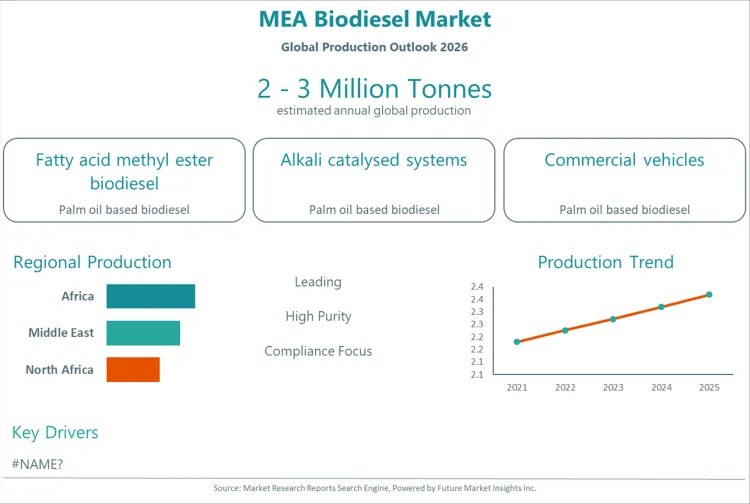
MEA biodiesel production capacity in 2026 is estimated at approximately 2 to 3 million tonnes per year, reflecting an early stage but gradually expanding regional footprint. Capacity growth is uneven and policy driven, with expansion focused on domestic fuel blending objectives, energy security considerations and agricultural value chain development rather than large scale export orientation.
Production remains concentrated in a limited number of countries with supportive policy frameworks, available feedstocks and basic conversion infrastructure. Africa accounts for the majority of regional capacity, led by South Africa and selected North and East African countries. Middle Eastern biodiesel capacity remains modest, reflecting competition from fossil fuels and alternative low carbon fuel pathways. Many countries remain import dependent or rely on pilot scale facilities due to feedstock, financing and logistics constraints.
Demand growth is supported by diesel consumption, off grid power use and gradual introduction of blending mandates. Buyers prioritise regulatory compliance, feedstock traceability and operational reliability.
Key Questions Answered
- How scalable is biodiesel production given regional feedstock constraints?
- How dependent is capacity growth on policy support?
- How do infrastructure limitations affect plant utilisation?
- How resilient is biodiesel demand across economic cycles?
Biodiesel Product Types That Define How Buyers Actually Use It
Product Classification
- Fatty acid methyl ester biodiesel
- Palm oil based biodiesel
- Soybean oil based biodiesel
- Sunflower and rapeseed oil biodiesel
- Waste and residue based biodiesel
- Used cooking oil conversion
- Animal fat biodiesel
- Low carbon feedstock grades
- Domestic mandate grade biodiesel
- National blending compliance
- Utility and transport use
- Regulated fuel distribution
- Small scale and captive biodiesel
- Mining and industrial fleets
- Agricultural operations
- Remote power generation
Vegetable oil based biodiesel dominates current output, while waste oil based biodiesel grows from a low base due to collection and logistics challenges.
Key Questions Answered
- How do buyers differentiate biodiesel by feedstock origin?
- How does feedstock choice affect fuel quality?
- How do specifications vary by country?
- How does traceability influence procurement decisions?
MEA Biodiesel Process Routes That Define Cost and Feedstock Flexibility
Process Classification
- Conventional transesterification
- Alkali catalysed systems
- Mature and low complexity technology
- Suitable for small to mid scale plants
- Feedstock pretreatment systems
- Degumming and drying
- Free fatty acid management
- Yield optimisation
- Flexible feedstock processing
- Multi oil input capability
- Waste oil co processing
- Cost control focus
- Glycerine recovery and handling
- Crude glycerine output
- Limited upgrading infrastructure
- Local industrial use
Process economics are highly sensitive to feedstock pricing and logistics costs. Plants with basic feedstock flexibility show improved utilisation in volatile agricultural environments.
Key Questions Answered
- How sensitive biodiesel cost is to vegetable oil pricing?
- How does feedstock flexibility affect plant economics?
- How do logistics costs influence competitiveness?
- How do co products support operating margins?
Biodiesel End Use Spread Across MEA Fuel and Power Segments
End Use Segmentation
- Road transport diesel blending
- Commercial vehicles
- Public transport fleets
- Government fuel programs
- Off grid and backup power
- Remote communities
- Telecom towers
- Industrial backup generation
- Mining and industrial fleets
- Heavy equipment
- Remote operations
- Captive fuel use
- Export and cross border trade
- Limited regional trade
- Pilot export volumes
- Specification driven supply
Road transport blending and off grid power generation dominate early biodiesel consumption due to diesel reliance and limited grid coverage.
Key Questions Answered
- How do blending mandates influence demand stability?
- How does off grid power use support biodiesel adoption?
- How do buyers manage fuel quality consistency?
- How does seasonality affect biodiesel consumption?
MEA Biodiesel Regional Production and Policy Assessment
Africa
Africa accounts for most regional biodiesel capacity, with South Africa, Egypt and selected East African countries leading production. Policy support and feedstock access vary widely by country.
Middle East
Middle Eastern biodiesel capacity remains limited, with focus on pilot projects, waste oil utilisation and niche applications rather than large scale blending.
North Africa
North Africa shows moderate potential driven by agricultural output and domestic fuel needs, though capacity remains constrained.
Sub Saharan Africa
Sub Saharan Africa demonstrates long term potential tied to agricultural expansion but faces financing and infrastructure barriers.
Key Questions Answered
- How do national policies affect capacity utilisation?
- How does feedstock availability differ by sub region?
- How do fuel subsidies affect biodiesel competitiveness?
- How does policy stability influence investment confidence?
MEA Biodiesel Supply Chain, Cost Drivers and Trade Patterns
The MEA biodiesel supply chain integrates agricultural production, oil extraction, biodiesel conversion, storage and regulated fuel distribution. Feedstock logistics and storage present major challenges due to dispersed agricultural production and limited infrastructure.
Key cost drivers include vegetable oil pricing, methanol costs, energy inputs and transport expenses. Trade remains limited, with most biodiesel consumed domestically. Imports supplement supply where mandates exceed domestic production capacity.
Contracts are typically short term and policy linked, reflecting evolving regulatory frameworks.
Key Questions Answered
- How do feedstock logistics affect biodiesel availability?
- How do input costs translate into delivered fuel pricing?
- How do buyers benchmark domestic versus imported supply?
- How do policy changes affect trade flows?
MEA Biodiesel Ecosystem View and Strategic Themes
The ecosystem includes farmers, oil processors, biodiesel producers, fuel distributors, utilities, mining operators and regulators. Biodiesel acts as a transitional fuel supporting energy diversification and rural development objectives.
Strategic themes include feedstock diversification, waste oil utilisation, gradual mandate introduction and integration with broader renewable fuel strategies.
Deeper Questions Decision Makers Should Ask
- How secure is long term feedstock access?
- How exposed are producers to policy reversals?
- How scalable are small and mid scale biodiesel assets?
- How resilient are projects to fuel subsidy structures?
- How robust are sustainability and traceability systems?
- How aligned are agriculture and energy stakeholders?
- How transparent are regulatory compliance mechanisms?
- How quickly can biodiesel adapt to alternative fuel pathways?
Bibliography
- Food and Agriculture Organization of the United Nations. (2024). Bioenergy, vegetable oil markets, and agricultural integration in Africa. FAO Publications.
- Food and Agriculture Organization of the United Nations. (2023). Oil crops, waste oils, and biofuel feedstock availability in developing regions. FAO Publications.
- World Bank. (2024). Renewable fuels, energy access, and infrastructure constraints in developing economies. World Bank Group.
Frequently Asked Questions
What is the estimated MEA biodiesel production volume in 2025?
MEA biodiesel production in 2025 is estimated at approximately 2 to 3 million tonnes, driven by domestic blending programs and captive fuel use.
What are the biggest cost drivers shaping biodiesel pricing in the region?
Pricing is driven by vegetable oil costs, logistics expenses, methanol pricing and policy compliance costs.
Why is biodiesel adoption slower in the Middle East?
Low fossil fuel prices, fuel subsidies and alternative decarbonisation pathways limit biodiesel competitiveness.
Which feedstocks dominate MEA biodiesel production?
Palm oil, soybean oil and sunflower oil dominate, with limited waste oil utilisation.
Which segments drive future biodiesel demand in MEA?
Road transport blending, off grid power and mining operations are expected to drive gradual growth.