On this page
Global m-xylene production in 2026 is estimated at approximately 3 to 5 million tonnes, reflecting steady growth aligned with aromatics processing rates and downstream chemical demand rather than standalone capacity expansion. m-Xylene is not typically produced as a primary target product. Instead, it is recovered as part of mixed xylene streams generated during catalytic reforming and aromatics extraction in refineries and petrochemical complexes.
Supply availability is therefore closely tied to refinery operating rates, gasoline blending economics, and para-xylene optimisation strategies. In many facilities, para-xylene recovery is prioritised, with m-xylene either separated for chemical use or recycled within the aromatics loop. Pricing trends reflect crude oil movements, aromatics margins, and the balance between separation capacity and downstream demand.
Production leadership remains concentrated in regions with large integrated refining and aromatics infrastructure. Asia Pacific leads global output driven by petrochemical expansion and polyester value chains. North America maintains stable supply supported by refinery integration. Europe shows mature output with limited growth. Several regions remain import dependent due to the absence of large scale aromatics separation assets.
Buyers value consistent purity, reliable supply continuity, and predictable specification control.
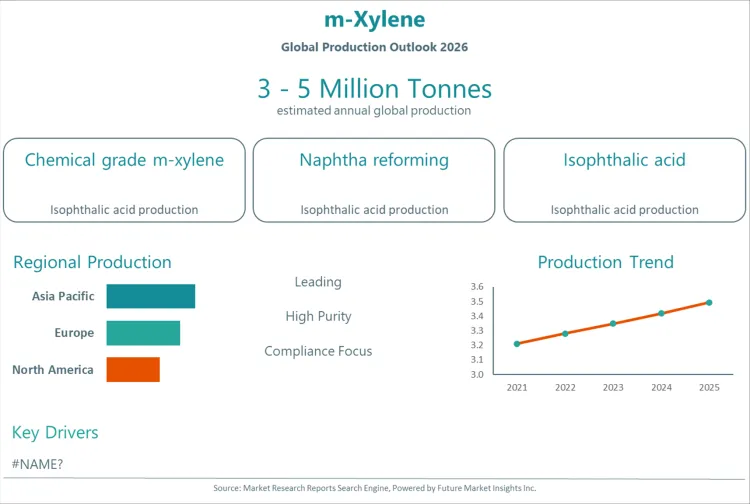
Chemical grade m-xylene accounts for the largest share of value due to its role as a feedstock for isophthalic acid and downstream polyester resins. Solvent grades support coatings, inks, and industrial processing. High purity grades represent small volumes but strict specification requirements.
m-Xylene recovery depends heavily on the configuration of aromatics units. Facilities focused on para-xylene recovery may limit m-xylene extraction, while integrated chemical producers invest in separation capacity to monetise m-xylene streams. Process choices affect energy use, recovery efficiency, and operating flexibility.
Buyers benefit from consistent composition and dependable supply rather than rapid changes in output volume.
Polyester resin production dominates chemical grade consumption due to long term demand from construction, automotive, and marine applications. Coatings and adhesives provide stable industrial demand, while specialty chemicals offer smaller but higher margin uses.
Asia Pacific dominates global production supported by large scale aromatics complexes and polyester resin manufacturing.
North America maintains stable output tied to refinery and petrochemical integration.
Europe shows mature production with limited growth and strong regulatory oversight.
The Middle East is expanding aromatics capacity, supporting incremental m-xylene availability.
These regions remain largely import dependent due to limited aromatics separation infrastructure.
m-Xylene supply begins with crude oil refining and naphtha reforming, followed by aromatics extraction, isomer separation, storage, and bulk distribution. Products are transported via tankers, pipelines, rail, and road depending on distance and regulation. Downstream buyers include resin producers, coatings manufacturers, and chemical processors.
Crude oil pricing, refinery utilisation, separation efficiency, energy use, and logistics dominate cost structure. Trade flows typically move from integrated petrochemical hubs to regions lacking aromatics capacity.
The m-xylene ecosystem includes refiners, petrochemical producers, aromatics operators, resin manufacturers, coatings producers, distributors, and regulators. Asia Pacific anchors demand growth, while North America and the Middle East provide integrated supply strength.
Strategic themes include balancing para-xylene optimisation with co-product recovery, managing solvent regulation exposure, and aligning aromatics capacity with downstream resin demand.
Global m-xylene production in 2025 is estimated at approximately 3 to 5 million tonnes, largely dependent on refinery and aromatics operating rates.
Pricing is driven by crude oil costs, refinery utilisation, aromatics separation efficiency, energy consumption, and logistics.
Para-xylene recovery strategies often determine whether m-xylene is extracted, recycled, or sold, directly influencing availability.
Solvent emission rules influence coatings and industrial use, while chemical applications remain structurally stable.
Buyers rely on long term contracts, diversified sourcing, and integration with aromatics suppliers.
Explore Hydrocarbons, Petrochemicals, and Organic Chemicals Insights
View Reports
m-Xylene Global Production Capacity and Growth Outlook

Thank you!
You will receive an email from our Business Development Manager. Please be sure to check your SPAM/JUNK folder too.
