On this page
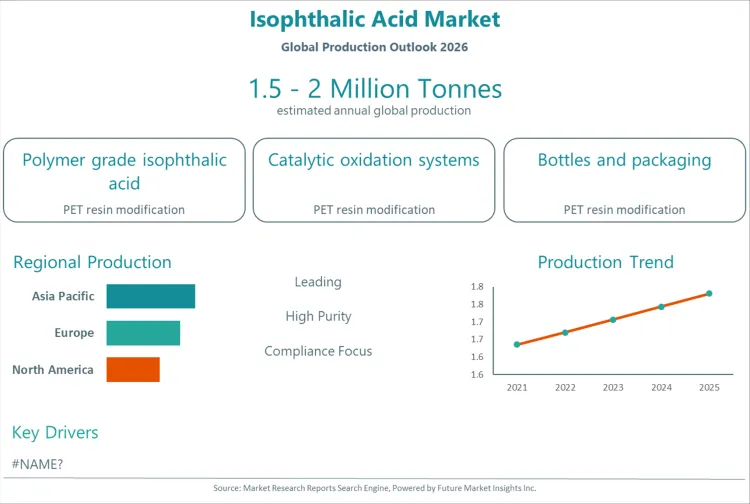
Global isophthalic acid production in 2026 is estimated at 1.5 to 2.0 million tonnes, reflecting steady expansion linked to polyester resins, PET modification, and coating applications. Growth is incremental rather than abrupt, as capacity additions tend to be tied to downstream integration and long term demand visibility rather than short cycle investment.
Isophthalic acid output is closely connected to polyester value chains, particularly in applications where enhanced thermal stability, chemical resistance, and mechanical performance are required. Unlike commodity terephthalic acid, isophthalic acid serves more performance driven uses, which creates a structurally stable demand profile with lower substitution risk.
Cost formation is shaped by para xylene feedstock availability, oxidation process efficiency, catalyst performance, utilities consumption, and environmental compliance. Integrated producers benefit from feedstock security and operational efficiency, while standalone units face higher exposure to upstream volatility and logistics complexity. Buyers focus on quality consistency, impurity control, and long term supply reliability.
Polymer grade material accounts for the largest share of consumption due to its role in improving clarity, toughness, and heat resistance in PET and polyester systems. Buyers prioritise particle size consistency, low metal content, and predictable reactivity.
Resin and coating applications require tight control of acid value and impurity profile to ensure stable curing and long service life. Specialty grades are selected where performance tolerance is narrow and qualification processes are extensive.
Production technology influences yield, impurity profile, waste generation, and energy intensity. Modern plants focus on catalyst efficiency, solvent recovery, and emissions control to meet tightening environmental standards.
Integration with aromatics and downstream polymer units reduces logistics exposure and improves responsiveness to customer requirements. Older standalone assets face higher compliance and operating costs.
Polyester modification represents the most stable and scalable consumption base, driven by demand for improved material performance. Resin and coating uses provide diversification and higher value density but show more sensitivity to construction and industrial cycles.
Asia Pacific holds the largest share of global capacity, supported by integrated aromatics production, large polyester manufacturing bases, and export oriented supply chains.
Europe maintains established capacity with strong regulatory oversight and focus on high purity and specialty applications.
North America operates integrated assets aligned with coatings, resins, and engineering polymer demand.
The Middle East shows emerging capacity linked to aromatics integration and export focused chemical strategies.
These regions rely largely on imports, with local consumption tied to coatings and packaging growth.
The supply chain begins with aromatics feedstock sourcing, followed by oxidation, purification, finishing, bulk storage, and delivery to polymer, resin, and coating producers. Material is typically transported in bags or bulk containers, requiring moisture control and contamination prevention.
Cost exposure is driven by feedstock pricing, energy consumption, catalyst replacement, utilities efficiency, and logistics reliability. Buyers often favour long term supply arrangements to support consistent production planning and product qualification.
The ecosystem includes aromatics producers, isophthalic acid manufacturers, polyester and resin producers, compounders, converters, distributors, and regulatory bodies. Coordination across these participants ensures consistent quality, compliance, and supply continuity.
Strategic priorities include maintaining integration advantages, upgrading older assets for compliance, supporting downstream customers with technical expertise, and aligning capacity expansion with long term application growth.
Global production in 2025 is estimated at 1.5 to 2 million tonnes, reflecting steady growth aligned with polyester and resin applications.
Costs are shaped by para xylene availability, energy and utilities consumption, catalyst efficiency, environmental compliance, and logistics reliability.
Isophthalic acid improves clarity, toughness, and thermal stability, enabling higher performance packaging and film applications.
Buyers rely on qualification testing, impurity specifications, long term supply relationships, and regular audits.
Tighter emissions and waste standards increase operating costs and favour newer, integrated facilities with advanced control systems.
Explore Hydrocarbons, Petrochemicals, and Organic Chemicals Insights
View Reports
Isophthalic Acid Global Production Capacity and Growth Outlook

Thank you!
You will receive an email from our Business Development Manager. Please be sure to check your SPAM/JUNK folder too.
