On this page
Global isopentane production in 2026 is estimated at approximately 2 to 3 million tonnes, reflecting steady growth linked to polymer processing, insulation materials, and specialty industrial uses rather than fuel driven expansion. Isopentane is a light hydrocarbon that is typically produced as part of broader refinery and natural gas liquids streams, which means supply availability is closely tied to upstream refining rates and gas processing activity.
Supply growth is supported by continued demand for expandable polystyrene and polyurethane insulation materials, where isopentane is used as a physical blowing agent. Additional demand comes from specialty solvents, laboratory uses, and chemical synthesis applications. Production economics balance relatively stable downstream demand against exposure to crude oil prices, natural gas liquids availability, and separation efficiency within refinery systems.
Production leadership remains concentrated in regions with large scale refining and gas processing infrastructure. Asia Pacific leads incremental capacity additions driven by construction and insulation demand. North America maintains strong production aligned with shale gas liquids processing. Europe supports stable output focused on regulated industrial uses. Several regions remain import dependent due to limited refinery integration.
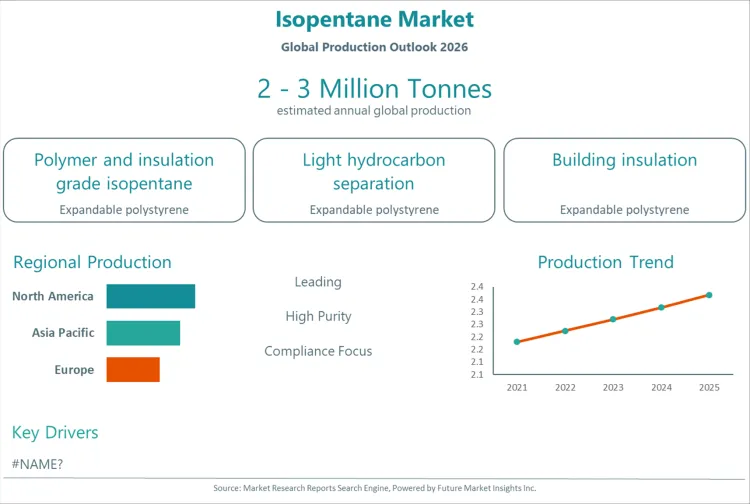
Polymer and insulation grades represent the largest share of consumption due to continuous demand from construction and packaging. Industrial and solvent grades serve niche but stable applications. High purity grades account for low volume but high specification demand.
Isopentane is primarily recovered as part of broader hydrocarbon separation rather than produced as a standalone product. Process efficiency depends on fractionation design, recovery rates, and blending control. Integration with refineries and gas plants provides cost stability but limits independent output scaling.
Buyers benefit from predictable specification control and supply reliability rather than rapid volume flexibility.
Insulation and polymer applications dominate consumption due to long term building efficiency requirements. Industrial and chemical uses provide diversification but remain smaller in volume.
North America maintains strong production driven by shale gas liquids availability and integrated refinery capacity.
Asia Pacific expands consumption aligned with construction growth and insulation demand, relying on both domestic supply and imports.
Europe supports stable production with strong regulatory oversight and emphasis on environmentally acceptable blowing agents.
The Middle East shows selective production tied to refinery expansion and export opportunities.
These regions remain partially import dependent with growing construction driven demand.
Isopentane supply begins with crude oil refining and natural gas processing, followed by fractionation, blending, storage, and distribution. Products are transported via pressurised tanks, rail, or ship depending on distance and regulation. Downstream buyers include polymer processors, insulation manufacturers, and industrial users.
Crude oil and gas liquids pricing, recovery efficiency, plant utilisation, storage requirements, and transport safety dominate cost structure. Trade flows support regions without sufficient refinery integration, particularly for insulation grade material.
The isopentane ecosystem includes oil and gas producers, refiners, gas processors, insulation manufacturers, polymer producers, distributors, and regulators. North America anchors supply availability, while Asia Pacific and Europe shape downstream demand trends and regulatory standards.
Equipment providers support fractionation columns, storage tanks, blending systems, and safety infrastructure. Producers coordinate feedstock sourcing, quality assurance, and long term supply agreements.
Global isopentane production in 2025 is estimated at approximately 2 to 3 million tonnes, supported by insulation and polymer demand.
Pricing is driven by crude oil and gas liquids costs, refinery operating rates, separation efficiency, storage requirements, and logistics.
Environmental and safety regulations favor hydrocarbons like isopentane as alternatives to high global warming potential blowing agents.
Isopentane is recovered as part of broader hydrocarbon streams, limiting independent production control.
Buyers rely on long term contracts, diversified sourcing, and inventory buffering.
Explore Hydrocarbons, Petrochemicals, and Organic Chemicals Insights
View Reports
Isopentane Global Production Capacity and Growth Outlook

Thank you!
You will receive an email from our Business Development Manager. Please be sure to check your SPAM/JUNK folder too.
