Output Levels, Cost Structure, and Production Direction
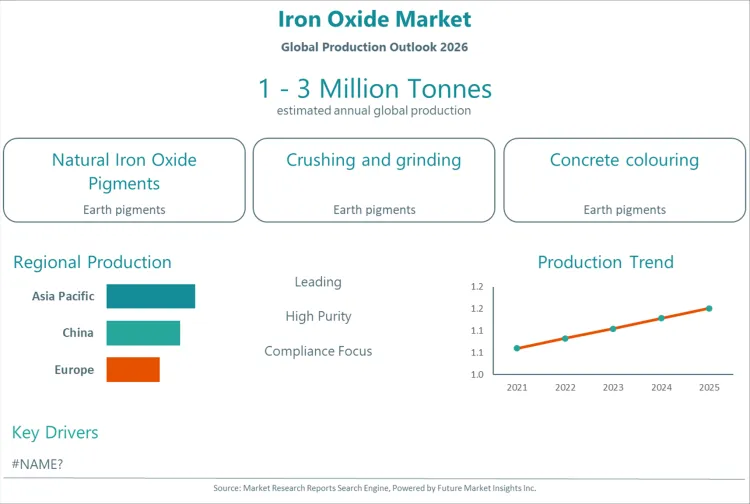
Global iron oxide output in 2026 is estimated at approximately 1 to 3 million tonnes, encompassing both natural and synthetic grades used across pigments, construction materials, metallurgy, and specialty applications. Production development is influenced by availability of iron-bearing ores, by-product recovery from steel and chemical processes, and demand for consistent colour and particle properties.
Natural iron oxide production remains concentrated in regions with accessible mineral deposits and beneficiation infrastructure, while synthetic iron oxide output is closely tied to steel pickling, aniline processing, and controlled precipitation routes. Asia Pacific leads overall volume output, supported by construction demand and integrated mineral processing. Europe and North America maintain smaller but technically advanced capacity focused on synthetic, high-purity, and colour-consistent grades.
Usage growth is supported by urban development, infrastructure projects, and rising demand for durable, weather-resistant pigments. Buyers prioritise colour stability, dispersion behaviour, and batch consistency over raw volume availability.
Key Questions Answered
- How does natural versus synthetic supply affect availability?
- How do ore quality and processing routes influence cost?
- How does environmental compliance affect production economics?
- How does capacity concentration affect grade availability?
Material Forms and Grades That Define Practical Use
Product Classification
- Natural Iron Oxide Pigments
- Earth pigments
- Construction colouring
- Lowcost applications
- Synthetic Iron Oxide Pigments
- Red, yellow, black, and brown grades
- Controlled particle size
- High colour consistency
- HighPurity and Specialty Iron Oxides
- Electronics and catalysts
- Polishing compounds
- Magnetic applications
- Micronised and SurfaceTreated Grades
- Improved dispersion
- Enhanced durability
- Applicationspecific performance
Synthetic grades dominate value-added usage due to uniformity and reliability. Buyers focus on tinting strength, lightfastness, and compatibility with binders.
Key Questions Answered
- How do users choose between natural and synthetic grades?
- How does particle size affect colour strength?
- How do surface treatments improve performance?
- How do purity requirements vary by application?
Manufacturing and Processing Routes That Shape Properties
Process Classification
- Mining and Beneficiation
- Crushing and grinding
- Washing and separation
- Impurity control
- Chemical Synthesis Routes
- Precipitation methods
- Thermal oxidation
- Controlled calcination
- Byproduct Recovery Processes
- Steel pickling liquors
- Chemical intermediate streams
- Waste valorisation
- PostProcessing and Finishing
- Milling and classification
- Surface modification
- Packaging and handling
Synthetic routes allow precise control of colour and particle morphology, while natural routes offer cost advantages where performance requirements are lower.
Key Questions Answered
- How do synthesis conditions affect colour tone?
- How does calcination influence stability?
- How do recovery routes compare with virgin synthesis?
- How do finishing steps affect dispersibility?
Application Spread Across End-Use Segments
End Use Segmentation
- Construction and Building Materials
- Concrete colouring
- Roofing tiles
- Paving stones
- Paints, Coatings, and Inks
- Architectural coatings
- Protective paints
- Printing inks
- Plastics and Rubber
- Masterbatches
- Elastomer colouring
- UVresistant formulations
- Industrial and Specialty Uses
- Catalysts
- Polishing agents
- Magnetic materials
Construction applications account for the largest volume usage, while coatings and plastics drive demand for higher-grade pigments.
Key Questions Answered
- How do construction users manage colour consistency?
- How do coatings formulators optimise dispersion?
- How do plastics processors balance cost and performance?
- How do specialty users manage purity requirements?
Geographic Concentration and Regional Capabilities
Asia Pacific
Asia Pacific leads total output supported by mineral availability, construction activity, and large-scale pigment production.
China
China dominates both natural and synthetic iron oxide production, supported by integrated mineral processing and downstream consumption.
Europe
Europe focuses on high-quality synthetic grades with strong environmental and performance compliance.
North America
North America maintains balanced production with emphasis on construction pigments and specialty applications.
Latin America and Africa
These regions supply natural iron oxides and show growing beneficiation activity, though value-added processing remains limited.
Key Questions Answered
- How do regional mineral resources affect supply stability?
- How do regulations shape production practices?
- How does proximity to construction activity influence output?
- How do logistics affect delivery reliability?
Value Chain Structure, Cost Influences, and Trade Movement
The iron oxide value chain begins with ore extraction or chemical feedstocks, followed by synthesis or beneficiation, finishing, and distribution to pigment users. Key cost drivers include energy use, processing intensity, environmental compliance, and logistics.
Trade movement reflects grade requirements, with synthetic and specialty grades moving across regions, while natural pigments are often consumed closer to extraction sites.
Key Questions Answered
- How do energy costs influence pigment pricing?
- How does processing intensity affect margins?
- How do transport costs affect delivered price?
- How do buyers compare local and imported grades?
Industry Ecosystem and Strategic Considerations
The iron oxide ecosystem includes mining companies, chemical producers, pigment processors, distributors, and end users in construction, coatings, and plastics. Reliability depends on consistent quality, regulatory compliance, and application support.
Strategic considerations include environmental upgrades, expansion of synthetic capacity, development of specialty grades, and closer collaboration with downstream formulators.
Deeper Questions Decision Makers Should Ask
- How secure is longterm raw material access?
- How concentrated is synthetic pigment production?
- How resilient are operations to regulatory tightening?
- How adaptable are processing facilities?
- How differentiated are product portfolios?
- How strong is technical support capability?
- How stable is downstream demand visibility?
- How aligned are suppliers and users?
Bibliography
- United Nations Conference on Trade and Development. (2024). Trade flows and market concentration in mineral-based industrial materials. UNCTAD Global Trade Analysis.
- World Bank Group. (2024). Commodity processing, value addition, and environmental constraints. World Bank Industry Policy Notes.
- Ullmann’s Encyclopedia of Industrial Chemistry. (2024). Iron oxide pigments and processing. Wiley-VCH.
- European Pigments Association. (2024). Inorganic pigment production and regulation.
Frequently Asked Questions
What is the estimated global iron oxide output in 2026?
Global output in 2026 is estimated at approximately 1-3 million tonnes, covering both natural and synthetic grades.
What factors most strongly influence iron oxide pricing?
Pricing is influenced by ore quality, synthesis route, energy costs, environmental compliance, and finishing requirements.
Which applications consume the largest volumes?
Construction materials such as concrete, tiles, and paving account for the largest volume usage.
How do synthetic iron oxides differ from natural grades?
Synthetic iron oxides offer superior colour consistency, purity, and performance stability compared with natural pigments.
How do buyers manage quality risk?
Buyers rely on batch testing, supplier qualification, and application-specific performance validation.