Industrial Gas Pipeline Infrastructure Capacity and Outlook
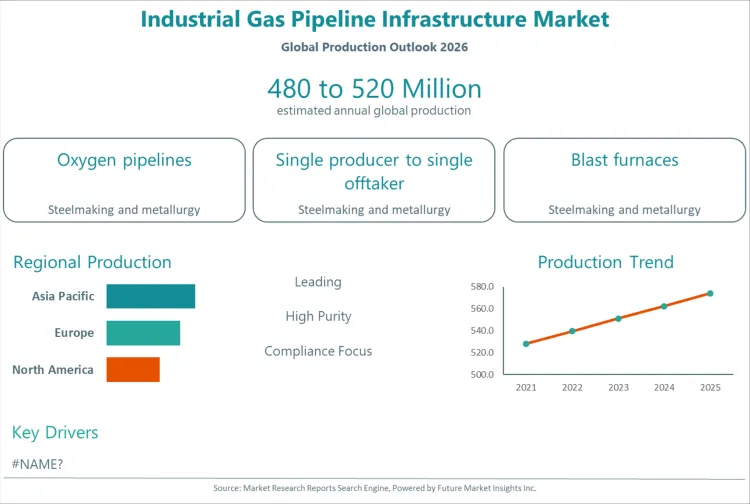
Global industrial gas pipeline infrastructure handles approximately 480 to 520 million tonnes of gas annually, expanding selectively rather than uniformly, with growth driven by large scale captive gas demand in steel, chemicals, refining, electronics, and energy transition projects. New pipeline capacity development prioritises long term offtake security over speculative build out, reflecting high capital intensity and long asset lifecycles. Expansion is closely linked to greenfield industrial complexes, refinery upgrades, and hydrogen ready infrastructure planning.
Infrastructure leadership remains concentrated in regions with dense industrial clustering and predictable long term gas demand. Asia Pacific leads new pipeline additions driven by steel, chemicals and electronics manufacturing growth. Europe focuses on optimisation, interconnection and repurposing of existing networks, particularly for hydrogen readiness. North America maintains steady expansion linked to refining, petrochemicals and hydrogen hubs. Several regions remain reliant on on site gas generation due to insufficient demand density to justify pipeline investment.
Demand stability is supported by the operational advantages of pipeline supplied gases including reliability, purity control and lower delivered cost at scale.
Key Questions Answered
- How closely is pipeline expansion tied to industrial cluster development?
- How do long term offtake contracts influence investment decisions?
- How does capital intensity affect expansion timelines?
- How resilient is pipeline demand across industrial cycles?
Industrial Gases Transported by Pipeline and How Buyers Use Them
Gas Classification
- Oxygen pipelines
- Steelmaking and metallurgy
- Refining and petrochemicals
- Wastewater treatment
- Nitrogen pipelines
- Electronics manufacturing
- Chemical processing
- Inerting and blanketing
- Hydrogen pipelines
- Refining and ammonia production
- Energy transition projects
- Semiconductor manufacturing
- Carbon dioxide pipelines
- Enhanced oil recovery
- Food and beverage processing
- Emerging carbon management uses
- Specialty and mixed gas lines
- Dedicated process gases
- Custom industrial applications
- High purity distribution
Oxygen and nitrogen dominate pipeline transported volumes due to continuous, high throughput demand. Hydrogen pipelines are gaining strategic importance despite limited geographic coverage.
Key Questions Answered
- How do buyers decide between pipeline supply and on site generation?
- How do purity and pressure requirements affect pipeline design?
- How does gas criticality influence redundancy planning?
- How do safety standards vary by gas type?
Pipeline Design and Delivery Models That Define Cost and Reliability
Infrastructure Models
- Point to point captive pipelines
- Single producer to single offtaker
- Long term volume commitments
- High reliability focus
- Multi user industrial networks
- Shared backbone systems
- Cluster based distribution
- Higher utilisation efficiency
- Hybrid pipeline and on site generation systems
- Load balancing
- Redundancy enhancement
- Flexible supply management
- Hydrogen ready and repurposed pipelines
- Material compatibility upgrades
- Pressure and embrittlement management
- Transition focused investment
Design choices reflect trade offs between utilisation, flexibility and upfront capital cost. Captive pipelines dominate due to predictable demand and simplified risk allocation.
Key Questions Answered
- How sensitive pipeline economics are to utilisation rates?
- How do material choices affect long term integrity?
- How does redundancy design improve operational resilience?
- How do hydrogen compatibility requirements change cost structure?
Industrial Gas Pipeline End Use Across Key Sectors
End Use Segmentation
- Steel and metals
- Blast furnaces
- Electric arc furnaces
- Direct reduced iron
- Chemicals and petrochemicals
- Oxidation and hydrogenation processes
- Inerting and synthesis
- Feedstock integration
- Refining and energy
- Hydrotreating and hydrocracking
- Hydrogen management
- Process optimisation
- Electronics and advanced manufacturing
- Semiconductor fabrication
- Flat panel display production
- Controlled atmosphere processing
- Emerging energy transition applications
- Low carbon hydrogen distribution
- Carbon management pilots
- Synthetic fuel production
Steel, chemicals and refining account for the largest pipeline volumes due to continuous demand and high flow rates.
Key Questions Answered
- How do industrial users integrate pipeline gases into operations?
- How does pipeline supply improve process stability?
- How do outage risks affect production planning?
- How do energy transition projects change pipeline requirements?
Industrial Gas Pipeline Infrastructure Regional Assessment
Asia Pacific
Asia Pacific leads new pipeline development driven by steelmaking, chemicals and electronics manufacturing clusters.
Europe
Europe prioritises network optimisation, cross border interconnection and hydrogen ready pipeline conversion.
North America
North America maintains steady expansion aligned with refining, petrochemicals and hydrogen hub development.
Middle East
The Middle East develops captive pipelines linked to large scale refining, chemicals and gas processing complexes.
Latin America and Africa
These regions show limited pipeline development, with reliance on on site gas generation due to lower demand density.
Key Questions Answered
- How do regional industrial structures influence pipeline viability?
- How do permitting and land access affect timelines?
- How do regulations differ across regions?
- How does geography affect infrastructure cost?
Industrial Gas Pipeline Supply Chain, Cost Drivers and Investment Patterns
The industrial gas pipeline supply chain spans engineering design, materials procurement, construction, commissioning and long term operation. Project development requires coordination among gas suppliers, industrial offtakers, regulators and land authorities.
Key cost drivers include steel and alloy materials, compression systems, safety monitoring infrastructure and civil works. Financing structures rely heavily on long term offtake agreements to secure returns. Investment patterns favour incremental extensions from existing networks rather than entirely new corridors.
Key Questions Answered
- How do material costs influence project economics?
- How do financing structures manage long payback periods?
- How do safety systems affect operating expenditure?
- How do investors assess utilisation risk?
Industrial Gas Pipeline Ecosystem View and Strategic Themes
The ecosystem includes industrial gas producers, pipeline engineering firms, EPC contractors, industrial offtakers, regulators and local authorities. Pipeline infrastructure creates long term lock in between suppliers and customers.
Strategic themes include demand aggregation, infrastructure sharing, hydrogen readiness, digital monitoring and asset life extension.
Deeper Questions Decision Makers Should Ask
- How secure is long term demand anchoring pipeline investment?
- How flexible are pipelines to future gas transitions?
- How exposed are assets to regulatory change?
- How scalable are existing networks?
- How robust are safety and integrity management systems?
- How aligned are suppliers and offtakers on risk sharing?
- How transparent are maintenance and inspection regimes?
- How does infrastructure support decarbonisation goals?
Bibliography
- European Industrial Gases Association. (2024). Pipeline safety and design guidelines.
- Ullmann’s Encyclopedia of Industrial Chemistry. (2024). Industrial gases and pipeline distribution systems. Wiley VCH.
- International Energy Agency. (2024). Hydrogen infrastructure and industrial gas outlook.
Frequently Asked Questions
What defines the economic viability of an industrial gas pipeline?
Viability depends on demand density, long term offtake commitments, utilisation rates and capital recovery periods.
Why do industrial users prefer pipeline supplied gases?
Pipelines offer continuous supply, consistent purity and lower delivered cost for high volume, uninterrupted operations.
How does hydrogen change pipeline infrastructure planning?
Hydrogen requires material compatibility assessment, pressure management and enhanced safety systems, increasing capital requirements.
Are industrial gas pipelines regulated differently from energy pipelines?
Yes. Industrial gas pipelines are often subject to site specific industrial safety regulations rather than national transmission rules.
Which sectors drive future pipeline expansion?
Steel, chemicals, refining and emerging hydrogen based processes are expected to drive expansion.