On this page

    Helium Gas Production and Capacity Outlook

    Global helium production capacity in 2026 is estimated at approximately 160 to 190 million cubic metres annually, reflecting gradual capacity recovery following extended supply disruptions and structural tightness. Capacity growth remains constrained due to helium’s dependence on natural gas extraction, limited recovery infrastructure and long project development timelines. New supply additions are uneven and closely tied to large scale gas processing projects rather than standalone helium investment.

    Production remains highly concentrated in a small number of regions with helium rich natural gas reserves and established extraction facilities. North America remains a major producer supported by legacy infrastructure and private sector recovery projects. The Middle East contributes significant supply through integrated gas processing complexes. Russia and Central Asia add capacity intermittently but face geopolitical and operational risks. Several consuming regions remain structurally import dependent due to the absence of domestic reserves.

    Demand stability is reinforced by non substitutable uses in medical imaging, semiconductor manufacturing and aerospace. Buyers prioritise continuity of supply, purity assurance and long term contract reliability.
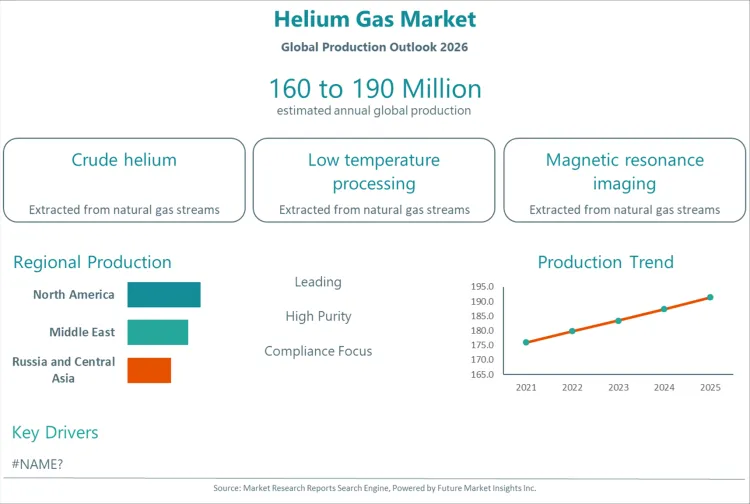
    Helium Gas Market

    Key Questions Answered

    • How constrained is global helium supply growth?
    • How does natural gas production volatility affect helium availability?
    • How do geopolitical factors influence supply security?
    • How resilient is helium demand across economic cycles?

    Helium Gas Product Forms That Define How Buyers Actually Use It

    Product Classification

    • Crude helium
    • Extracted from natural gas streams
    • Intermediate purification stage
    • Captive processing use
    • Grade A and high purity helium
    • Semiconductor manufacturing
    • Leak detection
    • Scientific research
    • Liquid helium
    • Magnetic resonance imaging
    • Cryogenic research
    • Space and aerospace use
    • Balloon and industrial helium
    • Lifting and inflation
    • Welding shielding
    • Controlled industrial applications

    High purity and liquid helium dominate strategic demand due to their critical role in medical and technology sectors. Lower purity uses remain price sensitive and more exposed to supply disruption.

    Key Questions Answered

    • How do buyers select gaseous versus liquid helium?
    • How do purity requirements vary by application?
    • How does liquefaction capacity affect availability?
    • How do handling and storage constraints influence sourcing?

    Helium Gas Recovery and Processing Routes That Define Cost and Reliability

    Process Classification

    • Cryogenic separation from natural gas
    • Low temperature processing
    • Capital intensive recovery
    • Long development timelines
    • Helium purification and upgrading
    • Removal of nitrogen and hydrocarbons
    • Multi stage separation
    • Tight specification control
    • Liquefaction and compression
    • High energy intensity
    • Specialised equipment
    • Limited global capacity
    • Storage and distribution systems
    • High pressure cylinders
    • Cryogenic tanks
    • Boil off management

    Recovery economics depend heavily on gas composition, energy pricing and scale. Liquefaction remains a key bottleneck influencing global trade flexibility.

    Key Questions Answered

    • How sensitive helium cost is to energy pricing?
    • How does recovery scale influence unit economics?
    • How do liquefaction constraints affect trade flows?
    • How do storage losses impact delivered volumes?

    Helium Gas End Use Spread Across Critical Sectors

    End Use Segmentation

    • Medical and healthcare
    • Magnetic resonance imaging
    • Cryosurgery
    • Research laboratories
    • Electronics and semiconductors
    • Chip manufacturing
    • Fibre optics
    • Leak detection
    • Aerospace and defence
    • Rocket propulsion testing
    • Space exploration
    • Military systems
    • Industrial and scientific applications
    • Welding and metallurgy
    • Controlled atmospheres
    • Research instrumentation

    Medical imaging and semiconductor manufacturing account for the majority of high value helium demand due to the lack of practical substitutes.

    Key Questions Answered

    • How do healthcare systems manage helium supply risk?
    • How does semiconductor growth influence demand?
    • How do aerospace programs affect demand variability?
    • How do users prioritise critical versus discretionary use?

    Helium Gas Regional Production and Consumption Potential

    North America

    North America remains a key producer and consumer supported by legacy infrastructure and strong technology demand.

    Middle East

    The Middle East contributes export oriented supply through integrated gas processing facilities.

    Russia and Central Asia

    These regions hold significant reserves but face operational and geopolitical uncertainties.

    Asia Pacific

    Asia Pacific is a major consumption region driven by electronics and healthcare, with heavy import dependence.

    Europe

    Europe remains almost entirely import dependent with demand concentrated in healthcare and research.

    Key Questions Answered

    • How do regional reserve profiles affect supply concentration?
    • How do importing regions manage strategic risk?
    • How do export restrictions affect availability?
    • How does logistics distance affect delivered cost?

    Helium Gas Supply Chain, Cost Drivers and Trade Patterns

    The helium supply chain begins with natural gas extraction followed by cryogenic separation, purification, liquefaction or compression and global distribution. Supply chains are fragile due to limited redundancy and high capital intensity.

    Key cost drivers include energy pricing, liquefaction capacity, plant uptime and logistics complexity. Trade flows connect a small number of producing regions with global healthcare and technology centres. Long term contracts dominate procurement due to supply risk.

    Buyers increasingly seek diversified sourcing and inventory buffering to manage volatility.

    Key Questions Answered

    • How do energy and processing costs translate into helium pricing?
    • How do buyers benchmark supply security?
    • How do transport constraints affect availability?
    • How do contracts mitigate disruption risk?

    Helium Gas Ecosystem View and Strategic Themes

    The ecosystem includes natural gas producers, helium recovery operators, industrial gas companies, healthcare providers, semiconductor manufacturers and governments. Supply concentration creates systemic risk across multiple critical industries.

    Strategic themes include recovery expansion tied to gas projects, conservation and recycling initiatives, long term offtake agreements and strategic stockpiling.

    Deeper Questions Decision Makers Should Ask

    • How secure is long term helium sourcing?
    • How diversified are supply contracts?
    • How exposed are operations to geopolitical disruption?
    • How scalable are recovery and liquefaction assets?
    • How effective are recycling and conservation efforts?
    • How robust are inventory management strategies?
    • How transparent are supplier reliability metrics?
    • How aligned are stakeholders across critical sectors?

    Bibliography

    • International Energy Agency. (2024). Natural gas processing, liquefaction, and by-product recovery outlook. IEA Publications.
    • USA Department of the Interior, Bureau of Land Management. (2023). Federal helium program transition, supply risks, and market impacts. U.S. Government Publishing Office.
    • World Health Organization. (2024). Medical imaging technologies and critical material requirements. WHO Press.

    Frequently Asked Questions

    What is the estimated global helium production volume in 2025?

    Global helium production in 2025 is estimated at approximately 160 to 190 million cubic metres, reflecting constrained supply and uneven recovery.

    What are the biggest cost drivers shaping helium pricing?

    Pricing is driven by energy costs, liquefaction capacity, recovery efficiency and logistics complexity.

    Why is helium considered a strategic material?

    Helium is non renewable on human timescales and critical for medical imaging, electronics and aerospace, with limited substitutes.

    How do supply disruptions affect end users?

    Disruptions lead to prioritisation of medical and semiconductor uses, with lower priority applications facing curtailment.

    Which sectors drive future helium demand?

    Healthcare imaging and semiconductor manufacturing are expected to remain the primary demand drivers.

    Key Questions Answered in the Report

    Supply chain and operations

    • How predictable is helium supply continuity?
    • How stable is recovery plant uptime?
    • How effective are storage and inventory buffers?
    • How resilient are logistics and distribution routes?
    • How quickly can supply disruptions be mitigated?
    • How are boil off losses managed?
    • How robust are safety systems?
    • How are operational disruptions handled?

    Procurement and raw material

    • How are helium contracts structured?
    • How do suppliers ensure purity consistency?
    • How is price volatility managed?
    • What contract duration supports security?
    • How are alternative suppliers qualified?
    • How do buyers manage force majeure risk?
    • How are audits conducted?
    • How do onboarding requirements vary by region?

    Technology and innovation

    • How do recovery technologies improve yield?
    • How are liquefaction efficiencies improved?
    • How does recycling reduce net consumption?
    • How do monitoring systems reduce losses?
    • How do producers manage scale up risk?
    • How are storage technologies advancing?
    • How do partnerships support supply security?
    • How does innovation support conservation goals?

    Buyer, channel and who buys what

    • Which sectors receive priority supply?
    • How do healthcare buyers manage allocation risk?
    • What volumes define standard agreements?
    • How do buyers balance inventory and cost?
    • How do channels influence delivered availability?
    • How do buyers verify supply assurances?
    • How do users manage operational risk?
    • How do specifications vary by application?

    Pricing, contract and commercial model

    • What reference points guide helium pricing?
    • How frequently are pricing reviews conducted?
    • How do contracts ensure continuity during shortages?
    • How do buyers compare long term versus spot supply?
    • What duration supports investment recovery?
    • How are disputes resolved?
    • How do logistics costs affect pricing terms?
    • How do contracts vary by end use criticality?

    Plant assessment and footprint

    • Which regions offer reliable reserve access?
    • What investment defines viable recovery scale?
    • How do permitting timelines affect projects?
    • How suitable are gas processing clusters?
    • How consistent are regulatory conditions?
    • How are safety and environmental audits managed?
    • How does workforce expertise affect uptime?
    • How do transport links support global supply?

    Explore Inorganic Chemicals Insights

    View Reports

    Trusted By
    Market Research Reports Search Engine

    Helium Gas Global Production Capacity and Growth Outlook