On this page
Global gum rosin production in 2026 is estimated at approximately 0.81 to 1.5 million tonnes, reflecting a mature but structurally tightening segment of the natural resins market. Supply growth is shaped by pine tapping productivity, labor availability, land use competition and environmental regulation in producing regions. Market conditions balance steady downstream demand from adhesives, inks and rubber with rising pressure on raw material availability and harvesting economics.
Production leadership remains concentrated in regions with established pine tapping traditions, large forest resources and integrated resin processing infrastructure. China continues to dominate global output, supported by extensive plantation forestry and processing capacity. Southeast Asia contributes incremental growth through expanded tapping activity, while Latin America maintains a stable but regionally concentrated supply base. Supply in many consuming regions remains import dependent due to climate constraints and lack of domestic pine resources.
Demand fundamentals remain resilient because gum rosin plays a critical role in tackifiers, paper sizing, rubber compounding and specialty chemical formulations. Buyers prioritise consistent acid number, colour stability and long-term supply reliability over spot price optimisation.
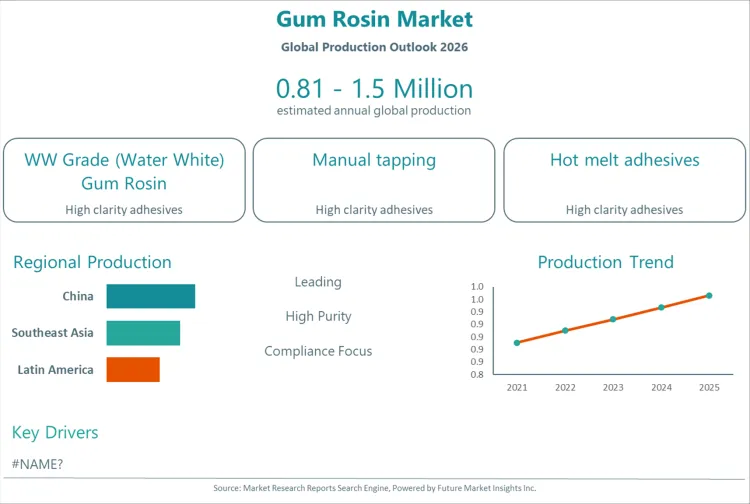
Higher grade gum rosin commands premium pricing due to tighter colour specifications and downstream performance requirements. Buyers focus on grade consistency, oxidation stability and predictable supply rather than maximum purity.
Traditional tapping remains dominant, but yield optimisation and labour efficiency increasingly determine cost competitiveness. Buyers benefit from suppliers that control both raw resin extraction and downstream distillation quality.
Adhesives dominate demand due to gum rosin’s irreplaceable tackifying properties. Buyers emphasise performance repeatability, colour control and secure supply rather than lowest-cost sourcing.
China leads global production supported by plantation forestry, large tapping labour pools and vertically integrated processors. Domestic consumption absorbs a significant share of output.
Vietnam and Indonesia contribute growing export volumes supported by favourable climates and expanding tapping programs, though scale remains below China.
Brazil and neighbouring regions maintain steady production linked to managed pine plantations, supplying both domestic and export markets.
These regions are largely import dependent due to limited tapping activity and higher labour costs, relying on stable long-term supply contracts.
Gum rosin supply begins with pine resin tapping followed by distillation, grading, packaging and international distribution. Key cost drivers include labour, yield per tree, energy for distillation and inland transport from forest regions to ports.
Trade flows are concentrated from Asia and Latin America to adhesive, ink and rubber manufacturing hubs worldwide. Buyers increasingly prefer contracted supply relationships to reduce exposure to seasonal variability and regulatory disruptions.
The gum rosin ecosystem includes forest owners, tapping labour networks, distillation processors, derivative producers and downstream industrial users. Supply resilience depends on sustainable forestry management, labour continuity and regulatory stability.
Strategic themes include yield optimisation, plantation expansion, derivative upgrading and long-term offtake alignment with adhesive and ink manufacturers.
Global gum rosin production in 2026 is estimated at approximately 0.81- 1.5 million tonnes, with growth constrained more by raw material availability than demand.
Pricing is primarily driven by tapping labour costs, resin yield per tree, energy use in distillation and inland logistics from forest regions.
Supply concentration in a few producing regions increases exposure to labour disruptions, environmental policy changes and seasonal yield variability for import-dependent markets.
Buyers increasingly favour suppliers with traceable forestry practices and stable long-term resin availability to reduce reputational and supply risk.
Selection depends on performance requirements, regulatory acceptance and formulation compatibility, with gum rosin remaining preferred in applications demanding natural origin and proven tack performance.
Explore Specialty Chemicals Insights
View Reports
Gum Rosin Global Production Capacity and Growth Outlook

Thank you!
You will receive an email from our Business Development Manager. Please be sure to check your SPAM/JUNK folder too.
