On this page

    Green Petroleum Coke Production and Capacity Outlook

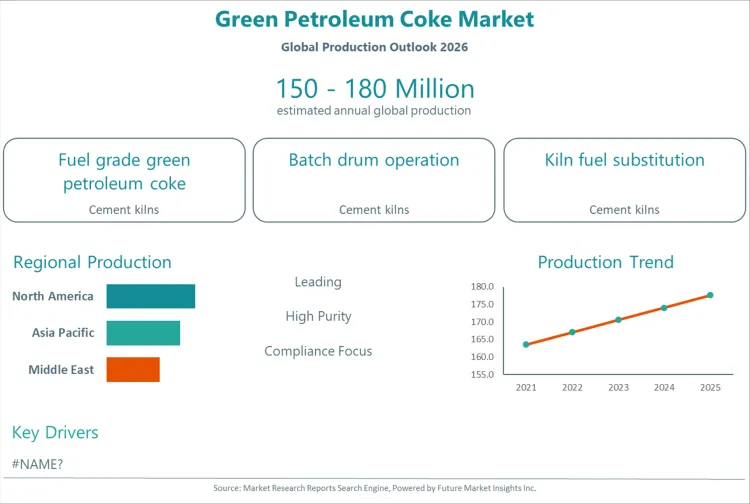
    Global green petroleum coke production capacity in 2026 is estimated at approximately 100 to 160 million tonnes, reflecting stable output tied closely to refinery throughput and crude slate selection rather than independent capacity expansion. Supply growth is structurally linked to delayed coking and fluid coking unit operations, making production largely a byproduct of fuel refining economics. Industry conditions balance steady downstream industrial demand with increasing environmental scrutiny and evolving fuel specifications.

    Production leadership remains concentrated in regions with high coking capacity and access to heavy or sour crude oil. North America leads global green petroleum coke output due to extensive delayed coking infrastructure. Asia Pacific continues to expand production alongside refinery upgrades and new coking units. The Middle East increases output through integrated refining and export focused operations. Europe maintains limited production due to lower coking intensity and environmental constraints. Several regions remain import dependent due to limited refinery coking capacity.

    Demand is supported by fuel use in cement, power and industrial boilers, alongside calcination feedstock requirements. Buyers prioritise sulphur content control, consistent quality and reliable supply continuity.
    Green Petroleum Coke Market

    Key Questions Answered

    • How does crude oil quality influence green petroleum coke output?
    • How closely is supply tied to refinery operating rates?
    • How do environmental regulations affect production economics?
    • How resilient is green petroleum coke demand across industrial cycles?

    Green Petroleum Coke Product Categories That Define How Buyers Actually Use It

    Product Classification

    • Fuel grade green petroleum coke
    • Cement kilns
    • Power generation
    • Industrial boilers
    • Low sulphur green petroleum coke
    • Calcined petroleum coke feedstock
    • Aluminium anode production
    • Specialty carbon materials
    • High sulphur green petroleum coke
      • Power and heat generation
      • Industrial fuel substitution
      • Export oriented fuel use
    • Shot coke and sponge coke variants
      • Fuel blending applications
      • Calcination suitability assessment
      • Handling and storage considerations

    Fuel grade material dominates global consumption by volume. Quality parameters such as sulphur, metals and volatile matter strongly influence end use suitability and pricing outcomes.

    Key Questions Answered

    • How do buyers differentiate fuel grade and calcination feedstock coke?
    • How does sulphur content influence end use selection?
    • How do coke morphology and hardness affect handling?
    • How do emissions requirements shape procurement decisions?

    Green Petroleum Coke Process Routes That Define Cost, Yield and Quality

    Process Classification

    • Delayed coking
      • Batch drum operation
      • High coke yield flexibility
      • Dominant global technology
    • Fluid coking
      • Continuous operation
      • Lower coke yield
      • Integrated gasification options
    • Flexi coking
      • Coke gasification integration
      • Reduced solid coke output
      • Higher capital intensity
    • Integrated refinery coking systems
      • Crude slate optimisation
      • Yield management
      • Product quality control

    Delayed coking remains the dominant route for green petroleum coke production. Process configuration and crude selection strongly influence coke quality, sulphur content and metals concentration.

    Key Questions Answered

    • How sensitive coke yield is to crude slate selection?
    • How do coking technologies affect coke quality?
    • How does refinery integration improve operational stability?
    • How do process choices influence emissions performance?

    Green Petroleum Coke End Use Spread Across Key Sectors

    End Use Segmentation

    • Cement and construction materials
      • Kiln fuel substitution
      • Cost driven energy sourcing
      • Emissions management
    • Power and industrial energy
      • Thermal power generation
      • Industrial boilers
      • Captive power plants
    • Calcination and carbon materials
      • Aluminium anodes
      • Carbon electrodes
      • Specialty carbon products
    • Metallurgical and other uses
      • Metal processing
      • Foundry fuel applications
      • Niche industrial uses

    Cement and power sectors account for the majority of fuel grade consumption. Calcination demand is more sensitive to sulphur limits and quality consistency.

    Key Questions Answered

    • How do cement producers evaluate fuel switching economics?
    • How do power users manage emissions compliance?
    • How does calcination demand influence quality requirements?
    • How do industrial users manage supply variability?

    Green Petroleum Coke Regional Production Potential Assessment

    North America

    North America leads global production supported by extensive delayed coking capacity and access to heavy crude blends.

    Asia Pacific

    Asia Pacific expands output through refinery upgrades and new coking unit installations aligned with fuel demand growth.

    Middle East

    The Middle East increases green petroleum coke supply through integrated refining and export focused operations.

    Europe

    Europe maintains limited production due to lower coking intensity and strict environmental regulation.

    Latin America and Africa

    Production exists in select refining hubs, while many countries rely on imports for industrial fuel needs.

    Key Questions Answered

    • How do regional refinery configurations shape supply availability?
    • How do export oriented regions manage logistics and quality control?
    • How do import dependent regions manage price and supply risk?
    • How do regulations influence regional competitiveness?

    Green Petroleum Coke Supply Chain, Cost Drivers and Trade Patterns

    The green petroleum coke supply chain begins at refinery coking units followed by crushing, screening, storage and bulk transport to end users. Material is commonly shipped in bulk via ports or transported domestically by rail and road.

    Key cost drivers include refinery operating rates, crude slate economics, handling costs and logistics. Environmental compliance costs related to dust, sulphur emissions and storage controls add complexity. Trade flows connect refining hubs with cement, power and calcination centres lacking domestic supply.

    Buyers structure contracts around quality specifications, sulphur thresholds and delivery reliability.

    Key Questions Answered

    • How do refinery economics influence coke availability?
    • How do logistics and storage costs affect delivered pricing?
    • How do buyers benchmark domestic versus imported supply?
    • How do environmental controls shape supply chain design?

    Green Petroleum Coke Ecosystem View and Strategic Themes

    The ecosystem includes crude oil suppliers, refinery operators, coke handlers, traders, cement producers, power generators and regulators. Supply leadership aligns with heavy crude processing regions, while demand concentrates in energy intensive industries.

    Strategic themes include emissions management, alternative fuel competition, refinery integration decisions and long term regulatory uncertainty.

    Deeper Questions Decision Makers Should Ask

    • How secure is long term access to refinery derived coke?
    • How exposed is demand to tightening emissions standards?
    • How competitive is green petroleum coke versus alternatives?
    • How resilient are logistics and storage systems?
    • How flexible are users in fuel substitution?
    • How transparent are quality and emissions disclosures?
    • How aligned are suppliers and end users on compliance?
    • How does crude slate evolution affect future supply?

    Bibliography

    • USA Energy Information Administration. (2024). Petroleum refining capacity, coking units, and refinery by-products. USA Department of Energy.
    • USA Energy Information Administration. (2023). International petroleum refining and heavy oil processing. USA Department of Energy.
    • Organisation for Economic Co-operation and Development. (2023). Industrial fuel use, emissions regulation, and energy-intensive sectors. OECD Publishing.
    • United Nations Environment Programme. (2023). Emissions control and fuel use in heavy industry. UNEP.

    Frequently Asked Questions

    What is the estimated global green petroleum coke production volume in 2025?

    Global green petroleum coke production in 2025 is estimated at approximately 145 to 180 million tonnes, aligned with refinery throughput and crude processing patterns.

    What are the biggest cost drivers shaping green petroleum coke pricing?

    Pricing is influenced by crude oil quality, refinery operating rates, logistics costs, sulphur content and environmental compliance requirements.

    How do regulations affect green petroleum coke usage?

    Environmental regulations restrict sulphur emissions, dust handling and fuel use in certain regions, influencing demand patterns and delivered cost.

    Why is green petroleum coke supply tied to refinery operations?

    Green petroleum coke is a byproduct of coking processes, making output dependent on crude slate and refinery configuration rather than standalone production decisions.

    Which sectors drive green petroleum coke demand?

    Cement manufacturing, power generation and calcination for carbon materials remain the primary demand drivers.

    Key Questions Answered in the Report

    Supply chain and operations

    • How predictable is refinery coke output?
    • How stable are handling and storage operations?
    • How effective are dust and emissions controls?
    • How resilient are logistics networks?
    • How quickly can supply adjust to refinery changes?
    • How are weather related disruptions managed?
    • How robust are quality inspection systems?
    • How are operational disruptions handled?

    Procurement and raw material

    • How is coke quality specified in contracts?
    • How do suppliers ensure sulphur consistency?
    • How is price volatility managed?
    • What contract terms support continuity?
    • How are alternative suppliers qualified?
    • How do buyers manage supply risk?
    • How are audits conducted?
    • How do onboarding requirements vary by region?

    Technology and innovation

    • How do handling systems reduce dust emissions?
    • How do storage designs improve safety?
    • How are emissions monitoring systems evolving?
    • How do refiners optimise coke quality?
    • How do users improve combustion efficiency?
    • How do plants reduce environmental footprint?
    • How do digital tools support compliance?
    • How do partnerships support transition planning?

    Buyer, channel and who buys what

    • Which sectors sustain green petroleum coke demand?
    • How do buyers evaluate fuel substitution options?
    • What volumes define standard agreements?
    • How do buyers manage emissions exposure?
    • How do channels influence delivered cost?
    • How do buyers verify quality documentation?
    • How do users manage operational risk?
    • How do specifications differ by application?

    Pricing, contract and commercial model

    • What reference points guide pricing?
    • How are quality adjustments reflected in contracts?
    • How do pricing reviews support continuity?
    • How do buyers compare regional offers?
    • What duration supports supply security?
    • How are disputes resolved?
    • How do environmental costs affect terms?
    • How do contracts vary by end use?

    Plant assessment and footprint

    • Which regions offer reliable refinery integration?
    • What scale defines economic viability?
    • How do permitting requirements affect operations?
    • How suitable are ports and terminals?
    • How consistent are regulatory conditions?
    • How are environmental inspections managed?
    • How does workforce readiness affect safety?
    • How do transport links support trade?

    Explore Fuel Insights

    View Reports
    Market Research Reports Search Engine

    Green Petroleum Coke Global Production Capacity and Growth Outlook