Food Additives Production and Capacity Outlook
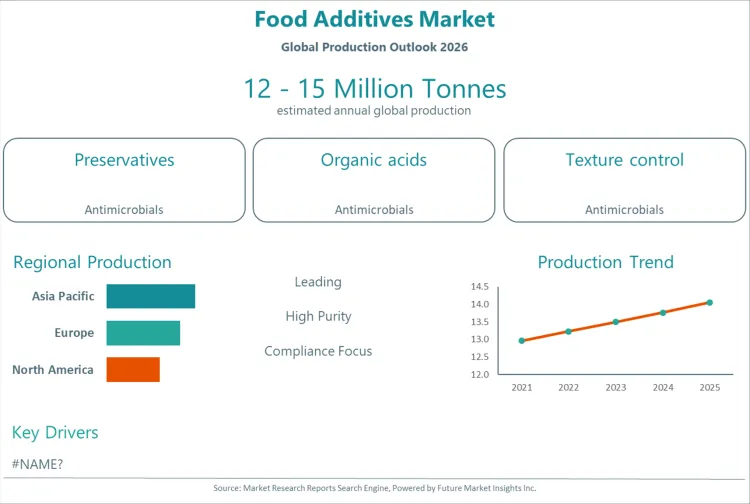
Global food additives production capacity in 2026 is estimated at approximately 12 to 15 million tonnes across flavour enhancers, preservatives, sweeteners, colours, emulsifiers and texturants. Capacity growth is steady and application led, reflecting rising processed food volumes, product diversification and reformulation activity rather than bulk commodity expansion. Investment focuses on debottlenecking, specialty ingredient lines and compliance upgrades rather than large scale greenfield capacity.
Production remains concentrated in regions with advanced food processing industries, strong regulatory infrastructure and integrated chemical and fermentation capability. Asia Pacific leads volume growth driven by packaged food consumption and export oriented processing. Europe maintains a strong position in regulated, specialty and clean label compliant additives. North America supports stable output aligned with large scale food manufacturing and innovation driven product launches. Several regions remain import dependent due to regulatory and technical barriers.
Demand growth is reinforced by shelf life management, texture control and flavour consistency requirements. Buyers prioritise regulatory clearance, formulation performance and supply continuity.
Key Questions Answered
- How closely is food additive demand tied to processed food production growth?
- How do regulatory approvals affect capacity expansion timelines?
- How does reformulation activity influence additive portfolios?
- How resilient is additive demand across economic cycles?
Food Additive Product Families That Define How Buyers Actually Use Them
Product Classification
- Preservatives
- Antimicrobials
- Antioxidants
- Shelf life extenders
- Sweeteners
- High intensity sweeteners
- Bulk sweeteners
- Sugar reduction systems
- Flavours and flavour enhancers
- Natural and nature identical flavours
- Umami enhancers
- Reaction flavours
- Colours
- Natural colours
- Synthetic colours
- Stability enhanced systems
- Emulsifiers and stabilisers
- Lecithins
- Mono and diglycerides
- Hydrocolloids
- Acidity regulators and texturants
- Organic acids
- Gelling agents
- Thickening systems
Sweeteners, preservatives and texturants account for the largest volume consumption, while flavours and natural colours drive higher value density and innovation.
Key Questions Answered
- How do buyers select additives by application and format?
- How do natural alternatives differ from synthetic options?
- How does stability affect additive choice?
- How do clean label trends influence procurement decisions?
Food Additive Production Routes That Define Cost, Quality and Compliance
Process Classification
- Fermentation based production
- Organic acids
- Amino acids
- Natural flavour compounds
- Chemical synthesis
- Sweeteners
- Preservatives
- Emulsifiers
- Extraction and purification
- Natural colours
- Botanical flavours
- Functional concentrates
- Blending and formulation
- Custom additive systems
- Application specific solutions
- Stability optimisation
Process selection prioritises purity, consistency and regulatory compliance. Fermentation based routes gain importance due to alignment with natural and clean label positioning.
Key Questions Answered
- How sensitive additive cost is to feedstock pricing?
- How do production routes affect regulatory classification?
- How does process yield influence competitiveness?
- How do quality systems affect customer qualification?
Food Additives End Use Spread Across Food Processing Segments
End Use Segmentation
- Bakery and confectionery
- Texture control
- Shelf life management
- Flavour enhancement
- Dairy and alternatives
- Emulsification
- Stability and mouthfeel
- Sugar reduction
- Beverages
- Sweetening systems
- Acid balance
- Colour stabilisation
- Savoury and ready meals
- Preservation
- Flavour consistency
- Texture retention
- Meat, seafood and plant based products
- Binding and water retention
- Oxidation control
- Colour stability
Bakery, beverages and dairy applications dominate additive use due to formulation intensity and volume scale.
Key Questions Answered
- How do processors balance functionality and ingredient lists?
- How does product shelf life requirement influence additive use?
- How do plant based products change additive demand patterns?
- How do processors manage additive substitution risk?
Food Additives Regional Production and Consumption Assessment
Asia Pacific
Asia Pacific leads volume growth supported by packaged food expansion and export oriented food processing.
Europe
Europe focuses on high compliance, natural and clean label additive production.
North America
North America maintains stable demand driven by large scale food manufacturing and innovation.
Latin America
Latin America shows rising consumption linked to processed food adoption with partial import dependence.
Middle East and Africa
These regions remain import dependent with growing demand driven by urbanisation and food security programs.
Key Questions Answered
- How do regional regulations influence additive portfolios?
- How do import dependent regions manage supply risk?
- How does consumer preference vary by region?
- How do logistics affect ingredient stability?
Food Additives Supply Chain, Cost Drivers and Trade Patterns
The food additives supply chain spans agricultural or petrochemical feedstocks, production, formulation and delivery to food processors. Traceability and documentation are critical due to regulatory oversight and consumer scrutiny.
Key cost drivers include raw material pricing, energy use, regulatory compliance and formulation complexity. Trade flows connect ingredient production hubs with global food manufacturing centres. Buyers favour suppliers offering application support and regulatory expertise.
Contracts emphasise specification stability, compliance documentation and long term availability.
Key Questions Answered
- How do feedstock costs translate into additive pricing?
- How do regulatory audits affect supplier qualification?
- How do buyers benchmark additive performance?
- How do logistics affect supply reliability?
Food Additives Ecosystem View and Strategic Themes
The ecosystem includes additive manufacturers, food processors, ingredient blenders, regulators and retailers. Supply concentration reflects regulatory barriers, formulation expertise and scale requirements.
Strategic themes include clean label reformulation, natural ingredient substitution, functional system development and supply chain transparency.
Deeper Questions Decision Makers Should Ask
- How secure is long term access to compliant additives?
- How diversified are sourcing strategies?
- How exposed are portfolios to regulatory reinterpretation?
- How scalable are natural additive alternatives?
- How robust are quality and traceability systems?
- How aligned are suppliers with reformulation roadmaps?
- How transparent are sustainability claims?
- How quickly can additive systems adapt to new regulations?
Bibliography
- World Trade Organization. (2023). Sanitary and phytosanitary measures and technical barriers to food ingredient trade. WTO Secretariat.
- Codex Alimentarius Commission. (2023). General standard for food additives and international harmonisation. FAO & WHO Codex Publications.
- United States Food and Drug Administration. (2024). Food additive status, GRAS notifications, and compliance oversight. USA Department of Health and Human Services.
Frequently Asked Questions
What is the estimated global food additives production volume in 2025?
Global food additives production in 2025 is estimated at approximately 12 to 15 million tonnes, driven by processed food demand and reformulation activity.
What are the biggest cost drivers shaping food additive pricing?
Pricing is driven by feedstock costs, energy inputs, regulatory compliance and formulation complexity.
How do regulations affect food additive availability?
Regulations define permitted additives, usage levels and labelling, influencing product portfolios and capacity planning.
Why are clean label additives gaining importance?
Clean label additives align with consumer preference for recognisable ingredients while maintaining functionality.
Which food segments drive future additive demand?
Bakery, beverages, dairy alternatives and plant based foods are expected to drive growth.