Tertiary Butyl Alcohol Production and Pricing Environment
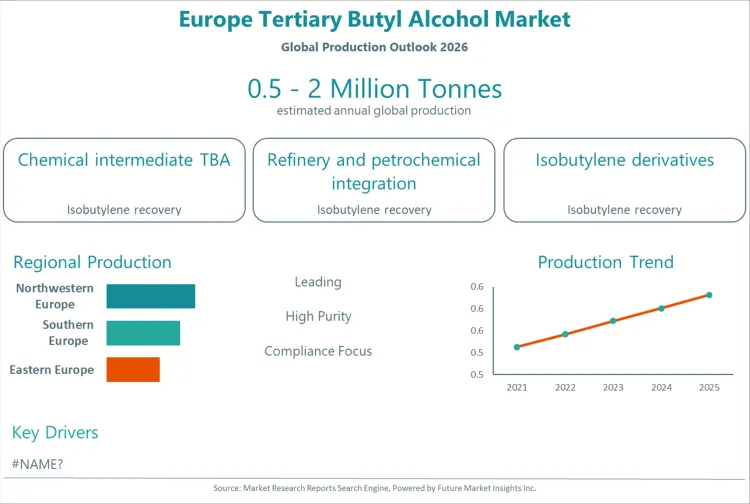
European tertiary butyl alcohol production capacity in 2026 is estimated at approximately 0.5 to 2 million tonnes, reflecting a tightly linked co production structure rather than widespread standalone synthesis. Output levels are driven primarily by the operating rates of propylene oxide units based on the PO TBA process, as well as isobutylene hydration routes connected to refinery and petrochemical operations.
Pricing conditions are influenced by propylene and isobutylene availability, energy costs, and the balance between TBA recovery and conversion into downstream products such as MTBE or isobutylene. When propylene oxide operating rates decline, TBA availability tightens regardless of downstream demand conditions. Energy pricing and maintenance cycles introduce additional variability.
Production concentration is highest in Northwestern Europe, supported by integrated petrochemical clusters in Germany, the Benelux region, and France. Other regions rely on interregional transfers or imports due to limited local production.
Key Questions Answered
- How dependent is TBA supply on propylene oxide operating rates?
- How do isobutylene and propylene availability affect output?
- How concentrated is European production capacity?
- How sensitive is pricing to energy and maintenance cycles?
Tertiary Butyl Alcohol Product Pathways That Define Actual Use
Product Classification
- Chemical intermediate TBA
- Isobutylene recovery
- Ether production feedstock
- Downstream chemical synthesis
- Solvent grade TBA
- Coatings and inks
- Chemical processing
- Cleaning formulations
- Fuel related use
- Intermediate for blending components
- Refinery balancing
- Limited direct fuel application
- Specialty and laboratory grade TBA
- Pharmaceuticals and research
- Controlled purity applications
- Analytical uses
Chemical intermediate use dominates European consumption due to integration with isobutylene and ether chains. Solvent applications provide smaller but stable volumes with defined quality requirements. Specialty grades require higher purity and traceability.
Key Questions Answered
- How do buyers distinguish chemical and solvent grade TBA?
- How does purity affect downstream usability?
- How flexible is allocation between recovery and conversion?
- How do specialty applications support value stability?
Tertiary Butyl Alcohol Production Routes That Shape Cost and Control
Process Classification
- PO TBA co production route
- Dominant European source
- Strong linkage to propylene oxide output
- Limited independent control
- Isobutylene hydration
- Refinery and petrochemical integration
- Smaller scale contribution
- Feedstock dependent economics
- Downstream dehydration and conversion
- Isobutylene regeneration
- Ether synthesis
- Margin optimisation
- Purification and finishing systems
- Water removal
- Quality adjustment
- Application specific specification
Co production from propylene oxide units defines European supply dynamics. On purpose TBA production remains limited due to cost and lack of independent demand drivers. Buyers value suppliers with flexible conversion capability and reliable quality control.
Key Questions Answered
- How viable is independent TBA production in Europe?
- How does PO unit utilisation influence availability?
- How flexible are conversion pathways?
- How does purification affect cost structure?
Tertiary Butyl Alcohol End Use Distribution Across European Industries
End Use Segmentation
- Petrochemical intermediates
- Isobutylene derivatives
- Ethers and additives
- Chemical chains
- Coatings and industrial solvents
- Paint formulations
- Printing inks
- Process solvents
- Refining and fuel systems
- Internal balancing
- Intermediate use
- Process optimisation
- Pharmaceutical and specialty uses
- Synthesis intermediates
- Laboratory solvents
- Controlled applications
Petrochemical integration anchors baseline consumption, while solvent uses provide steady secondary demand. Fuel related use is indirect and linked to broader refinery economics rather than standalone consumption.
Key Questions Answered
- How exposed is demand to propylene oxide cycles?
- How do solvent users manage substitution options?
- How does refinery utilisation affect offtake?
- How do specialty users manage quality assurance?
European Regional Production Assessment
Northwestern Europe
Germany, the Benelux region, and France form the core production cluster supported by integrated propylene oxide and refinery assets.
Southern Europe
Southern Europe shows limited local production and depends on interregional supply for solvent and chemical use.
Central and Eastern Europe
These regions rely primarily on imports and redistribution from Western European producers.
Nordic Region
The Nordic region consumes limited volumes mainly for specialty and laboratory applications.
Key Questions Answered
- How does integration shape regional supply security?
- How do cross border flows balance availability?
- How do logistics costs affect delivered pricing?
- How do regional energy policies influence operations?
Tertiary Butyl Alcohol Supply Chain, Cost Structure, and Trade Flows
The TBA supply chain begins with co production or hydration followed by purification, storage, and distribution to chemical and solvent users. Limited long distance transport feasibility increases reliance on regional supply.
Primary cost drivers include propylene or isobutylene pricing, energy consumption, purification intensity, and utilisation rates of upstream units. Trade flows within Europe are moderate, while imports from outside the region remain limited due to integration and logistics constraints.
Key Questions Answered
- How do feedstock costs translate into TBA pricing?
- How constrained is storage and logistics capacity?
- How do upstream outages affect supply continuity?
- How do buyers compare regional and imported material?
Tertiary Butyl Alcohol Ecosystem View and Strategic Considerations
The European TBA ecosystem includes propylene oxide producers, refinery operators, chemical converters, solvent formulators, distributors, and regulators. Alignment between PO unit operation and downstream TBA offtake is critical to avoid imbalances.
Strategic considerations include maintaining flexible conversion routes, securing long term offtake agreements, managing exposure to propylene availability, and ensuring compliance with solvent handling and safety regulation.
Deeper Questions Decision Makers Should Ask
- How resilient is supply to propylene oxide unit downtime?
- How diversified are conversion and offtake options?
- How adequate is regional storage capacity?
- How robust are logistics and safety systems?
- How defensible are long term supply agreements?
- How adaptable are assets to regulatory change?
Bibliography
- Organisation for Economic Co-operation and Development. (2024). Global propylene oxide production technologies and by-product management. OECD Environment, Health and Safety Publications.
- European Commission. (2024). Best Available Techniques (BAT) Reference Document for the Large Volume Organic Chemical Industry. Publications Office of the European Union.
- American Chemical Society. (2023). Propylene oxide manufacture: Process integration and co-product economics. Industrial & Engineering Chemistry Research, 62(48), 17521-17538.
Frequently Asked Questions
What is the estimated European TBA production capacity in 2026?
European tertiary butyl alcohol production capacity in 2026 is estimated at approximately 0.5 to 2 million tonnes.
What factors most strongly influence TBA pricing?
Key influences include propylene oxide operating rates, isobutylene availability, energy costs, and purification requirements.
Why is TBA production largely co produced rather than on purpose?
Demand patterns and economics favour recovery from integrated propylene oxide or refinery based processes rather than standalone investment.
How do buyers manage TBA supply risk?
Buyers prioritise integrated suppliers, diversify sourcing where possible, and align contracts with upstream operating cycles.