On this page

    Sodium Sulphate Production and Pricing Environment

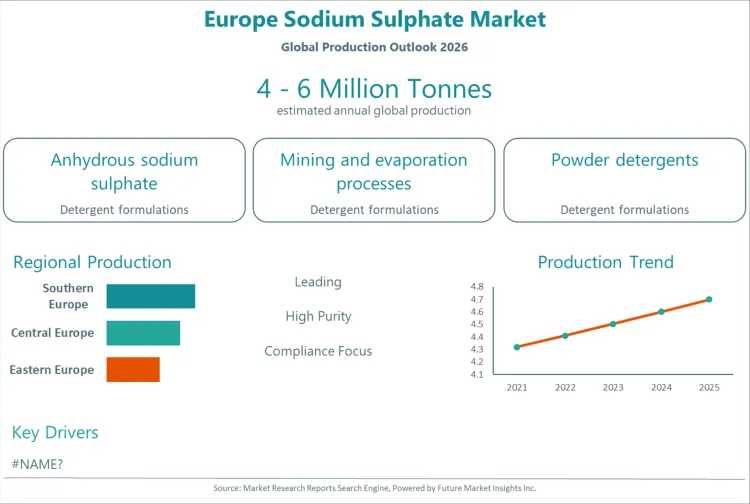
    European sodium sulphate production capacity in 2026 is estimated at approximately 4 to 6 million tonnes, reflecting a dual supply structure based on both natural deposits and synthetic byproduct generation. Output levels depend strongly on operating rates in upstream chemical processes such as hydrochloric acid, viscose fibre, and lithium battery material production, as well as mining activity at natural sodium sulphate deposits.

    Pricing conditions are influenced by purity, moisture content, particle size, and transport distance rather than raw material scarcity. In many regions sodium sulphate clears at relatively low values at the production site, with delivered pricing shaped primarily by logistics intensity and handling costs. Availability can tighten when upstream byproduct generating plants reduce operating rates or when transport capacity becomes constrained.

    Production concentration is highest in Central and Southern Europe where natural deposits and large chemical complexes are located. Spain, Germany, and Eastern European countries anchor supply. Northern Europe relies more heavily on cross border flows due to limited local production.
    Europe Sodium Sulphate Market

    Key Questions Answered

    • How dependent is sodium sulphate availability on upstream chemical operations?
    • How do logistics costs shape delivered pricing?
    • How does product form influence usability across sectors?
    • How concentrated is European production?

    Sodium Sulphate Product Forms That Define Actual Use

    Product Classification

    • Anhydrous sodium sulphate
    • Detergent formulations
    • Glass manufacturing
    • Chemical processing
    • Sodium sulphate decahydrate
    • Thermal storage applications
    • Specialty industrial uses
    • Controlled crystallisation systems
    • Natural mineral sodium sulphate
    • Detergents and fillers
    • Glass batch materials
    • Bulk industrial consumption
    • Synthetic byproduct sodium sulphate
      • Chemical intermediates
      • Fibre and textile processing
      • Battery related supply chains

    Anhydrous sodium sulphate accounts for the majority of industrial consumption due to ease of handling and compatibility with detergent and glass processes. Hydrated forms and specialty grades serve narrower applications that require specific thermal or physical properties.

    Key Questions Answered

    • How do buyers choose between natural and synthetic supply?
    • How do moisture and particle size affect processing?
    • How do purity requirements differ by application?
    • How does product form affect transport economics?

    Sodium Sulphate Production Routes That Shape Cost and Control

    Process Classification

    • Natural mineral extraction
      • Mining and evaporation processes
      • Stable long term output
      • Geographic concentration
    • Chemical byproduct recovery
      • Hydrochloric acid and chlorination chains
      • Viscose fibre production
      • Battery materials processing
    • Salt cake generation
      • Sulphuric acid reactions
      • Inorganic chemical manufacturing
      • Variable purity profiles
    • Drying and crystallisation systems
      • Moisture control
      • Particle sizing
      • Application specific finishing

    Natural production provides baseline stability, while byproduct recovery introduces variability tied to upstream industrial cycles. Buyers value suppliers that can offer consistent quality and predictable logistics despite the byproduct nature of much of the supply.

    Key Questions Answered

    • How sensitive is output to upstream operating rates?
    • How controllable is quality from byproduct streams?
    • How does drying intensity affect cost?
    • How do producers manage variability?

    Sodium Sulphate End Use Distribution Across European Industries

    End Use Segmentation

    • Detergents and cleaning products
      • Powder detergents
      • Industrial cleaners
      • Bulk formulation use
    • Glass manufacturing
      • Flat glass
      • Container glass
      • Specialty glass compositions
    • Pulp and paper
      • Kraft process recovery
      • Chemical balancing
      • Process efficiency support
    • Industrial and specialty uses
      • Textile processing
      • Thermal storage materials
      • Chemical synthesis

    Detergent production remains the primary consumption anchor due to volume requirements and formulation compatibility. Glass and pulp and paper uses provide stable industrial demand, while specialty applications support smaller but higher specification volumes.

    Key Questions Answered

    • How does detergent formulation change affect demand?
    • How cyclical is glass production related consumption?
    • How do pulp and paper mills manage sourcing?
    • How do specialty users manage quality consistency?

    European Regional Production Assessment

    Southern Europe

    Spain hosts significant natural sodium sulphate deposits that support large scale extraction and export within Europe.

    Central Europe

    Germany and neighbouring countries combine natural supply with substantial byproduct generation from chemical industries.

    Eastern Europe

    Eastern Europe contributes both natural and synthetic output with growing relevance tied to battery material production.

    Northern Europe

    Northern Europe depends largely on imports and regional redistribution due to limited domestic production.

    Key Questions Answered

    • How does resource location affect supply concentration?
    • How do cross border flows balance regional gaps?
    • How do transport distances affect delivered cost?
    • How do environmental rules vary by region?

    Sodium Sulphate Supply Chain, Cost Structure, and Trade Flows

    The sodium sulphate supply chain begins with mining or chemical recovery followed by drying, crystallisation, storage, and distribution via bulk trucks, rail, or maritime transport. Low unit value at origin increases sensitivity to logistics efficiency.

    Primary cost drivers include energy use for drying, labour, storage infrastructure, and transport distance. Trade flows within Europe are active due to uneven geographic distribution of production and consumption. Long distance imports from outside Europe remain limited due to transport cost sensitivity.

    Key Questions Answered

    • How does transport distance affect delivered pricing?
    • How constrained is drying and storage capacity?
    • How do energy costs influence processing economics?
    • How do buyers evaluate local versus imported supply?

    Sodium Sulphate Ecosystem View and Strategic Considerations

    The European sodium sulphate ecosystem includes mining operators, chemical producers, detergent manufacturers, glass producers, pulp and paper mills, distributors, and logistics providers. Coordination between byproduct generators and downstream users is essential to maintain balance and minimise disposal risk.

    Strategic considerations include securing long term offtake for byproduct streams, optimising drying and handling infrastructure, managing environmental compliance for mining and waste streams, and maintaining logistics resilience.

    Deeper Questions Decision Makers Should Ask

    • How resilient is supply to upstream chemical cycles?
    • How diversified are sourcing options?
    • How adequate is regional storage capacity?
    • How robust are logistics networks?
    • How defensible are long term supply agreements?
    • How adaptable are assets to quality changes?

    Bibliography

    • European Environment Agency. (2024). Mining, inorganic chemicals, and environmental compliance in Europe. EEA.
    • International Labour Organization. (2024). Occupational safety in mineral extraction and bulk chemical handling. ILO.
    • United Nations Environment Programme. (2024). Lifecycle and environmental management of inorganic salts. UNEP.

    Frequently Asked Questions

    What is the estimated European sodium sulphate production capacity in 2026?

    European sodium sulphate production capacity in 2026 is estimated at approximately 4 to 6 million tonnes.

    Why is sodium sulphate often priced low at the production site?

    Because a significant share is generated as a byproduct, pricing reflects disposal avoidance and logistics cost rather than raw material scarcity.

    What factors most strongly influence delivered pricing?

    Transport distance, drying intensity, storage availability, and handling requirements have the largest impact.

    How do buyers choose between natural and synthetic sodium sulphate?

    Buyers assess purity, consistency, moisture content, proximity, and long term supply reliability.

    Key Questions Answered in the Report

    Supply chain and operations

    • How reliable are upstream byproduct sources?
    • How sufficient is drying and storage capacity?
    • How consistent is product quality?
    • How resilient are logistics routes?
    • How quickly can supply adjust to disruptions?
    • How effective are maintenance practices?
    • How robust are safety and environmental controls?
    • How exposed is supply to upstream shutdowns?

    Procurement and sourcing

    • How are supply contracts structured?
    • How is moisture and purity specified?
    • How diversified are suppliers?
    • How do buyers manage delivery risk?
    • How are compliance requirements verified?
    • How do logistics costs vary by region?
    • How are force majeure clauses applied?
    • How do sourcing strategies differ by use case?

    Technology and process improvement

    • How efficient are drying and crystallisation systems?
    • How is energy usage optimised?
    • How are emissions and dust controlled?
    • How is digital monitoring applied?
    • How do upgrades improve consistency?
    • How are new product forms qualified?
    • How do partnerships support optimisation?
    • How do assets adapt to variable feed quality?

    Buyer, channel, and who buys what

    • Which sectors anchor baseline demand?
    • How do detergent producers plan volumes?
    • How do glass manufacturers manage continuity?
    • What volumes define long term agreements?
    • How do buyers assess supplier reliability?
    • How do delivery models differ by region?
    • How do buyers verify quality consistency?
    • How do users manage substitution options?

    Pricing, contract, and commercial structure

    • What benchmarks guide sodium sulphate pricing?
    • How often are prices reviewed?
    • How are transport and energy costs passed through?
    • How do contracts differ by product form?
    • How long are supply commitments?
    • How are disputes resolved?
    • How is delivery flexibility priced?
    • How do suppliers protect cost recovery?

    Plant assessment and footprint

    • Which locations offer reliable feedstock access?
    • What defines efficient drying scale?
    • How do energy costs affect operations?
    • How do environmental rules shape output?
    • How available is skilled labour?
    • How modern are storage and handling assets?
    • How adaptable are plants to demand shifts?
    • How suitable are sites for reinvestment?

    Explore Inorganic Chemicals Insights

    View Reports

    Trusted By
    Market Research Reports Search Engine

    Europe Sodium Sulphate Production Capacity and Growth Outlook