On this page

    Fluoroelastomer Production and Pricing Environment

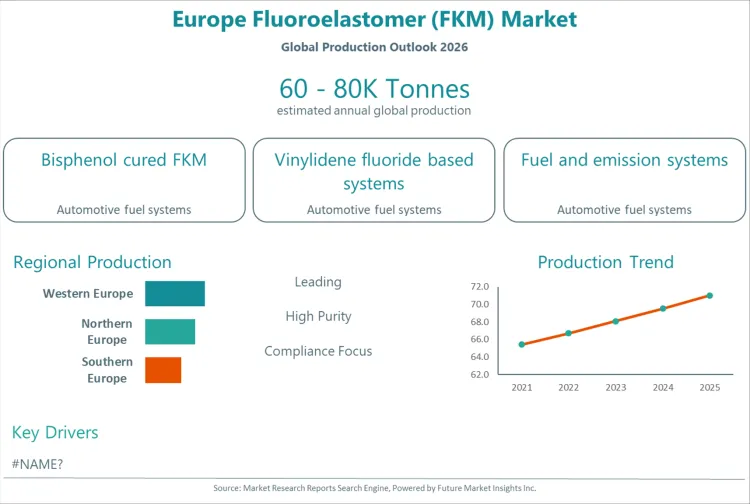
    European fluoroelastomer production capacity in 2026 is estimated at approximately 65 to 85 thousand tonnes, reflecting a specialised and tightly controlled production base. Output levels are governed less by volume expansion and more by qualification driven demand, regulatory compliance, and technology capability. European producers prioritise consistency, traceability, and formulation depth rather than scale focused growth.

    Pricing conditions are influenced by fluorspar availability, upstream fluorinated intermediates, energy intensity, and environmental compliance costs. Regulatory restrictions on certain fluorinated substances increase operating complexity and compliance expenditure, contributing to structurally higher cost levels relative to many other elastomers. Specialty grades maintain stronger pricing stability due to limited substitution options and long qualification cycles.

    Production concentration is highest in Western Europe, with key assets located in Germany, France, and Italy. These facilities are closely integrated with upstream fluorochemical production and downstream compounding. Other European regions rely on imports to support local consumption.
    Europe Fluoroelastomer Fkm Market

    Key Questions Answered

    • How constrained is fluoroelastomer production capacity in Europe?
    • How do regulatory requirements influence operating costs?
    • How sensitive is supply to upstream fluorochemical availability?
    • How concentrated is regional production?

    Fluoroelastomer Grade Families That Define Actual Use

    Product Classification

    • Bisphenol cured FKM
    • Automotive fuel systems
    • Seals and O rings
    • General industrial use
    • Peroxide cured FKM
      • High temperature environments
      • Chemical processing
      • Enhanced compression set resistance
    • Specialty low temperature FKM
      • Aerospace components
      • Energy sector sealing
      • Extreme operating conditions
    • Custom compounded FKM formulations
      • Application specific hardness
      • Media resistance optimisation
      • OEM qualified solutions

    Bisphenol cured grades account for the largest share of European consumption due to established automotive and industrial use. Peroxide cured and specialty grades support higher value applications where thermal stability, chemical resistance, and durability are critical.

    Key Questions Answered

    • How do cure systems affect performance trade offs?
    • How do buyers manage qualification complexity?
    • How does compounding expand application range?
    • How do specialty grades justify premium pricing?

    Fluoroelastomer Production Routes That Shape Cost and Control

    Process Classification

    • Fluorinated monomer synthesis
      • Vinylidene fluoride based systems
      • Hexafluoropropylene integration
      • High regulatory oversight
    • Emulsion and suspension polymerisation
      • Molecular weight control
      • Performance consistency
      • Capital intensive reactors
    • Post polymerisation compounding
      • Fillers and curatives
      • Property tailoring
      • Customer specific formulations
    • Integrated upstream to downstream operations
      • Feedstock security
      • Quality control
      • Compliance management

    Integrated producers benefit from tighter control over feedstocks, quality, and regulatory compliance. Non integrated compounders depend on merchant polymers and face greater exposure to supply and cost volatility. Buyers value suppliers with strong formulation expertise and regulatory transparency.

    Key Questions Answered

    • How sensitive are costs to fluorinated intermediate pricing?
    • How do regulatory constraints affect process design?
    • How flexible are producers across grade portfolios?
    • How does integration reduce supply risk?

    Fluoroelastomer End Use Distribution Across Europe

    End Use Segmentation

    • Automotive and mobility
      • Fuel and emission systems
      • Powertrain sealing
      • Electric vehicle thermal management
    • Energy and industrial processing
      • Oil and gas equipment
      • Chemical processing plants
      • High pressure sealing
    • Aerospace and defence
      • Engine components
      • Hydraulic systems
      • Extreme environment sealing
    • Industrial equipment and manufacturing
      • Pumps and valves
      • Compressors
      • Specialty machinery

    Automotive applications remain the largest volume driver, while energy and aerospace uses support higher specification demand. Electrification trends increase requirements for thermal and chemical resistance, reinforcing FKM relevance in next generation mobility.

    Key Questions Answered

    • How does electrification change sealing requirements?
    • How cyclical is energy sector demand?
    • How do aerospace standards affect supplier qualification?
    • How do industrial users manage long term reliability?

    European Regional Production Assessment

    Western Europe

    Germany, France, and Italy form the core production cluster supported by fluorochemical integration, skilled labour, and advanced regulatory compliance systems.

    Northern Europe

    Northern Europe relies primarily on imports and local compounding to serve industrial and energy applications.

    Central and Eastern Europe

    These regions show limited production capacity and depend on regional distribution networks for supply continuity.

    Southern Europe

    Southern Europe combines local compounding with imported base polymers to support automotive and industrial demand.

    Key Questions Answered

    • How does integration level differ across European regions?
    • How do cross border flows support supply continuity?
    • How do logistics costs affect delivered pricing?
    • How do regulatory frameworks vary by country?

    Fluoroelastomer Supply Chain, Cost Structure, and Trade Flows

    The FKM supply chain begins with fluorspar mining and fluorochemical processing, followed by monomer synthesis, polymerisation, compounding, and distribution to OEMs and component manufacturers. Each step is subject to strict environmental and safety regulation.

    Primary cost drivers include fluorspar pricing, energy consumption, regulatory compliance costs, and labour intensity. Trade flows within Europe are active due to limited production locations. Imports from Asia complement European supply for certain grades but face qualification and regulatory hurdles.

    Key Questions Answered

    • How do upstream fluorochemical costs translate into elastomer pricing?
    • How do regulatory costs affect competitiveness?
    • How do qualification requirements limit trade flexibility?
    • How do buyers benchmark domestic versus imported supply?

    Fluoroelastomer Ecosystem View and Strategic Considerations

    The European fluoroelastomer ecosystem includes fluorochemical producers, polymer manufacturers, compounders, seal producers, OEMs, regulators, and testing bodies. Close coordination across the value chain is essential due to safety, performance, and compliance requirements.

    Strategic considerations include securing compliant fluorinated feedstocks, investing in formulation innovation, managing regulatory change related to PFAS scrutiny, and maintaining long term customer qualification positions.

    Deeper Questions Decision Makers Should Ask

    • How exposed is supply to regulatory tightening?
    • How secure is long term fluorochemical sourcing?
    • How differentiated is the formulation portfolio?
    • How resilient are margins under compliance cost pressure?
    • How defensible are customer qualifications?
    • How scalable are development and testing capabilities?

    Bibliography

    • Kang, H., Müller, M., & Schaub, G. (2024). Cost transmission and regulatory burden in high-performance elastomer value chains. Industrial & Engineering Chemistry Research, 63(24), 10421-10434.
    • Roth, S., & Weber, M. (2024). Qualification-driven demand and pricing stability in specialty elastomers. Polymer Engineering & Science, 64(8), 1987-2001.
    • Bazzanella, A. M., & Ausfelder, F. (2024). Fluoropolymers and fluoroelastomers under PFAS regulatory pressure. Energy & Environmental Science, 17(2), 682-696.

    Frequently Asked Questions

    What is the estimated European fluoroelastomer production capacity in 2026?

    European fluoroelastomer production capacity in 2026 is estimated at approximately 65 to 85 thousand tonnes.

    What factors most strongly influence FKM pricing?

    Key influences include fluorochemical feedstock costs, energy prices, regulatory compliance expenses, and grade complexity.

    Why is European FKM production highly specialised?

    Strict environmental regulation, high capital intensity, and long qualification cycles limit the number of viable producers.

    How do buyers choose between FKM suppliers?

    Buyers evaluate chemical resistance, thermal performance, regulatory compliance, qualification history, and long term supply reliability.

    Key Questions Answered in the Report

    Supply chain and operations

    • How secure is fluorspar and fluorochemical sourcing?
    • How compliant are upstream processes with evolving regulation?
    • How flexible are polymerisation and compounding units?
    • How sufficient is buffer inventory?
    • How resilient are logistics routes?
    • How effective are quality control systems?
    • How robust are safety practices?
    • How exposed are operations to regulatory disruption?

    Procurement and feedstocks

    • How are fluorochemical contracts structured?
    • How volatile are upstream material costs?
    • How diversified are sourcing options?
    • How do buyers manage compliance verification?
    • How are audit requirements handled?
    • How do sourcing strategies differ by grade?
    • How are long term agreements negotiated?
    • How do buyers manage supply concentration risk?

    Technology and process improvement

    • How efficient are polymerisation systems?
    • How flexible is formulation development?
    • How are emissions and waste managed?
    • How is digital monitoring applied?
    • How do process upgrades improve consistency?
    • How are new grades validated?
    • How do partnerships support innovation?
    • How are testing capabilities expanded?

    Buyer, channel, and who buys what

    • Which sectors anchor baseline demand?
    • How do automotive OEMs manage qualification cycles?
    • How do energy users secure continuity?
    • What volumes define long term agreements?
    • How do buyers assess supplier reliability?
    • How do distribution models differ by region?
    • How do buyers verify consistency?
    • How do users manage substitution risk?

    Pricing, contract, and commercial structure

    • What benchmarks guide FKM pricing?
    • How often are prices reviewed?
    • How are regulatory cost changes passed through?
    • How do contracts differ by grade?
    • How long are supply commitments?
    • How are disputes resolved?
    • How are logistics costs allocated?
    • How do suppliers protect cost recovery?

    Plant assessment and footprint

    • Which sites offer integrated fluorochemical access?
    • What defines efficient polymerisation scale?
    • How do energy costs affect operations?
    • How do environmental rules shape output?
    • How available is skilled labour?
    • How modern are compounding assets?
    • How adaptable are plants to regulatory change?
    • How suitable are sites for reinvestment?

    Explore Polymers & Plastics Insights

    View Reports

    Trusted By
    Market Research Reports Search Engine

    Europe Fluoroelastomer (FKM) Production Capacity and Growth Outlook