On this page
European ethanol production capacity in 2026 is estimated at approximately 9.5 to 10.5 million tonnes, reflecting a mature production base operating under shifting regulatory, agricultural, and energy conditions. Output is closely linked to grain availability, sugar beet processing, and policy driven fuel blending requirements rather than discretionary capacity expansion.
Pricing conditions are strongly influenced by feedstock costs, energy inputs, and blending obligations tied to transport fuels. Periods of agricultural volatility introduce cost instability, while energy price movements affect fermentation, distillation, and dehydration economics. Ethanol producers operate within narrow operating margins that depend on co-product valorisation such as distillers dried grains and carbon dioxide recovery.
Production concentration remains strongest in France, Germany, the Benelux region, and Central Europe, where agricultural integration, logistics infrastructure, and fuel demand intersect. Northern and Western Europe maintain stable output anchored in fuel blending. Southern Europe relies more heavily on imports due to limited feedstock availability and smaller production assets.
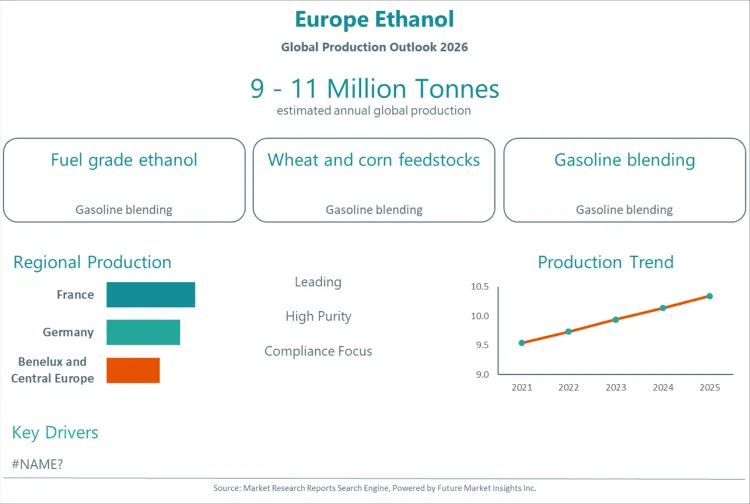
Fuel grade ethanol represents the largest volume segment due to regulatory blending requirements. Industrial and potable grades command higher unit value but require tighter quality control and certification. Buyers differentiate suppliers based on purity consistency, traceability, and long-term delivery reliability.
Conventional fermentation routes dominate European output due to established infrastructure and feedstock access. Advanced routes remain limited but attract interest for long-term sustainability alignment. Buyers benefit from producers with operational flexibility and diversified feedstock sourcing.
Transport fuels account for the majority of consumption due to regulatory alignment, while industrial and beverage uses provide stable non-fuel demand. Healthcare usage expanded structurally following public health requirements and remains an important specialty segment.
France leads European ethanol production through strong sugar beet and grain integration supported by fuel blending requirements.
Germany maintains significant grain based capacity aligned with domestic fuel consumption and industrial demand.
These regions operate logistics efficient plants serving both domestic use and cross border distribution.
Southern Europe relies more heavily on imports due to limited feedstock availability and smaller scale assets.
The Nordic region focuses on sustainability aligned fuels with limited domestic production and higher import reliance.
The ethanol supply chain begins with agricultural feedstocks followed by fermentation, distillation, dehydration, storage, and distribution to fuel blenders, industrial users, and beverage producers. Co-products play a critical role in revenue balance and risk mitigation.
Primary cost drivers include grain or sugar prices, energy consumption, labour, and compliance costs. Trade flows within Europe remain active, while imports from non-European origins supplement supply during feedstock shortfalls or demand spikes.
The European ethanol ecosystem includes agricultural producers, bio-refineries, fuel blenders, chemical users, beverage producers, regulators, and logistics providers. Alignment across agriculture, energy, and transport policy remains central to long-term stability.
Strategic considerations include feedstock diversification, energy efficiency investments, emissions compliance, and resilience against policy shifts affecting fuel blending requirements.
European ethanol production capacity in 2026 is estimated at approximately 9.5 to 10.5 million tonnes.
Key drivers include feedstock prices, energy costs, operating efficiency, and regulatory compliance requirements.
Co-products such as animal feed and recovered carbon dioxide provide essential revenue that supports plant economics during periods of cost pressure.
Buyers evaluate price competitiveness, sustainability certification, supply reliability, and logistics efficiency.
Explore Energy and Environmental Chemicals Insights
View Reports
Europe Ethanol Production Capacity and Growth Outlook

Thank you!
You will receive an email from our Business Development Manager. Please be sure to check your SPAM/JUNK folder too.
