On this page

    BOPET Film Production and Pricing Environment

    European BOPET film production capacity in 2026 is estimated at approximately 2 to 3 million tonnes, reflecting a mature and capital intensive manufacturing base. Capacity growth has been limited, with investment focused primarily on line upgrades, specialty coating capability, and efficiency improvement rather than greenfield expansion.

    Pricing behaviour is influenced by PET resin costs, energy pricing, film line utilisation, and product mix between standard packaging grades and higher value specialty films. Energy intensity remains a critical cost component due to stretching, heat setting, and coating processes. Periods of elevated energy costs place pressure on operating margins and may reduce effective supply through temporary rate adjustments.

    Production concentration is strongest in Western and Central Europe, where long established film producers operate integrated or semi integrated sites close to major packaging and industrial conversion hubs. Eastern and Southern Europe rely more heavily on regional supply flows and imports for specific film grades.
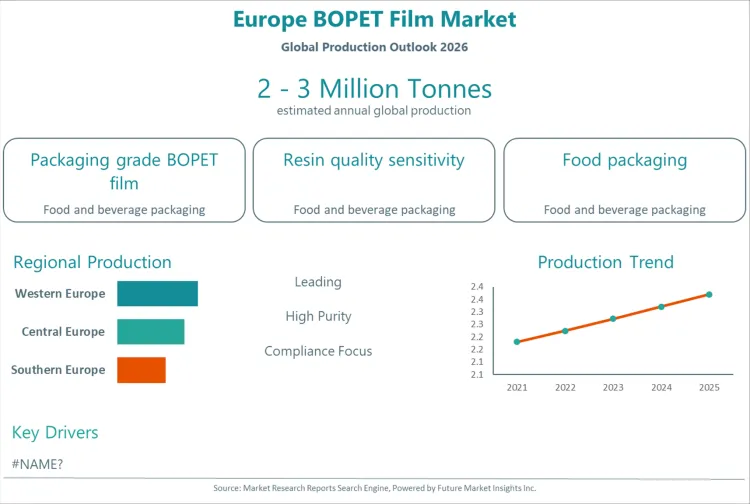
    Europe Bopet Film Market

    Key Questions Answered

    • How constrained is BOPET film capacity expansion in Europe?
    • How do PET resin and energy costs affect pricing behaviour?
    • How does product mix influence profitability and availability?
    • How concentrated is production across the region?

    BOPET Film Grade Families That Define Actual Use

    Product Classification

    • Packaging grade BOPET film
    • Food and beverage packaging
    • Flexible packaging laminates
    • Barrier and metallised structures
    • Industrial grade BOPET film
    • Release liners
    • Labels and tapes
    • Industrial laminates
    • Electrical and electronic film
    • Insulation films
    • Capacitors
    • Flexible electronics
    • Specialty and coated BOPET film
    • Optical films
    • Solar and energy applications
    • High temperature and functional coatings

    Packaging grades account for the largest volume share due to scale and continuity of use. Electrical, industrial, and specialty films represent lower volumes but higher technical complexity, longer qualification cycles, and more stable customer relationships.

    Key Questions Answered

    • How do buyers differentiate standard and specialty BOPET films?
    • How do coating and surface treatments affect performance?
    • How strict are thickness and defect tolerances by application?
    • How do qualification requirements shape supplier selection?

    BOPET Film Production Routes That Shape Cost and Control

    Process Classification

    • PET resin drying and extrusion
    • Resin quality sensitivity
    • Moisture control requirements
    • Energy intensive preparation
    • Biaxial orientation lines
    • Machine direction and transverse stretching
    • Capital intensive equipment
    • Throughput optimisation
    • Heat setting and surface treatment
    • Dimensional stability
    • Adhesion control
    • Functional performance
    • Coating and metallisation platforms
    • Value added functionality
    • Barrier enhancement
    • Differentiation capability

    Producers with newer film lines benefit from higher output efficiency, improved thickness control, and lower scrap rates. Coating and metallisation capabilities provide strategic differentiation but increase operational complexity and capital requirements.

    Key Questions Answered

    • How does line age affect cost competitiveness?
    • How sensitive are operations to resin quality variation?
    • How do coating capabilities influence value positioning?
    • How flexible are producers in adjusting film specifications?

    BOPET Film End Use Distribution Across Europe

    End Use Segmentation

    • Flexible packaging
    • Food packaging
    • Beverage and snack laminates
    • Personal care products
    • Industrial applications
    • Labels and release films
    • Adhesive tapes
    • Protective laminates
    • Electrical and electronics
    • Insulation materials
    • Capacitor films
    • Electronic components
    • Energy and specialty uses
    • Photovoltaic backsheets
    • Insulation systems
    • Advanced functional films

    Flexible packaging anchors baseline demand due to volume scale. Industrial and electrical applications provide steady consumption tied to manufacturing activity. Energy related uses remain smaller but strategically important for specialty film producers.

    Key Questions Answered

    • How stable is packaging related film consumption?
    • How do industrial cycles affect demand variability?
    • How do electrical standards affect supplier qualification?
    • How do specialty uses support long term demand visibility?

    European Regional Production Assessment

    Western Europe

    Western Europe hosts a large share of BOPET capacity supported by proximity to packaging converters and advanced coating capability.

    Central Europe

    Central Europe combines modern film lines with access to downstream industrial and electronics manufacturing.

    Southern Europe

    Southern Europe relies more on imports and regional redistribution, particularly for specialty and coated films.

    Eastern Europe

    Eastern Europe shows selective capacity additions focused on packaging grades, with increasing relevance for regional supply.

    Key Questions Answered

    • How does geographic proximity affect logistics costs?
    • How do regional demand profiles shape grade mix?
    • How do energy costs vary by location?
    • How does infrastructure support film distribution?

    BOPET Film Supply Chain, Cost Structure, and Trade Flows

    The BOPET film supply chain begins with PET resin sourcing followed by extrusion, biaxial orientation, finishing, and delivery to converters and OEMs. Inventory management is critical due to wide grade diversity and thickness requirements.

    Primary cost drivers include PET resin pricing, energy consumption, labour, line utilisation, and coating inputs. Trade flows within Europe remain active, particularly for specialty films, while imports from Asia supplement supply during periods of tight availability or for cost competitive packaging grades.

    Key Questions Answered

    • How do resin costs translate into film pricing?
    • How sensitive is supply to energy cost changes?
    • How do imports affect availability of standard grades?
    • How do buyers benchmark regional and imported film?

    BOPET Film Ecosystem View and Strategic Considerations

    The European BOPET film ecosystem includes PET resin suppliers, film producers, coating specialists, packaging converters, industrial users, and brand owners. Collaboration across the value chain is increasingly important to meet recyclability, downgauging, and performance requirements.

    Strategic considerations include upgrading film lines, expanding specialty and coated portfolios, improving energy efficiency, and aligning products with circular economy and recycling initiatives.

    Deeper Questions Decision Makers Should Ask

    • How resilient are operations under high energy cost scenarios?
    • How differentiated is the specialty film portfolio?
    • How secure is PET resin sourcing?
    • How scalable are coating and metallisation assets?
    • How defensible are long term customer relationships?
    • How adaptable are products to sustainability regulation?

    Bibliography

    • Eurostat. (2024). Intra-EU and extra-EU trade statistics for plastic films and sheets. Statistical Office of the European Union.
    • World Trade Organization. (2024). International trade in plastic films and packaging materials. WTO Statistics and Research.
    • UN Conference on Trade and Development. (2024). Global trade patterns in packaging materials. UNCTAD Trade and Development Report.

    Frequently Asked Questions

    What is the estimated European BOPET film production capacity in 2026?

    European BOPET film production capacity in 2026 is estimated at approximately 2 to 3 million tonnes.

    What factors most strongly influence BOPET film pricing in Europe?

    Key influences include PET resin costs, energy prices, film line utilisation, and the share of specialty and coated grades.

    Why is capacity growth limited in Europe?

    High capital intensity, energy costs, mature demand patterns, and a focus on upgrading existing assets limit new capacity additions.

    How do buyers choose between BOPET film suppliers?

    Buyers evaluate film consistency, defect rates, thickness control, coating capability, supply reliability, and sustainability alignment.

    Key Questions Answered in the Report

    Supply chain and operations

    • How reliable are film line operating rates?
    • How sensitive are operations to energy disruption?
    • How sufficient is buffer inventory?
    • How resilient are logistics networks?
    • How quickly can output adjust to demand changes?
    • How effective are maintenance strategies?
    • How robust are quality control systems?
    • How exposed are operations to resin supply disruption?

    Procurement and raw materials

    • How are PET resin contracts structured?
    • How volatile are energy and additive costs?
    • How diversified are sourcing options?
    • How do buyers manage price pass through?
    • How are sustainability criteria verified?
    • How do sourcing strategies differ by grade?
    • How are long term agreements negotiated?
    • How do buyers manage import reliance?

    Technology and process improvement

    • How modern are biaxial orientation lines?
    • How efficient are stretching and heat setting processes?
    • How is energy usage optimised?
    • How is digital monitoring applied?
    • How are coating defects minimised?
    • How are new film structures qualified?
    • How do upgrades improve yield and consistency?
    • How do partnerships support innovation?

    Buyer, channel, and who buys what

    • Which applications anchor baseline demand?
    • How do converters manage supply continuity?
    • How do industrial users plan qualification cycles?
    • What volumes define long term agreements?
    • How do buyers assess supplier reliability?
    • How do channels differ by application?
    • How do buyers verify performance consistency?
    • How do users manage substitution risk?

    Pricing, contract, and commercial structure

    • What benchmarks guide BOPET film pricing?
    • How often are prices reviewed?
    • How are resin and energy changes passed through?
    • How do contracts differ by grade and coating?
    • How long are supply commitments?
    • How are disputes resolved?
    • How are logistics costs allocated?
    • How do suppliers protect cost recovery?

    Plant assessment and footprint

    • Which sites offer energy efficient operation?
    • What defines efficient film line scale?
    • How do local energy policies affect output?
    • How do environmental rules shape production?
    • How available is skilled labour?
    • How modern are coating and metallisation assets?
    • How adaptable are plants to new specifications?
    • How suitable are sites for long term reinvestment?

    Explore Polymers & Plastics Insights

    View Reports

    Trusted By
    Market Research Reports Search Engine

    Europe BOPET Film Production Capacity and Growth Outlook