Europe Biodiesel Production and Capacity Outlook
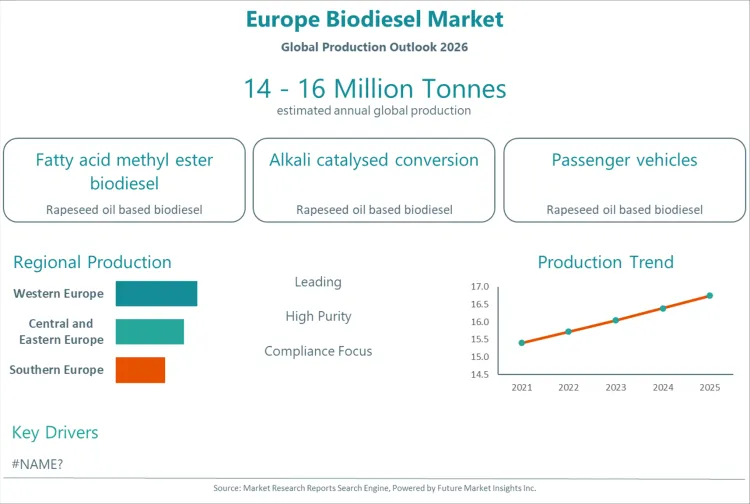
Europe biodiesel production capacity in 2026 is estimated at approximately 14 to 16 million tonnes per year, positioning the region among the largest biodiesel producing blocs globally. Capacity growth is constrained and policy shaped, reflecting tightening sustainability rules, feedstock eligibility limits and increasing competition from renewable diesel rather than unrestricted expansion. Investment activity focuses on feedstock flexibility upgrades, waste and residue processing capability and compliance driven plant modifications.
Production leadership remains concentrated in countries with established blending mandates, advanced fuel infrastructure and access to compliant feedstocks. Germany, France, Spain and Italy account for a significant share of regional capacity. Central and Eastern Europe contribute growing volumes supported by agricultural output and domestic blending requirements. Several countries rely on imports to balance supply due to feedstock constraints and plant rationalisation.
Demand stability is anchored in mandated blending targets and greenhouse gas reduction obligations. Buyers prioritise sustainability certification, traceability and regulatory compliance over purely volumetric supply.
Key Questions Answered
- How restrictive are European sustainability rules on biodiesel capacity growth?
- How does feedstock eligibility affect long term production viability?
- How does renewable diesel competition influence utilisation rates?
- How resilient is biodiesel demand under evolving transport decarbonisation pathways?
Biodiesel Product Types That Define How Buyers Actually Use It
Product Classification
- Fatty acid methyl ester biodiesel
- Rapeseed oil based biodiesel
- Soybean oil based biodiesel
- Sunflower oil based biodiesel
- Waste and residue based biodiesel
- Used cooking oil biodiesel
- Animal fat biodiesel
- Advanced biodiesel grades
- Mandate compliant biodiesel
- National blending obligation supply
- Greenhouse gas reduction certified volumes
- Regulated fuel distribution
- Export and intra regional biodiesel
- Cross border trade within Europe
- Specification aligned supply
- Contract based volumes
Waste and residue based biodiesel gains share due to favourable regulatory treatment, while crop based biodiesel faces stricter sustainability thresholds.
Key Questions Answered
- How do buyers distinguish crop based and waste based biodiesel?
- How do greenhouse gas thresholds affect procurement decisions?
- How do national specifications differ across Europe?
- How does certification influence supplier selection?
Europe Biodiesel Process Routes That Define Cost and Compliance
Process Classification
- Conventional transesterification
- Alkali catalysed conversion
- Mature and widely deployed
- Rapeseed focused systems
- Advanced feedstock pretreatment
- High free fatty acid processing
- Waste oil upgrading
- Yield optimisation
- Multi feedstock processing
- Flexible oil input systems
- Residue based feedstock handling
- Compliance driven optimisation
- Glycerine recovery and upgrading
- Pharmaceutical grade glycerine
- Industrial applications
- Co product value enhancement
European biodiesel economics are driven by feedstock cost, compliance expenditure and carbon intensity performance rather than scale alone.
Key Questions Answered
- How sensitive biodiesel economics are to rapeseed oil pricing?
- How do waste based feedstocks improve compliance outcomes?
- How do pretreatment systems affect plant utilisation?
- How do co products support operating margins?
Biodiesel End Use Spread Across European Fuel Segments
End Use Segmentation
- Road transport diesel blending
- Passenger vehicles
- Freight transport
- Public transport fleets
- Heating and stationary fuels
- Renewable heating oil
- District heating blends
- Seasonal consumption
- Marine and inland navigation
- Inland waterways
- Port operations
- Pilot fuel programs
- Export and cross border supply
- Intra European trade
- Contract driven shipments
- Compliance balancing volumes
Road transport blending dominates demand, while heating and marine uses provide supplementary demand influenced by national policy choices.
Key Questions Answered
- How do blending mandates shape biodiesel demand stability?
- How do heating fuel applications affect seasonal demand?
- How do fuel quality standards vary by end use?
- How do buyers manage cold flow and storage requirements?
Europe Biodiesel Regional Production and Policy Assessment
Western Europe
Western Europe leads biodiesel production supported by strong regulatory frameworks, established mandates and fuel infrastructure.
Central and Eastern Europe
This region expands production aligned with agricultural output and domestic blending requirements.
Southern Europe
Southern Europe balances domestic production with imports due to feedstock limitations.
Nordic Countries
Nordic countries focus on advanced and waste based biodiesel with limited crop based production.
Key Questions Answered
- How do national policies influence capacity utilisation?
- How does feedstock availability vary across Europe?
- How do import flows balance regional supply gaps?
- How does regulatory stability affect investment confidence?
Europe Biodiesel Supply Chain, Cost Drivers and Trade Patterns
The European biodiesel supply chain integrates agricultural production, waste oil collection, biodiesel conversion, storage and regulated fuel distribution. Sustainability verification and traceability systems play a central role.
Key cost drivers include feedstock pricing, certification costs, energy inputs and logistics expenses. Trade flows are predominantly intra European, with limited imports supplementing waste based feedstock shortfalls.
Contracts are structured around blending compliance, sustainability documentation and indexed feedstock pricing.
Key Questions Answered
- How do feedstock costs translate into biodiesel pricing?
- How do certification systems affect supplier qualification?
- How do logistics influence delivered fuel cost?
- How do buyers benchmark domestic and imported biodiesel?
Europe Biodiesel Ecosystem View and Strategic Themes
The ecosystem includes farmers, waste oil collectors, biodiesel producers, fuel distributors, regulators and certification bodies. Biodiesel operates within a tightly regulated framework aligned with broader climate policy.
Strategic themes include transition toward waste and residue feedstocks, alignment with renewable diesel pathways, compliance optimisation and long term policy risk management.
Deeper Questions Decision Makers Should Ask
- How secure is long term access to compliant feedstocks?
- How exposed are producers to regulatory tightening?
- How resilient are assets to declining diesel demand?
- How scalable are waste oil collection systems?
- How robust are sustainability verification frameworks?
- How aligned are national and European level policies?
- How transparent are carbon accounting methodologies?
- How quickly can producers adapt to fuel transition scenarios?
Bibliography
- USDA Foreign Agricultural Service. (2023). EU oilseeds and products annual: Rapeseed supply, waste oils, and biofuel demand. Global Agricultural Information Network.
- European Environment Agency. (2024). Greenhouse gas intensity thresholds and sustainability verification for transport fuels. EEA Publications.
- European Environment Agency. (2023). Renewable fuels, land use change risk, and feedstock sustainability in Europe. EEA Publications.
Frequently Asked Questions
What is the estimated Europe biodiesel production volume in 2025?
Europe biodiesel production in 2025 is estimated at approximately 14 to 16 million tonnes, supported by blending mandates and greenhouse gas reduction targets.
What are the biggest cost drivers shaping biodiesel pricing in Europe?
Pricing is driven by feedstock costs, sustainability certification expenses, energy inputs and compliance with greenhouse gas thresholds.
Why is waste based biodiesel gaining share?
Waste based biodiesel offers lower carbon intensity scores and more favourable regulatory treatment compared with crop based alternatives.
How does renewable diesel affect biodiesel demand?
Renewable diesel competes for feedstocks and policy support, influencing biodiesel utilisation rates.
Which countries are most influential in European biodiesel production?
Germany, France, Spain and Italy remain the most influential producers due to scale and policy frameworks.