On this page
Global dimethyl amine production in 2026 is estimated at approximately 1.1 to 1.4 million tonnes, reflecting steady expansion tied to specialty chemicals, pharmaceuticals, crop protection and water treatment demand. Dimethyl amine is a core intermediate within the aliphatic amines family and is commonly produced alongside mono methyl amine and trimethyl amine in integrated plants.
Supply growth is driven by downstream demand rather than speculative capacity additions. Production economics depend on methanol and ammonia pricing, catalyst performance, energy use and separation efficiency. Because dimethyl amine is rarely produced as a standalone product, availability is closely linked to operating decisions within mixed amine production units.
Production leadership remains concentrated in regions with integrated methanol supply and downstream chemical manufacturing depth. Asia Pacific leads global capacity supported by agrochemical and pharmaceutical production. North America maintains stable output aligned with water treatment and industrial uses. Europe supports regulated but technologically advanced capacity. Several regions remain import dependent due to safety and infrastructure constraints.
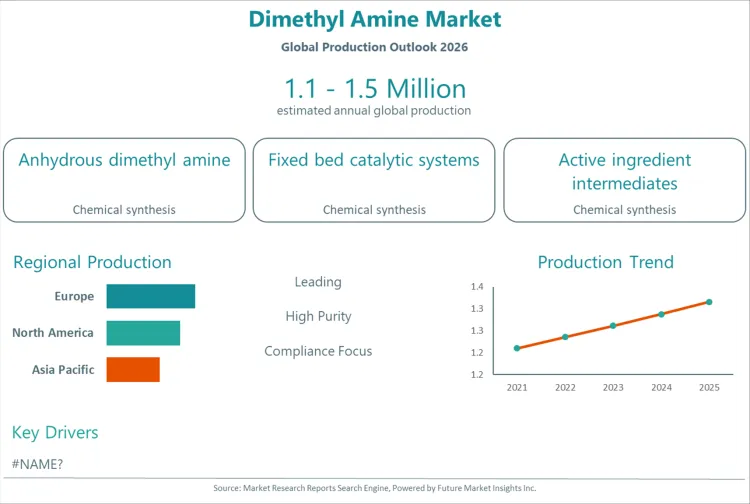
Anhydrous material dominates chemical synthesis due to higher reactivity. Aqueous solutions are preferred where handling safety and dosing control are priorities. High purity grades require additional purification and compliance, limiting supplier availability.
Catalytic methylation remains the standard production route. Selectivity control is critical to optimise dimethyl amine yield relative to co products. Separation efficiency directly affects unit economics and product availability.
Pharmaceutical and agrochemical uses account for the majority of value demand due to synthesis requirements. Water treatment applications provide stable volume demand linked to infrastructure and municipal spending.
Asia Pacific dominates global production supported by methanol availability and strong downstream chemical manufacturing.
North America maintains stable capacity aligned with water treatment, pharmaceuticals and industrial chemicals.
Europe supports regulated production with emphasis on high purity and safety compliance.
The Middle East shows emerging potential through methanol based chemical integration.
These regions remain largely import dependent due to limited local amine production infrastructure.
Dimethyl amine supply begins with methanol and ammonia sourcing, followed by catalytic synthesis, separation, storage and regulated distribution. Products are transported in pressurised containers or as aqueous solutions depending on application. Downstream buyers include pharmaceutical manufacturers, agrochemical companies and water treatment formulators.
Feedstock costs, catalyst life, energy consumption, plant utilisation, safety systems and logistics dominate cost structure. Trade flows are often regional due to transport restrictions and safety requirements.
The dimethyl amine ecosystem includes methanol producers, ammonia suppliers, amine manufacturers, pharmaceutical companies, agrochemical firms, water treatment providers, distributors and regulators. Asia Pacific anchors volume growth, while Europe and North America influence safety and quality standards.
Strategic themes include balancing mixed amine product slates, managing safety compliance and aligning production with regulated downstream demand.
Global dimethyl amine production in 2025 is estimated at approximately 1.1 to 1.4 million tonnes, supported by pharmaceutical and agrochemical demand.
Pricing is driven by methanol and ammonia feedstock costs, catalyst efficiency, energy use, separation intensity and safety compliance.
The methylation process naturally yields multiple amines, making integrated co production more efficient.
Safety, transport and emissions rules limit production locations and favour experienced operators.
Buyers rely on long term contracts, regional sourcing and qualification of multiple suppliers.
Explore Hydrocarbons, Petrochemicals, and Organic Chemicals Insights
View Reports
Dimethyl Amine Global Production Capacity and Growth Outlook

Thank you!
You will receive an email from our Business Development Manager. Please be sure to check your SPAM/JUNK folder too.
