On this page
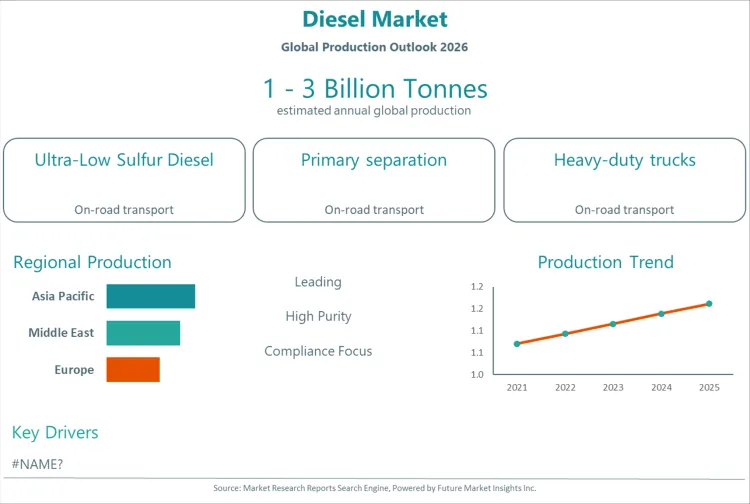
Global diesel production in 2026 is estimated at approximately 1 to 3 billion tonnes, reflecting its position as the most widely used refined transport fuel globally. Output direction is shaped by crude slate selection, refinery upgrading capacity, regional fuel standards, and the balance between diesel, gasoline, and jet fuel yields.
Production capacity is concentrated in regions with large and complex refining systems. Asia Pacific continues to add new capacity, particularly in China, India, and Southeast Asia, supported by modern refineries designed for high middle-distillate output. The Middle East has emerged as a major exporter through large-scale conversion refineries. Europe and North America maintain mature refining systems, with output influenced by maintenance cycles, biofuel blending mandates, and emissions regulations.
Usage remains broad-based across freight transport, agriculture, mining, construction, and backup power generation. Buyers prioritise fuel reliability, specification compliance, and supply continuity rather than absolute volume growth.
Fuel specifications such as sulfur content, cetane number, density, and cold-flow properties determine suitability. Buyers focus on engine compatibility, emissions compliance, and performance under local operating conditions.
Processing intensity determines diesel quality and production cost. Buyers benefit from refineries with advanced upgrading units capable of meeting strict specifications consistently.
Freight transport accounts for the largest share of consumption, while agriculture and construction provide stable, seasonal demand. Industrial uses prioritise reliability and energy density.
Asia Pacific leads demand growth and capacity additions, driven by freight activity, infrastructure development, and expanding refining systems.
The Middle East plays a growing role as an export hub for diesel due to large-scale, high-conversion refineries.
Europe remains structurally diesel-heavy in transport, with supply influenced by refinery rationalisation and renewable fuel integration.
North America maintains balanced diesel production supported by shale-derived crude, strong freight activity, and renewable diesel expansion.
These regions rely heavily on imports due to limited refining capacity, exposing them to logistics and price volatility.
The diesel supply chain includes crude sourcing, refining, storage, pipeline and marine transport, terminal handling, and final distribution. Major cost drivers include crude prices, refinery operating rates, compliance costs, freight rates, and inventory management.
International movement is shaped by refinery location, shipping economics, and regional specification differences. Diesel flows are increasingly influenced by arbitrage opportunities and seasonal demand shifts.
The diesel ecosystem includes crude producers, refiners, logistics operators, fuel distributors, fleet operators, industrial users, and regulators. Long-term positioning depends on refinery competitiveness, compliance readiness, and adaptation to energy transition pressures.
Strategic considerations include refinery upgrading decisions, renewable diesel integration, emissions management, and balancing near-term demand with long-term decarbonisation pathways.
Global diesel production in 2026 is estimated at approximately 1-3 billion tonnes.
Road freight transport accounts for the largest share, followed by agriculture, construction, and industrial uses.
Stricter sulfur and emissions standards increase refining complexity and can limit supply from less complex refineries.
Diesel faces gradual displacement in light-duty transport, while heavy-duty, industrial, and off-road uses remain more resilient in the near to medium term.
Buyers rely on diversified sourcing, storage management, long-term contracts, and blending strategies.
Explore Hydrocarbons, Petrochemicals, and Organic Chemicals Insights
View Reports
Diesel Global Production Capacity and Growth Outlook

Thank you!
You will receive an email from our Business Development Manager. Please be sure to check your SPAM/JUNK folder too.
