On this page

    Dichloroethane Production and Capacity Outlook

    Global dichloroethane production capacity in 2026 is estimated at approximately 50 to 55 million tonnes, reflecting growth closely tied to polyvinyl chloride expansion rather than independent merchant supply development. Capacity additions are primarily integrated within chlor alkali and PVC complexes, with limited standalone investment. Industry conditions balance strong PVC driven demand with high capital intensity, energy sensitivity and environmental compliance requirements.

    Production leadership remains concentrated in regions with integrated ethylene, chlorine and PVC infrastructure. Asia Pacific leads global capacity additions driven by construction and infrastructure demand. North America maintains significant production supported by ethane advantaged ethylene supply and established chlor alkali capacity. Europe shows limited growth, focusing on asset optimisation and emissions reduction rather than volume expansion. The Middle East expands selectively through export oriented integrated complexes. Several regions remain import dependent due to lack of chlorine infrastructure.

    Demand stability is reinforced by PVC consumption in construction, pipes and profiles. Buyers prioritise integration reliability, operational uptime and regulatory compliance.
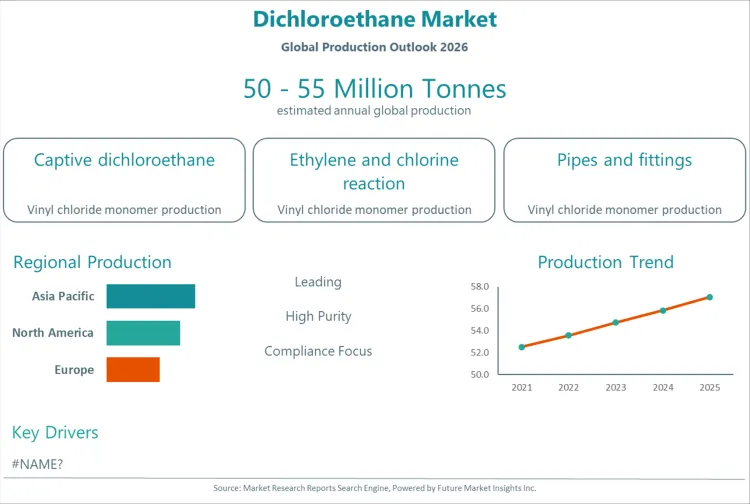
    Dichloroethane Market

    Key Questions Answered

    • How tightly is dichloroethane capacity linked to PVC demand growth?
    • How does chlorine availability constrain production expansion?
    • How do energy costs affect operating economics?
    • How do environmental regulations influence capacity utilisation?

    Dichloroethane Product Forms That Define How Buyers Actually Use It

    Product Classification

    • Captive dichloroethane
      • Vinyl chloride monomer production
      • Integrated PVC value chains
      • Reduced transport exposure
    • Merchant dichloroethane
      • Export oriented supply
      • Regional PVC balancing
      • Limited standalone demand
    • High purity dichloroethane
      • Specialty polymer applications
      • Controlled industrial uses
      • Tight impurity specifications

    Captive consumption dominates global volume, with most dichloroethane converted directly into vinyl chloride on site. Merchant volumes remain secondary and are sensitive to logistics and regulatory constraints.

    Key Questions Answered

    • How do buyers distinguish captive and merchant supply?
    • How do purity requirements affect downstream cracking performance?
    • How do transport risks influence sourcing strategies?
    • How does regulatory classification affect merchant trade?

    Dichloroethane Process Routes That Define Cost, Integration and Control

    Process Classification

    • Direct chlorination of ethylene
      • Ethylene and chlorine reaction
      • High selectivity
      • Integrated chlor alkali dependency
    • Oxychlorination
      • Ethylene hydrochloride route
      • Hydrogen chloride recycling
      • Improved chlorine balance
    • Balanced chlorination systems
      • Combined direct and oxychlorination
      • Optimised chlorine utilisation
      • Integrated PVC complexes
    • Thermal cracking to VCM
      • High temperature furnaces
      • Energy intensive operation
      • Stringent emissions control

    Balanced chlorination systems dominate modern plants due to improved chlorine efficiency and integration flexibility.

    Key Questions Answered

    • How sensitive dichloroethane cost is to ethylene pricing?
    • How does chlorine balance affect plant stability?
    • How do process choices influence emissions performance?
    • How does integration reduce operational risk?

    Dichloroethane End Use Spread Across Key Sectors

    End Use Segmentation

    • Polyvinyl chloride production
      • Pipes and fittings
      • Profiles and window systems
      • Flooring and films
    • Specialty polymers and resins
      • Copolymers
      • Industrial plastics
      • Niche applications
    • Limited solvent and industrial use
      • Controlled chemical processing
      • Laboratory applications
      • Restricted industrial formulations

    PVC production accounts for the overwhelming majority of dichloroethane consumption, making construction activity a key demand driver.

    Key Questions Answered

    • How does construction activity influence dichloroethane demand?
    • How do PVC formulation trends affect upstream volumes?
    • How do specialty uses manage regulatory constraints?
    • How do buyers manage demand cyclicality?

    Dichloroethane Regional Production Potential Assessment

    Asia Pacific

    Asia Pacific leads global capacity growth supported by PVC demand, infrastructure investment and integrated chlor alkali assets.

    North America

    North America maintains strong production supported by low cost ethylene feedstock and export oriented PVC chains.

    Europe

    Europe focuses on compliance driven optimisation, energy efficiency and emissions reduction.

    Middle East

    The Middle East shows selective growth through integrated export focused petrochemical complexes.

    Latin America and Africa

    These regions remain largely import dependent for dichloroethane and downstream PVC.

    Key Questions Answered

    • How do regional feedstock economics affect competitiveness?
    • How do import dependent regions manage supply risk?
    • How do environmental rules differ by region?
    • How do logistics affect regional availability?

    Dichloroethane Supply Chain, Cost Drivers and Trade Patterns

    The dichloroethane supply chain is highly integrated, spanning ethylene production, chlorine generation, chlorination, cracking to vinyl chloride and polymerisation. Merchant trade is limited due to hazardous handling requirements and regulatory oversight.

    Key cost drivers include ethylene pricing, electricity costs for chlor alkali production, energy use in cracking and emissions compliance. Trade flows mainly occur between integrated hubs and deficit PVC regions.

    Contracts prioritise integration reliability, safety documentation and long term supply continuity.

    Key Questions Answered

    • How do feedstock costs translate into dichloroethane economics?
    • How do energy prices affect chlorine production cost?
    • How do safety requirements limit trade flexibility?
    • How do buyers benchmark integrated versus merchant supply?

    Dichloroethane Ecosystem View and Strategic Themes

    The ecosystem includes ethylene producers, chlor alkali operators, PVC manufacturers, logistics providers and regulators. Supply concentration reflects the need for tight integration and compliance.

    Strategic themes include chlorine balance optimisation, emissions management, energy efficiency and long term PVC demand alignment.

    Deeper Questions Decision Makers Should Ask

    • How secure is long term ethylene and chlorine access?
    • How resilient are assets to energy price volatility?
    • How exposed are operations to regulatory tightening?
    • How flexible are plants to demand shifts?
    • How scalable are integrated complexes?
    • How robust are safety and environmental systems?
    • How transparent are compliance processes?
    • How aligned are upstream and downstream investments?

    Bibliography

    • Organisation for Economic Co-operation and Development. (2023). Global plastics and chemical value chains: PVC, upstream intermediates, and regulatory pressures. OECD Publishing.
    • European Commission Joint Research Centre. (2023). Best available techniques (BAT) for chlor-alkali, chlorination, and PVC production. Publications Office of the European Union.
    • USA Environmental Protection Agency. (2024). Toxic substances control act (TSCA) risk management actions for chlorinated hydrocarbons. Office of Chemical Safety and Pollution Prevention.

    Frequently Asked Questions

    What is the estimated global dichloroethane production volume in 2025?

    Global dichloroethane production in 2025 is estimated at approximately 50 to 55 million tonnes, driven largely by captive PVC production.

    What are the biggest cost drivers shaping dichloroethane pricing?

    Pricing is driven by ethylene feedstock costs, electricity pricing for chlor alkali production, energy use in cracking and environmental compliance expenses.

    Why is most dichloroethane consumed captively?

    Captive consumption reduces transport risk, improves chlorine balance and enhances integration with vinyl chloride and PVC production.

    How do regulations affect dichloroethane availability?

    Strict environmental and safety regulations limit merchant trade and increase operating costs, particularly in developed regions.

    Which sectors ultimately drive dichloroethane demand?

    Construction, infrastructure and PVC based manufacturing are the primary demand drivers.

    Key Questions Answered in the Report

    Supply chain and operations

    • How predictable is ethylene and chlorine supply?
    • How stable is plant utilisation?
    • How effective are emissions control systems?
    • How resilient are utilities and power supply?
    • How quickly can output adjust to PVC demand?
    • How are hazardous material risks managed?
    • How robust are safety monitoring systems?
    • How are operational disruptions handled?

    Procurement and raw material

    • How are ethylene and chlorine indexed in contracts?
    • How do suppliers ensure integration reliability?
    • How is price volatility managed?
    • What contract duration supports asset stability?
    • How are alternative suppliers qualified?
    • How do buyers manage supply disruption risk?
    • How are audits conducted?
    • How do onboarding requirements vary by region?

    Technology and innovation

    • How do oxychlorination improvements enhance efficiency?
    • How are emissions reduced across chlorination units?
    • How does digital monitoring improve safety?
    • How do plants reduce energy intensity?
    • How do cracking technologies evolve?
    • How are waste streams minimised?
    • How do partnerships support optimisation?
    • How does innovation support compliance goals?

    Buyer, channel and who buys what

    • Which PVC segments drive upstream demand?
    • How do buyers evaluate captive versus merchant supply?
    • What volumes define standard agreements?
    • How do buyers manage regulatory exposure?
    • How do channels influence delivered cost?
    • How do buyers verify compliance claims?
    • How do users manage operational risk?
    • How do specifications vary by application?

    Pricing, contract and commercial model

    • What reference points guide dichloroethane pricing?
    • How frequently are pricing reviews conducted?
    • How do contracts ensure supply continuity?
    • How do buyers compare regional cost structures?
    • What duration supports integrated investments?
    • How are disputes resolved?
    • How do environmental costs affect pricing terms?
    • How do contracts vary by integration level?

    Plant assessment and footprint

    • Which regions offer reliable feedstock access?
    • What investment defines competitive scale?
    • How do permitting requirements affect operations?
    • How suitable are integrated chemical clusters?
    • How consistent are regulatory conditions?
    • How are safety and environmental audits managed?
    • How does workforce readiness affect performance?
    • How do logistics links support integrated value chains?

    Explore Hydrocarbons, Petrochemicals, and Organic Chemicals Insights

    View Reports

    Trusted By
    Market Research Reports Search Engine

    Dichloroethane Global Production Capacity and Growth Outlook