On this page
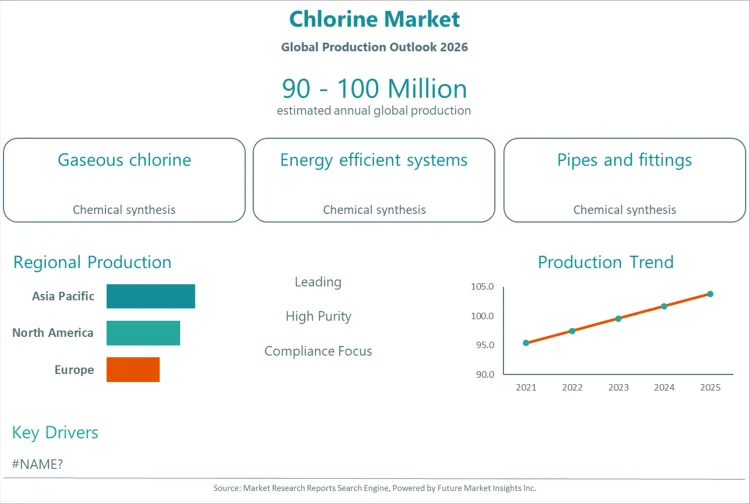
Global chlorine production in 2026 is estimated at approximately 90 to 95 million tonnes, reflecting stable growth closely tied to downstream chemical manufacturing rather than standalone capacity expansion. Chlorine is a core industrial chemical whose production economics are inseparable from caustic soda due to its co-product nature in chlor alkali processes. As a result, chlorine output is primarily driven by caustic soda demand rather than independent chlorine consumption trends.
Supply growth is influenced by construction activity, polymer production, water treatment needs, and industrial manufacturing output. Capacity additions are typically incremental, focused on modernising membrane cell technology, improving energy efficiency, and replacing older mercury or diaphragm systems. The overall supply picture shows gradual year on year volume growth aligned with infrastructure development and population driven demand.
Production leadership remains concentrated in regions with large scale chlor alkali infrastructure and strong downstream integration. Asia Pacific leads global output supported by PVC manufacturing and industrial chemical demand. North America maintains stable production aligned with construction, water treatment, and industrial markets. Europe operates regulated capacity focused on efficiency and environmental compliance. Many developing regions remain import dependent due to capital intensity and safety constraints.
Water treatment, polymer production, and chemical synthesis continue to anchor baseline demand. Buyers value supply reliability, compliance with safety standards, and long term operational continuity.
Gaseous chlorine dominates industrial consumption due to direct integration with downstream chemical processes. Liquefied chlorine supports municipal water treatment and industrial sanitation where on site generation is not feasible. Many buyers prefer derivative forms to reduce handling risk.
Membrane cell technology dominates new and replacement capacity due to lower energy consumption and reduced environmental impact. Process selection directly affects power usage, operating cost, emissions profile, and regulatory compliance.
Because chlorine cannot be economically stored or transported long distances, proximity to downstream users is critical. Buyers benefit from predictable output and integrated supply rather than rapid scalability.
PVC production represents the largest chlorine consumption segment, followed by water treatment and chemical synthesis. Water treatment demand is structurally stable due to public health requirements, while polymer demand fluctuates with construction cycles.
Asia Pacific leads global chlorine production driven by PVC manufacturing and infrastructure development.
North America maintains stable capacity aligned with construction, water treatment, and industrial demand.
Europe operates regulated capacity with strong focus on energy efficiency and emissions control.
The Middle East shows selective capacity expansion linked to downstream polymers.
These regions remain partially import dependent with limited local chlor alkali capacity.
Chlorine supply begins with salt sourcing and electricity input, followed by electrolysis, compression or liquefaction, and short distance distribution. Due to safety risks, chlorine is rarely traded over long distances. Most supply is consumed close to production sites or converted into derivatives.
Electricity cost, cell efficiency, plant utilisation, and safety infrastructure dominate cost structure. Trade patterns focus on derivatives rather than elemental chlorine. Buyers align contracts with long term operational planning rather than spot procurement.
The chlorine ecosystem includes salt suppliers, power utilities, chlor alkali producers, PVC manufacturers, water utilities, chemical companies, distributors, and regulators. Asia Pacific leads volume growth, while Europe drives technology modernisation and compliance standards.
Equipment providers support electrolysers, compressors, storage systems, and safety infrastructure. Producers coordinate co-product balancing, regulatory compliance, and long term customer contracts.
Global chlorine production in 2025 is estimated at approximately 90 to 95 million tonnes, aligned with caustic soda driven operating rates.
Electricity costs, electrolysis technology, plant utilisation, safety infrastructure, and regulatory compliance dominate pricing.
Chlorine and caustic soda are co-products of chlor alkali electrolysis, making production economics inseparable.
Safety constraints limit long distance transport, requiring production close to consumption or conversion into derivatives.
Environmental and safety regulations favour membrane cell technology and discourage legacy systems.
Explore Inorganic Chemicals Insights
View Reports
Chlorine Global Production Capacity and Growth Outlook

Thank you!
You will receive an email from our Business Development Manager. Please be sure to check your SPAM/JUNK folder too.
