On this page

    Polyamide Production and Pricing Environment

    China polyamide production capacity in 2026 is estimated at approximately 8.5 to 9.5 million tonnes, reflecting sustained expansion across both nylon 6 and nylon 66 value chains. Capacity growth has been driven by large scale investments in upstream intermediates, improved polymerisation efficiency, and strong domestic consumption across engineering plastics and fibres.

    Pricing conditions are influenced primarily by caprolactam and adipic acid costs, energy pricing, and operating rates across integrated complexes. Periods of upstream overcapacity place pressure on polymer pricing, while disruptions in intermediate supply can quickly tighten availability. Cost competitiveness varies significantly by producer depending on integration depth and energy efficiency.

    Production concentration is highest in Eastern and Central China, supported by dense petrochemical infrastructure and proximity to downstream manufacturing hubs. Western China continues to add capacity, but logistics and downstream proximity remain limiting factors.
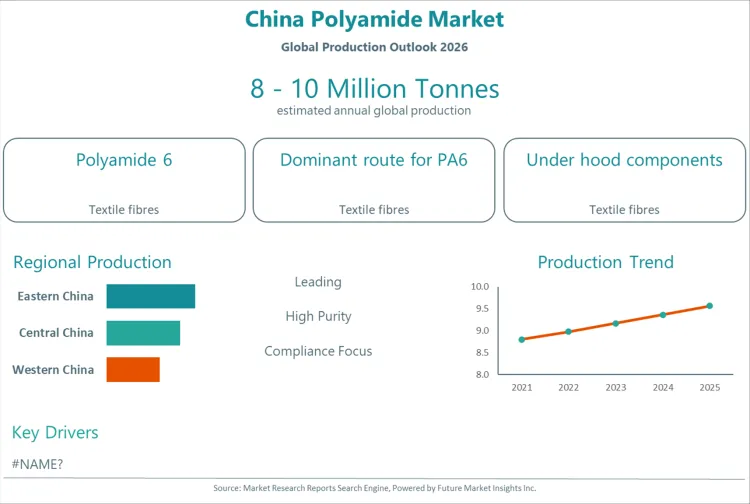
    China Polyamide Market

    Key Questions Answered

    • How fast is polyamide capacity expanding in China?
    • How do upstream intermediates influence pricing behaviour?
    • How differentiated are production cost positions?
    • How concentrated is capacity by region?

    Polyamide Product Families That Define Actual Use

    Product Classification

    • Polyamide 6
    • Textile fibres
    • Engineering plastics
    • Film and packaging applications
    • Polyamide 66
    • Automotive components
    • Electrical and electronic parts
    • High temperature engineering plastics
    • Specialty polyamides
      • Bio based and semi aromatic grades
      • High performance compounds
      • Flame retardant and reinforced materials
    • Fibre and filament grades
      • Apparel and industrial yarns
      • Carpet fibres
      • Technical textiles

    Polyamide 6 accounts for the largest volume share due to its broad use across fibres and plastics. Polyamide 66 and specialty grades grow steadily, supported by automotive lightweighting, electronics miniaturisation, and higher performance requirements.

    Key Questions Answered

    • How do buyers choose between PA6 and PA66?
    • How do performance requirements drive specialty demand?
    • How do fibre and resin uses differ in volume stability?
    • How do qualification cycles affect supplier selection?

    Polyamide Production Routes That Shape Cost and Control

    Process Classification

    • Caprolactam based polymerisation
      • Dominant route for PA6
      • High sensitivity to benzene and energy costs
      • Scale driven efficiency advantages
    • Adipic acid and hexamethylene diamine routes
      • Core pathway for PA66
      • Strong integration benefits
      • Higher capital intensity
    • Integrated upstream to polymer systems
      • Feedstock security
      • Reduced logistics exposure
      • Improved cost stability
    • Compounding and modification platforms
      • Glass fibre reinforcement
      • Flame retardancy
      • Application specific performance tuning

    Integrated producers benefit from tighter control over raw materials and pricing exposure. Non integrated compounders rely on merchant polymer supply and face greater volatility. Buyers value suppliers with stable quality, formulation support, and consistent delivery.

    Key Questions Answered

    • How sensitive are costs to upstream chemical pricing?
    • How does integration affect operating resilience?
    • How flexible are producers in grade switching?
    • How does compounding enhance value creation?

    Polyamide End Use Distribution Across China

    End Use Segmentation

    • Automotive and mobility
      • Under hood components
      • Structural and functional parts
      • Electric vehicle systems
    • Electrical and electronics
      • Connectors and housings
      • Consumer electronics
      • Industrial electrical systems
    • Textiles and fibres
      • Apparel and carpets
      • Industrial yarns
      • Technical fabrics
    • Industrial and consumer goods
      • Machinery components
      • Appliances
      • Tools and housings

    Automotive and electronics applications drive higher performance demand, while textiles provide large volume stability. Industrial uses expand steadily with manufacturing automation and equipment upgrades.

    Key Questions Answered

    • How does electric vehicle growth influence polyamide demand?
    • How stable is fibre related consumption?
    • How do electronics trends affect grade requirements?
    • How do industrial users manage long term sourcing?

    China Regional Production Assessment

    Eastern China

    Eastern China leads polyamide production with strong integration and proximity to automotive, electronics, and textile manufacturing hubs.

    Central China

    Central China hosts large scale integrated complexes benefiting from logistics access and regional consumption growth.

    Western China

    Western China adds upstream capacity focused on feedstock advantages, though downstream conversion remains more limited.

    Southern China

    Southern China emphasises compounding and downstream processing aligned with electronics and consumer goods manufacturing.

    Key Questions Answered

    • How does regional integration affect cost competitiveness?
    • How do logistics influence interregional flows?
    • How does downstream proximity shape investment decisions?
    • How do regional policies affect capacity utilisation?

    Polyamide Supply Chain, Cost Structure, and Trade Flows

    The polyamide supply chain begins with upstream aromatics and olefins followed by caprolactam or adipic acid production, polymerisation, compounding, and distribution to converters and OEMs. Inventory management plays a critical role due to volume scale and diverse grade requirements.

    Primary cost drivers include upstream chemical pricing, energy consumption, labour efficiency, and utilisation rates. Trade flows within China are extensive, while exports focus on fibres and selected engineering resin grades. Imports remain relevant for certain specialty and high performance polyamides.

    Key Questions Answered

    • How do upstream costs translate into polymer pricing?
    • How efficient are domestic logistics networks?
    • How competitive are exports in higher value grades?
    • How do buyers benchmark domestic versus imported material?

    Polyamide Ecosystem View and Strategic Considerations

    The China polyamide ecosystem includes upstream chemical producers, polymer manufacturers, compounders, textile mills, automotive suppliers, electronics OEMs, and logistics providers. Rapid capacity expansion has increased competition and placed emphasis on differentiation through quality, integration, and application development.

    Strategic considerations include managing upstream overcapacity risk, improving energy efficiency, expanding specialty and high performance grades, and aligning production with long term automotive and electronics demand trends.

    Deeper Questions Decision Makers Should Ask

    • How resilient are margins during capacity expansion cycles?
    • How differentiated is the product and grade portfolio?
    • How secure is upstream feedstock access?
    • How scalable are compounding and application development capabilities?
    • How defensible are customer qualification positions?
    • How adaptable are plants to regulatory and energy changes?

    Bibliography

    • World Bank. (2024). Industrial commodity pricing and cost transmission in manufacturing economies. World Bank Industry and Trade Studies.
    • OECD Environment Directorate. (2024). Energy intensity and cost competitiveness in polymer manufacturing. OECD Environment Working Papers.
    • International Monetary Fund. (2024). Producer price dynamics in industrial materials. IMF Global Manufacturing Outlook.

    Frequently Asked Questions

    What is the estimated China polyamide production capacity in 2026?

    China polyamide production capacity in 2026 is estimated at approximately 8.5 to 9.5 million tonnes.

    What factors most strongly influence polyamide pricing in China?

    Key influences include caprolactam and adipic acid costs, energy pricing, operating rates, and integration depth.

    Why is capacity expansion concentrated in China?

    Strong domestic demand, integrated feedstock availability, and large scale manufacturing ecosystems support continued investment.

    How do buyers choose between suppliers?

    Buyers evaluate consistency, performance specifications, supply reliability, technical support, and long term cost stability.

    Key Questions Answered in the Report

    Supply chain and operations

    • How stable are upstream intermediate supplies?
    • How flexible are polymerisation and compounding units?
    • How sufficient is buffer inventory?
    • How resilient are domestic logistics networks?
    • How quickly can output adjust to demand shifts?
    • How effective are maintenance practices?
    • How robust are quality control systems?
    • How exposed are operations to energy disruption?

    Procurement and feedstocks

    • How are caprolactam and adipic acid contracts structured?
    • How volatile are energy inputs?
    • How diversified are sourcing options?
    • How do buyers manage price pass through?
    • How are quality and compliance verified?
    • How do sourcing strategies differ by grade?
    • How are long term agreements negotiated?
    • How do buyers manage oversupply risk?

    Technology and process improvement

    • How efficient are polymerisation processes?
    • How flexible is grade switching capability?
    • How is energy usage optimised?
    • How is digital monitoring applied?
    • How are emissions controlled?
    • How does compounding enhance performance?
    • How are new grades qualified?
    • How do partnerships support innovation?

    Buyer, channel, and who buys what

    • Which sectors anchor baseline demand?
    • How do automotive suppliers plan volumes?
    • How do electronics manufacturers secure continuity?
    • What volumes define long term agreements?
    • How do buyers assess supplier reliability?
    • How do channels differ by application?
    • How do buyers verify consistency?
    • How do users manage substitution risk?

    Pricing, contract, and commercial structure

    • What benchmarks guide polyamide pricing?
    • How often are prices reviewed?
    • How are feedstock and energy changes passed through?
    • How do contracts differ by resin and fibre grades?
    • How long are supply commitments?
    • How are disputes resolved?
    • How are logistics costs allocated?
    • How do suppliers protect cost recovery?

    Plant assessment and footprint

    • Which locations offer integrated feedstock access?
    • What defines efficient polymerisation scale?
    • How do energy costs affect operations?
    • How do environmental rules shape output?
    • How available is skilled labour?
    • How modern are compounding assets?
    • How adaptable are plants to grade changes?
    • How suitable are sites for long term reinvestment?

    Explore Polymers & Plastics Insights

    View Reports

    Trusted By
    Market Research Reports Search Engine

    China Polyamide Production Capacity and Growth Outlook