On this page
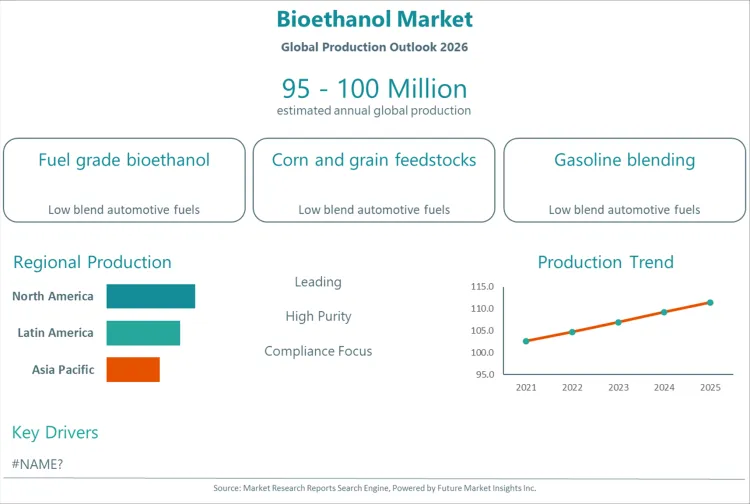
Global bioethanol production capacity in 2026 is estimated at approximately 95 to 100 million tonnes, reflecting sustained expansion driven by fuel blending mandates, energy security priorities and demand from chemical and industrial users. Capacity growth is supported by incremental expansion of existing plants, yield improvements in fermentation and selective greenfield investments in feedstock advantaged regions. Industry conditions balance policy supported demand with exposure to agricultural volatility, weather risk and input cost sensitivity.
Production leadership remains concentrated in regions with abundant agricultural feedstocks, established fuel blending programs and mature logistics infrastructure. North America leads global output through corn based ethanol production supported by nationwide blending requirements. Brazil remains a major producer driven by sugarcane based ethanol and flexible fuel vehicle penetration. Asia Pacific expands capacity through grain based and emerging cellulosic pathways aligned with energy transition goals. Europe focuses on compliance driven production tied to renewable fuel standards and emissions reduction targets. Several regions remain import dependent due to limited feedstock availability or constrained production infrastructure.
Fuel blending continues to anchor baseline demand, while industrial and chemical applications provide additional growth pathways. Buyers prioritise consistent quality, regulatory compliance and long term supply reliability.
Fuel grade ethanol dominates consumption due to mandated blending programs. Industrial and chemical grades grow steadily supported by demand for renewable and bio based raw materials.
Conventional starch and sugar based routes dominate global production due to proven economics and established supply chains. Cellulosic pathways continue to scale gradually supported by policy incentives and technology improvements.
Transportation fuels dominate demand due to regulatory blending requirements. Industrial and chemical uses provide diversification and reduce dependence on fuel cycles.
North America leads global bioethanol production driven by corn availability, established blending mandates and extensive logistics infrastructure.
Latin America, led by Brazil, benefits from sugarcane based ethanol with strong cost competitiveness and flexible fuel vehicle adoption.
Asia Pacific expands production through grain based ethanol and emerging cellulosic projects aligned with energy security strategies.
Europe focuses on compliance driven bioethanol production under renewable energy and emissions reduction directives.
Africa shows emerging potential supported by agricultural resources but faces infrastructure and financing constraints.
The bioethanol supply chain spans feedstock cultivation, fermentation, distillation, storage and distribution to fuel blenders and industrial users. Co products such as distillers grains and electricity generation contribute to plant economics.
Feedstock costs, plant utilisation and energy inputs dominate cost structure. Logistics, storage stability and regulatory compliance add complexity. International trade connects surplus producing regions with blending mandate driven demand centres.
Buyers structure contracts around quality specifications, sustainability certification and volume commitments.
The bioethanol ecosystem includes farmers, feedstock aggregators, ethanol producers, fuel blenders, industrial consumers, logistics providers and regulators. North America and Latin America anchor supply, while Asia Pacific and Europe drive incremental demand growth.
Strategic themes include feedstock security, yield optimisation, emissions reduction and diversification into chemical and advanced fuel applications.
Global bioethanol production in 2025 is estimated at approximately 95 to 100 million tonnes, supported by fuel blending mandates and industrial demand.
Pricing is primarily driven by agricultural feedstock costs, energy inputs, plant utilisation rates and logistics.
Mandates provide baseline demand visibility and support high utilisation rates, reducing exposure to fuel price cycles.
Sustainability criteria shape feedstock selection, land use practices and eligibility for incentives and blending credits.
Buyers evaluate cost, availability, emissions performance and regulatory qualification.
Explore Fuel Insights
View Reports
Bioethanol Global Production Capacity and Growth Outlook

Thank you!
You will receive an email from our Business Development Manager. Please be sure to check your SPAM/JUNK folder too.
