On this page

    Bimodal HDPE Production and Capacity Outlook

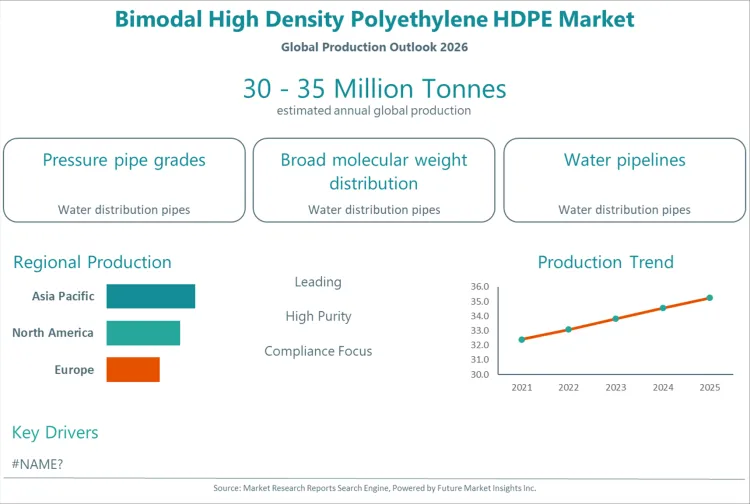
    Global bimodal HDPE production capacity in 2026 is estimated at approximately 30 to 35 million tonnes, representing a growing share of total HDPE output due to its superior mechanical performance and durability. Capacity growth is driven by demand for pressure pipes, large containers and infrastructure related applications rather than commodity packaging alone. New investments favour bimodal technology due to its ability to deliver high stiffness and stress crack resistance within a single polymer grade.

    Production remains concentrated in regions with access to low cost ethylene, advanced catalyst systems and large scale polymerisation assets. Asia Pacific leads new capacity additions supported by infrastructure expansion and packaging demand. North America maintains strong output driven by ethane based ethylene economics and established pipe grade production. Europe focuses on efficiency upgrades and specialty bimodal grades aligned with regulatory and sustainability requirements. Several emerging regions remain import dependent due to limited access to advanced polymerisation technology.

    Demand growth is supported by water, gas and sewage infrastructure development, alongside rigid packaging applications. Buyers prioritise long term performance reliability, processing consistency and compliance with pressure pipe standards.
    Bimodal High Density Polyethylene Hdpe Market

    Key Questions Answered

    • How does bimodal technology improve HDPE performance compared with unimodal grades?
    • How closely is capacity growth linked to infrastructure investment cycles?
    • How do ethylene cost dynamics affect operating economics?
    • How do regulatory standards influence grade qualification?

    Bimodal HDPE Product Families That Define How Buyers Actually Use It

    Product Classification

    • Pressure pipe grades
    • Water distribution pipes
    • Gas transmission pipes
    • Sewage and drainage systems
    • Large blow moulding grades
    • Drums and containers
    • Industrial packaging
    • Fuel tanks
    • Injection moulding grades
    • Crates and pallets
    • Industrial components
    • Heavy duty caps and closures
    • Specialty bimodal grades
    • High stress crack resistance applications
    • Long life infrastructure products
    • Performance critical mouldings

    Pressure pipe grades dominate bimodal HDPE consumption due to their requirement for long term mechanical stability. Blow moulding and injection grades support diversified demand across industrial packaging.

    Key Questions Answered

    • How do buyers qualify bimodal HDPE for pressure pipe use?
    • How does molecular weight distribution affect processing behaviour?
    • How do application standards differ across end uses?
    • How does grade selection affect lifetime performance?

    Bimodal HDPE Process Routes That Define Cost, Control and Performance

    Process Classification

    • Dual reactor slurry or gas phase systems
    • Broad molecular weight distribution
    • High density control
    • Mechanical property optimisation
    • Cascade reactor configurations
    • Sequential polymerisation
    • Precise comonomer distribution
    • Enhanced stress crack resistance
    • Advanced catalyst systems
    • Ziegler Natta catalysts
    • Metallocene assisted systems
    • Property consistency improvement
    • Integrated polymer finishing
    • Pelletisation
    • Additive dosing
    • Quality stabilisation

    Bimodal HDPE production relies on precise control of polymer architecture through multi reactor configurations. Process complexity increases capital requirements but delivers superior performance characteristics.

    Key Questions Answered

    • How sensitive is bimodal HDPE cost to ethylene pricing?
    • How do reactor configurations influence property balance?
    • How does catalyst selection affect grade consistency?
    • How do process controls reduce off spec production?

    Bimodal HDPE End Use Spread Across Key Sectors

    End Use Segmentation

    • Infrastructure and utilities
    • Water pipelines
    • Gas distribution networks
    • Wastewater systems
    • Packaging and containers
    • Large containers
    • Industrial drums
    • Chemical packaging
    • Industrial goods
    • Crates and pallets
    • Material handling products
    • Heavy duty mouldings
    • Agriculture and irrigation
    • Irrigation pipes
    • Storage tanks
    • Distribution systems

    Infrastructure applications dominate demand due to long service life requirements and regulatory specifications. Packaging and industrial uses provide additional volume stability.

    Key Questions Answered

    • How do infrastructure projects drive long term demand?
    • How do processors balance toughness and stiffness?
    • How do regulatory standards affect product qualification?
    • How do buyers manage demand cyclicality?

    Bimodal HDPE Regional Production Potential Assessment

    Asia Pacific

    Asia Pacific leads capacity expansion supported by urbanisation, infrastructure spending and growing polymer processing capability.

    North America

    North America maintains strong production driven by ethane advantaged ethylene supply and established pressure pipe demand.

    Europe

    Europe focuses on high performance grades, recycling compatibility and compliance driven optimisation rather than volume expansion.

    Middle East

    The Middle East expands selectively through integrated petrochemical complexes and export oriented polymer production.

    Latin America and Africa

    These regions remain largely import dependent but show rising demand tied to infrastructure development.

    Key Questions Answered

    • How do regional feedstock economics affect competitiveness?
    • How do import dependent regions manage supply risk?
    • How does infrastructure investment vary by region?
    • How do logistics influence regional availability?

    Bimodal HDPE Supply Chain, Cost Drivers and Trade Patterns

    The bimodal HDPE supply chain begins with ethylene production followed by polymerisation, pelletisation and distribution to processors. Pressure pipe grades often require certification and long term supply agreements due to performance liability.

    Ethylene pricing, plant utilisation and energy inputs dominate cost structure. Trade flows connect feedstock advantaged regions with infrastructure demand centres. Buyers favour suppliers offering technical support and long term grade stability.

    Contracts emphasise specification consistency, certification support and supply continuity.

    Key Questions Answered

    • How do feedstock costs translate into bimodal HDPE pricing?
    • How do certification requirements affect supply selection?
    • How do logistics shape delivered cost?
    • How do buyers benchmark suppliers across regions?

    Bimodal HDPE Ecosystem View and Strategic Themes

    The ecosystem includes ethylene producers, polymer manufacturers, pipe producers, packaging converters, infrastructure developers and regulators. Supply concentration reflects the technical barriers associated with multi reactor polymerisation.

    Strategic themes include infrastructure driven demand growth, recyclability alignment, grade differentiation and long term asset optimisation.

    Deeper Questions Decision Makers Should Ask

    • How secure is long term ethylene sourcing?
    • How resilient is demand to infrastructure spending cycles?
    • How scalable are bimodal polymerisation assets?
    • How exposed are portfolios to regulatory change?
    • How robust are quality and certification systems?
    • How aligned are producers and converters on performance standards?
    • How transparent are sustainability disclosures?
    • How quickly can grades adapt to recycling requirements?

    Bibliography

    • International Energy Agency. (2024). Petrochemical feedstocks and infrastructure outlook.
    • USA Department of Energy. (2023). Ethylene supply, polymer manufacturing, and energy intensity in petrochemicals. USA DOE.
    • International Organization for Standardization. (2023). Quality management and certification systems for plastic piping and pressure applications. ISO Standards Publications.

    Frequently Asked Questions

    What is the estimated global bimodal HDPE production volume in 2025?

    Global bimodal HDPE production in 2025 is estimated at approximately 30 to 35 million tonnes, driven by infrastructure and industrial packaging demand.

    What are the biggest cost drivers shaping bimodal HDPE pricing?

    Pricing is driven by ethylene feedstock costs, capital intensity of multi reactor systems, energy inputs and certification related expenses.

    How does bimodal HDPE differ from unimodal HDPE?

    Bimodal HDPE offers a broader molecular weight distribution, delivering improved toughness, stress crack resistance and long term durability.

    How do regulations affect bimodal HDPE demand?

    Infrastructure standards and pressure pipe certifications support stable demand while recyclability regulations influence grade development.

    Which sectors drive future bimodal HDPE growth?

    Water and gas infrastructure, industrial packaging and agricultural irrigation systems remain the primary growth drivers.

    Key Questions Answered in the Report

    Supply chain and operations

    • How predictable is ethylene feedstock availability?
    • How stable is bimodal HDPE plant utilisation?
    • How effective are process control systems?
    • How resilient are logistics and distribution networks?
    • How quickly can grade slates be adjusted?
    • How are quality deviations managed?
    • How robust are certification processes?
    • How are operational disruptions handled?

    Procurement and raw material

    • How is ethylene indexed in contracts?
    • How do suppliers ensure grade consistency?
    • How is price volatility managed?
    • What contract duration supports continuity?
    • How are alternative suppliers qualified?
    • How do buyers manage supply disruption risk?
    • How are audits conducted?
    • How do onboarding requirements vary by region?

    Technology and innovation

    • How do catalyst improvements enhance performance?
    • How are multi reactor systems optimised?
    • How do producers improve recyclability compatibility?
    • How does digital monitoring improve yield?
    • How are energy efficiencies improved?
    • How do plants reduce off spec material?
    • How do partnerships support innovation?
    • How does innovation support sustainability goals?

    Buyer, channel and who buys what

    • Which infrastructure segments drive demand growth?
    • How do processors qualify long life pipe grades?
    • What volumes define standard agreements?
    • How do buyers balance cost and performance?
    • How do channels influence delivered cost?
    • How do buyers verify compliance claims?
    • How do users manage operational risk?
    • How do specifications vary by application?

    Pricing, contract and commercial model

    • What reference points guide bimodal HDPE pricing?
    • How frequently are pricing reviews conducted?
    • How do contracts ensure supply continuity?
    • How do buyers compare regional offers?
    • What duration supports asset utilisation?
    • How are disputes resolved?
    • How do certification costs affect pricing terms?
    • How do contracts vary by end use?

    Plant assessment and footprint

    • Which regions offer reliable ethylene access?
    • What investment defines competitive scale?
    • How do permitting requirements affect operations?
    • How suitable are polymer clusters?
    • How consistent are regulatory conditions?
    • How are quality and compliance audits managed?
    • How does workforce readiness affect performance?
    • How do transport links support downstream converters?

    Explore Polymers & Plastics Insights

    View Reports

    Trusted By
    Market Research Reports Search Engine

    Bimodal High Density Polyethylene HDPE Global Production Capacity and Growth Outlook