On this page

    Benzyl Chloride Price and Production Outlook

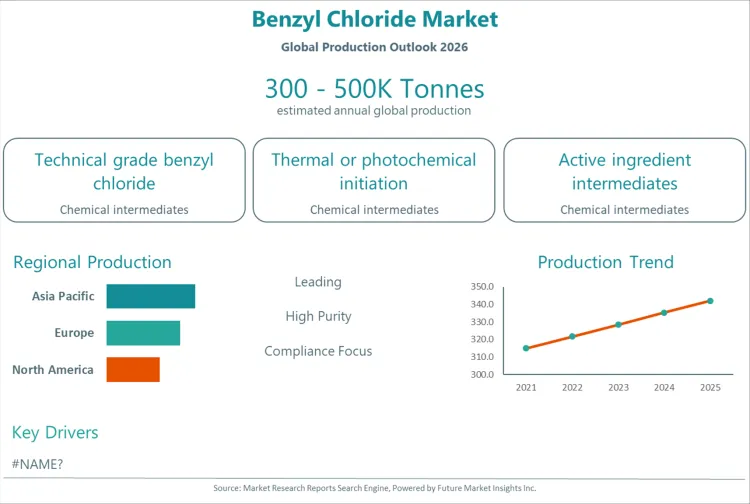
    Global benzyl chloride production in 2026 is estimated at approximately 300 to 500 thousand tonnes, reflecting steady demand tied to its role as a versatile intermediate rather than large scale volume expansion. Benzyl chloride sits within the broader chlorinated aromatics value chain and is produced mainly to meet captive or contract based downstream requirements.

    Supply growth is supported by pharmaceutical intermediates, agrochemical synthesis, quaternary ammonium compounds, fragrances and specialty resins. Production economics balance relatively stable demand against exposure to toluene availability, chlorine pricing, energy costs and increasingly strict environmental and occupational safety regulations. Capacity additions are typically incremental, focused on debottlenecking, emission control upgrades and process optimisation rather than greenfield construction.

    Production leadership remains concentrated in regions with integrated aromatics and chlor alkali infrastructure. Asia Pacific leads global output supported by pharmaceutical and agrochemical manufacturing depth. Europe maintains limited but specialised capacity aligned with regulated applications. North America supports stable production tied to specialty chemicals. Many regions remain import dependent due to safety, regulatory and infrastructure barriers.
    Benzyl Chloride Market

    Key Questions Answered

    • How scalable is toluene availability for benzyl chloride production?
    • How do chlorine pricing and availability influence cost structure?
    • How do safety and environmental rules shape operating viability?
    • How do transport and storage constraints affect regional supply?

    Benzyl Chloride: Product Families that Define How Buyers Actually Use It

    Product Classification

    • Technical grade benzyl chloride
    • Chemical intermediates
    • Quaternary ammonium compounds
    • Pharmaceutical and fine chemical grade
    • Active ingredient intermediates
    • Controlled synthesis steps
    • Agrochemical grade
      • Herbicide and insecticide intermediates
    • High purity and specialty grades
      • Fragrance and flavour intermediates
      • Research applications

    Technical grade material accounts for the majority of volume due to broad use in downstream synthesis. Pharmaceutical and specialty grades require tighter impurity limits, moisture control and traceability, reducing the number of qualified suppliers.

    Key Questions Answered

    • How do buyers distinguish technical and pharmaceutical grades?
    • How do impurity profiles affect downstream yields?
    • How does moisture sensitivity influence handling?
    • How do specialty grades affect supplier qualification timelines?

    Benzyl Chloride: Process Routes That Define Cost, Speed and Customer Focus

    Process Classification

    • Side chain chlorination of toluene
      • Thermal or photochemical initiation
      • Controlled substitution reactions
    • Continuous and batch chlorination systems
      • Output flexibility
      • Process safety control
    • Neutralisation and washing operations
      • Acid removal
      • Colour control
    • Distillation and purification systems
      • Fraction separation
      • Specification adjustment

    Side chain chlorination remains the dominant commercial route. Process control is critical to limit over chlorination and formation of benzylidene chloride or benzal chloride. Technology choice affects yield efficiency, emissions control and operating safety.

    Integrated facilities benefit from shared chlorine infrastructure and waste treatment systems. Buyers value consistent specification and predictable reactivity rather than rapid volume scaling.

    Key Questions Answered

    • How sensitive is benzyl chloride cost to toluene pricing?
    • How do chlorination conditions affect selectivity?
    • How does purification influence grade flexibility?
    • How does integration reduce operational risk?

    Benzyl Chloride: End Use Spread Across Key Sectors

    End Use Segmentation

    • Pharmaceutical synthesis
      • Active ingredient intermediates
      • Benzyl protecting groups
    • Agrochemicals
      • Crop protection intermediates
    • Surfactants and quaternary ammonium salts
      • Disinfectants
      • Phase transfer catalysts
    • Fragrances, resins and specialty chemicals
      • Benzyl derivatives
      • Performance additives

    Pharmaceutical and specialty chemical applications dominate value demand due to purity requirements. Agrochemical and surfactant uses provide volume stability linked to agricultural and hygiene activity.

    Key Questions Answered

    • How do pharmaceutical users manage regulatory compliance?
    • How do agrochemical producers control reaction selectivity?
    • How do surfactant producers manage by product risk?
    • How do users evaluate substitution feasibility?

    Benzyl Chloride: Regional Potential Assessment

    Asia Pacific

    Asia Pacific dominates production supported by integrated chlor alkali capacity and strong pharmaceutical manufacturing.

    Europe

    Europe maintains limited production focused on high purity and regulated uses.

    North America

    North America supports selective capacity aligned with specialty chemicals and contract manufacturing.

    Middle East

    The Middle East shows minimal production due to limited downstream demand.

    Latin America and Africa

    These regions remain largely import dependent with constrained local handling infrastructure.

    Key Questions Answered

    • How do regulatory frameworks influence regional capacity?
    • How do import dependent regions manage continuity?
    • How does feedstock integration affect competitiveness?
    • How do logistics constraints shape delivered cost?

    Benzyl Chloride Supply Chain, Cost Drivers and Trade Patterns

    Benzyl chloride supply begins with toluene and chlorine sourcing, followed by chlorination, purification, storage and regulated distribution. Products are transported in specialised containers due to toxicity and reactivity. Downstream buyers include pharmaceutical manufacturers, agrochemical companies and specialty chemical producers.

    Toluene pricing, chlorine costs, energy use, safety infrastructure, compliance requirements and logistics dominate cost structure. Trade flows are controlled and regionally focused due to handling and regulatory complexity.

    Key Questions Answered

    • How does feedstock pricing influence competitiveness?
    • How do utilisation rates affect unit economics?
    • How do storage and transport rules shape delivered cost?
    • How do buyers benchmark domestic versus imported supply?

    Benzyl Chloride: Ecosystem View and Strategic Themes

    The benzyl chloride ecosystem includes aromatics suppliers, chlor alkali producers, specialty chemical manufacturers, pharmaceutical companies, agrochemical firms, distributors and regulators. Asia Pacific anchors volume demand, while Europe and North America influence safety and quality standards.

    Strategic themes include tightening environmental controls, demand for higher purity grades and increasing integration with downstream synthesis.

    Deeper Questions Decision Makers Should Ask

    • How secure is long term toluene and chlorine availability?
    • How diversified are production assets by region?
    • How bankable are compliance driven investments?
    • How resilient are operations to regulatory tightening?
    • How scalable are existing chlorination units?
    • How quickly can grade slates be adjusted?
    • How robust are emissions and waste controls?
    • How aligned are producers with downstream synthesis trends?

    Bibliography

    • Arpe, H.-J., Weissermel, K., & Francke, R. (2019). Industrial organic chemistry (5th ed.). Wiley-VCH.
    • March, J., & Smith, M. B. (2020). March’s advanced organic chemistry: Reactions, mechanisms, and structure (8th ed.). Wiley.
    • Food and Agriculture Organization of the United Nations. (2024). Chlorinated intermediates in agrochemical synthesis. FAO Technical Papers.
    • International Council of Chemical Associations. (2024). Safe handling of chlorinated organic chemicals. ICCA Publications.

    Frequently Asked Questions

    What is the estimated global benzyl chloride production volume in 2025?

    Global benzyl chloride production in 2025 is estimated at approximately 300 to 500 thousand tonnes, supported by pharmaceutical and specialty chemical demand.

    What are the biggest cost drivers that shape benzyl chloride pricing?

    Pricing is driven by toluene and chlorine feedstock costs, energy use, safety compliance expenses and logistics.

    Why is benzyl chloride production geographically concentrated?

    Strict safety requirements and the need for integrated chlorine infrastructure limit viable production locations.

    How do regulations influence benzyl chloride availability?

    Occupational exposure limits and emissions controls restrict capacity expansion and favour experienced producers.

    How do buyers manage supply risk?

    Buyers rely on long term contracts, qualified suppliers and regional sourcing strategies.

    Key Questions Answered in the Report

    Supply chain and operations

    • How predictable is output under chlorination safety constraints?
    • How much buffer inventory supports continuity?
    • How stable are reactor operations?
    • How effective are emissions and monitoring systems?
    • How quickly can capacity be expanded?
    • How dependable are regulated logistics routes?
    • How does site location affect compliance exposure?
    • How are contingency risks managed?

    Procurement and raw material

    • How are toluene and chlorine prices structured contractually?
    • How do suppliers ensure feedstock consistency?
    • How does grade specification vary by application?
    • What contract duration supports asset planning?
    • How do buyers mitigate feedstock volatility?
    • Which suppliers offer regional diversification?
    • How are compliance requirements handled?
    • How do onboarding processes differ by region?

    Technology and innovation

    • Which reactor upgrades improve selectivity?
    • How effective are digital control systems?
    • How does waste minimisation improve compliance?
    • How are producers validating cleaner chlorination routes?
    • How do plants reduce emissions intensity?
    • How are safety systems evolving?
    • How do materials extend equipment life?
    • How are partnerships supporting compliance upgrades?

    Buyer, channel and who buys what

    • Which sectors rely most on benzyl chloride?
    • How do pharmaceutical users integrate it into synthesis?
    • How do agrochemical producers manage reactivity?
    • What volumes define standard offtake agreements?
    • How do buyers choose between domestic and imported supply?
    • How do channel structures influence delivered cost?
    • How do buyers verify quality and compliance?
    • How do users manage operational risk?

    Pricing, contract and commercial model

    • What reference points guide benzyl chloride pricing?
    • How frequent are feedstock linked adjustments?
    • How do pricing reviews support long term visibility?
    • How do buyers compare benzyl chloride with alternatives?
    • What contract duration ensures project viability?
    • How are disputes managed across jurisdictions?
    • What incentives support cleaner production?
    • How do contracts differ by grade?

    Plant assessment and footprint

    • Which regions maintain reliable chlorine integration?
    • What investment levels define commercial chlorination plants?
    • How do permitting and safety rules shape site selection?
    • How suitable are industrial hubs for chlorinated aromatics?
    • How consistent are utility and logistics conditions?
    • How do plants manage audits and inspections?
    • How do skills and workforce readiness affect operations?
    • How suitable are transport systems for hazardous materials?

    Explore Hydrocarbons, Petrochemicals, and Organic Chemicals Insights

    View Reports

    Trusted By
    Market Research Reports Search Engine

    Benzyl Chloride Global Production Capacity and Growth Outlook