Production Volumes, Cost Exposure, and Capacity Direction
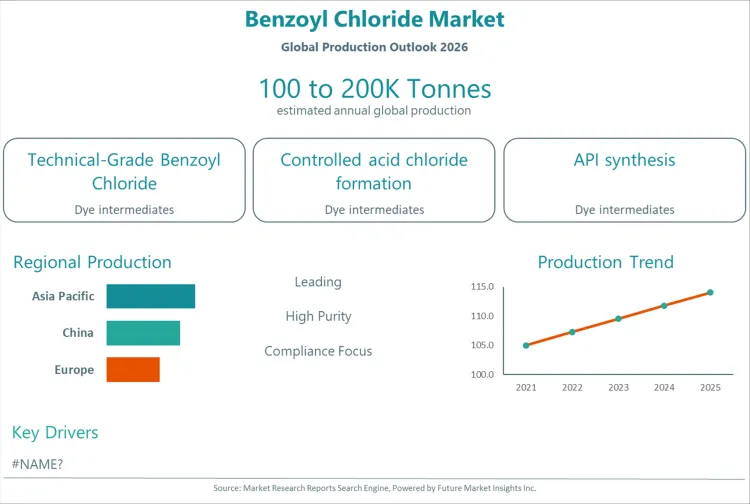
Global benzoyl chloride output in 2026 is estimated at approximately 150,000 to 200,000 tonnes, reflecting its role as a reactive intermediate rather than a bulk chemical. Output direction is shaped by availability of benzoic acid or toluene feedstocks, chlorine sourcing, plant safety constraints, and demand from pharmaceuticals, agrochemicals, and specialty intermediates.
Production capacity is concentrated among a limited number of manufacturers with expertise in acid chloride chemistry and hazardous operations. Asia Pacific accounts for the largest share of volume output due to integrated aromatic chemical production and proximity to downstream synthesis clusters. Europe and North America maintain smaller but high-compliance capacity focused on regulated pharmaceutical and specialty applications.
Usage remains synthesis-driven. Buyers prioritise purity, moisture control, and delivery reliability over volume flexibility, as benzoyl chloride is typically consumed immediately in downstream reactions.
Key Questions Answered
- How does benzoic acid availability affect output stability?
- How do chlorine costs influence production economics?
- How concentrated is global production capacity?
- How do safety requirements affect plant utilisation rates?
Purity Grades and Specification Bands That Matter
Product Classification
- TechnicalGrade Benzoyl Chloride
- Dye intermediates
- Agrochemical synthesis
- General acylation reactions
- HighPurity Benzoyl Chloride
- Pharmaceutical intermediates
- Specialty chemicals
- Controlled synthesis routes
- LowIron and LowImpurity Grades
- Sensitive catalytic reactions
- Colourcritical applications
- Electronic and specialty uses
- CustomSpecified Benzoyl Chloride
- Tight moisture limits
- Controlled acidity
- Customerqualified material
Technical-grade material accounts for the largest share of volume, while high-purity grades command premiums due to stricter processing and analytical control.
Key Questions Answered
- How do impurity levels affect downstream reactions?
- How critical is moisture control for safe handling?
- How do buyers qualify material by application?
- How do custom specifications reduce process risk?
Reaction Routes and Process Controls
Process Classification
- Benzoic Acid Chlorination
- Reaction with thionyl chloride or phosphorus chlorides
- Controlled acid chloride formation
- Byproduct management
- TolueneBased Oxidation and Conversion
- Oxidation to benzoic acid
- Subsequent chlorination
- Integrated aromatic processing
- Distillation and Purification
- Removal of unreacted feed
- Moisture reduction
- Colour and stability control
- Containment, Storage, and Handling Systems
- Inert atmosphere storage
- Corrosionresistant materials
- Hazard mitigation
Process design strongly affects safety, yield, and product stability. Buyers favour producers with robust containment, monitoring, and emergency response systems.
Key Questions Answered
- How do reaction routes affect impurity formation?
- How is moisture ingress controlled during processing?
- How do containment systems reduce risk?
- How does distillation improve product stability?
Application Footprint Across Downstream Synthesis
End Use Segmentation
- Pharmaceutical Intermediates
- API synthesis
- Protected acylation steps
- Specialty drug precursors
- Agrochemicals
- Herbicide and fungicide intermediates
- Formulation precursors
- Crop protection synthesis
- Dyes and Pigments
- Azo and anthraquinone dyes
- Colour intermediates
- Textile processing chemicals
- Specialty and Industrial Chemicals
- Benzoyl peroxide production
- Plastic additives
- Fine chemical synthesis
Pharmaceutical and agrochemical uses account for the highest value per tonne, while dyes and industrial applications absorb steady baseline volumes.
Key Questions Answered
- How do pharmaceutical users manage quality risk?
- How do agrochemical users balance cost and purity?
- How do dye producers manage colour sensitivity?
- How do specialty uses justify higherspec material?
Geographic Production Footprint and Regulatory Contrast
Asia Pacific
Asia Pacific leads global output supported by integrated aromatics production and extensive downstream synthesis activity.
China
China is a major producer and exporter, supplying agrochemical, dye, and pharmaceutical intermediates.
Europe
Europe maintains limited but high-compliance production focused on pharmaceutical and specialty uses under strict safety regulation.
North America
North America supports controlled production aligned with regulated chemical synthesis and domestic specialty demand.
Latin America and Middle East
These regions rely primarily on imports, with local consumption tied to agrochemical formulation and specialty manufacturing.
Key Questions Answered
- How do safety regulations affect regional capacity?
- How does export orientation influence plant location?
- How do compliance requirements affect cost structures?
- How do logistics affect hazardous material movement?
Value Chain Structure, Cost Drivers, and Supply Movement
The benzoyl chloride value chain begins with aromatic feedstocks and chlorine chemistry, followed by controlled chlorination, purification, packaging, and regulated distribution. Major cost drivers include feedstock pricing, chlorine availability, energy use, safety systems, and regulatory compliance.
Supply movement is tightly controlled due to hazardous classification. High-purity material often moves under contract to qualified users, while technical-grade supply supports regional synthesis clusters.
Key Questions Answered
- How do feedstock price shifts affect delivered cost?
- How do transport restrictions affect availability?
- How do buyers manage inventory risk?
- How do compliance requirements affect supplier selection?
Industry Ecosystem and Strategic Considerations
The benzoyl chloride ecosystem includes aromatic chemical producers, chlorination specialists, pharmaceutical and agrochemical manufacturers, distributors, and regulators. Long-term reliability depends on feedstock security, process safety, and regulatory alignment.
Strategic considerations include investment in safer production routes, containment upgrades, diversification of downstream exposure, and alignment with pharmaceutical and agrochemical synthesis pipelines.
Deeper Questions Decision Makers Should Ask
- How resilient is production under tightening safety regulation?
- How concentrated is highpurity capacity?
- How exposed is supply to chlorine availability?
- How adaptable are plants to specification changes?
- How credible are safety and environmental controls?
- How strong is customer qualification capability?
- How stable is downstream synthesis demand visibility?
- How aligned are producers with regulatory evolution?
Bibliography
- Ullmann’s Encyclopedia of Industrial Chemistry. (2024). Acid chlorides and aromatic intermediates.
- European Medicines Agency. (2024). Impurity control and acylation reagents in API synthesis. EMA Quality Guidelines.
- World Health Organization. (2024). Chemical intermediates in essential medicine production. WHO Technical Report Series.
- World Trade Organization. (2024). Trade in specialty and hazardous chemical intermediates. WTO Trade Statistics Review.
Frequently Asked Questions
What is the estimated global benzoyl chloride output in 2026?
Global output in 2026 is estimated at approximately 150,000-200,000 tonnes, reflecting its role as a reactive intermediate.
Why is benzoyl chloride considered hazardous?
It is moisture-sensitive, corrosive, and releases hydrogen chloride upon hydrolysis, requiring strict handling and containment.
Which applications consume the highest-purity grades?
Pharmaceutical intermediates and specialty chemical synthesis require the highest purity and tightest impurity control.
How does benzoyl chloride compare with other acid chlorides?
It offers high reactivity and specificity for aromatic acylation, but requires stricter safety management than less reactive derivatives.
How do buyers manage supply and safety risk?
Buyers rely on approved suppliers, closed-system handling, regulatory documentation, and long-term supply arrangements.